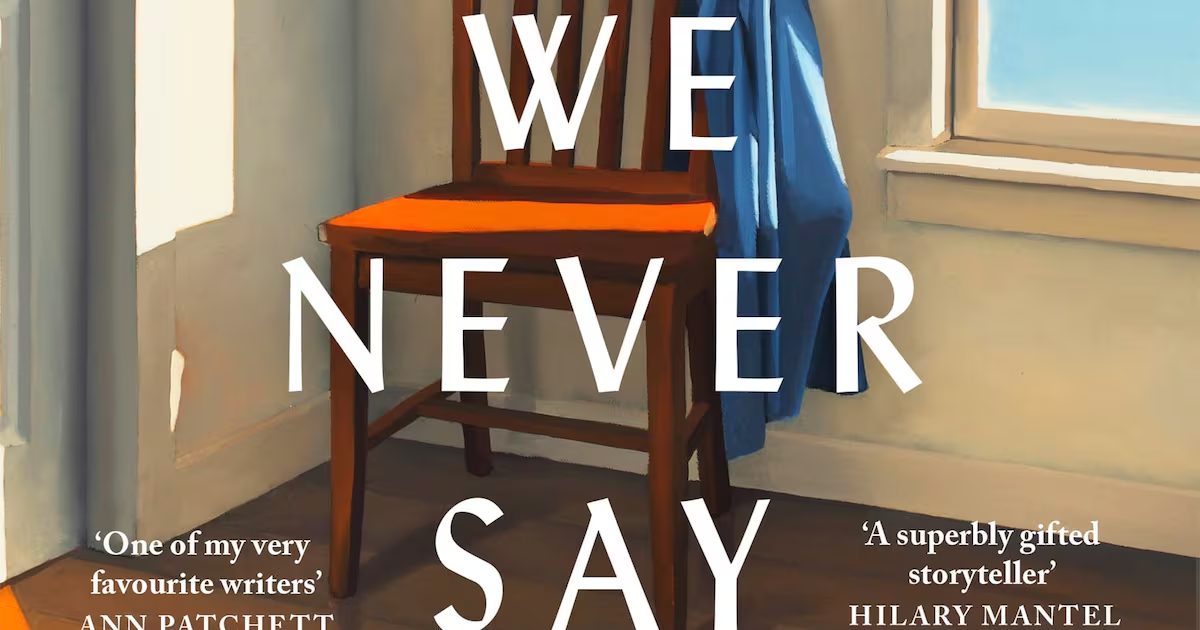
Kind, conscientious and slightly awkward, 57-year-old history teacher Artie Dam is adored by his pupils, who call him “Damn-Dam, the greatest man”. His life looks enviable. He has taught for decades and been married to Evie for more than 30 years. They live in her family’s handsome house by the sea and he spends his weekends sailing. But Artie is profoundly lonely.The Jung quotation in the epigraph to Elizabeth Strout’s superb new novel, The Things We Never Say, points to the novel’s central dilemma: “Loneliness does not come from having no people about one, but from being unable to communicate the things that seem important to oneself or from holding certain views which others find inadmissible.”Surrounded by people but unable to reach them, Artie can’t tell anyone what’s really going on in his head. He and his younger sister, Maria, grew up poor in a deeply unstable household with a mother who had psychotic episodes and was repeatedly hospitalised.Maria died young, but Artie remains haunted by her decades later. He often remembers seeing Maria secretly eating confectioners’ sugar straight from the packet. Only later did he understand that she had been searching for some sweetness in an unhappy childhood. It’s one of the novel’s most affecting depictions of unmet emotional need. Artie thinks about Maria almost every day yet has never spoken to anyone about her suffering or his grief. That’s why he has instinctive sympathy for vulnerable people. Education and marriage have taken him into a more prosperous world, but he has never felt entirely at home there. “It was a private thing, to be alive,” he thinks.His wife, Evie, comes from money and finds Artie overly sensitive and tiresome. She has little patience for his stories about school, his childhood or his fears about the country and withdraws whenever he tries to discuss anything serious. Through these domestic tensions, Strout shows how class differences can persist even in a long marriage.Ten years earlier, their 17-year-old son, Rob, was driving when a car crash killed his girlfriend. The accident changed the family. Evie retrained as a family therapist and threw herself into her work. Rob went to MIT and became a successful software developer but remained distant and burdened by shame. Artie can see that his son is suffering but does not know how to reach him.The story begins in the summer of 2024, before the re-election of Donald Trump, who is never named. Artie’s pupils have become more anxious since the pandemic, while he grows increasingly distressed by the country’s cruelty and disregard for truth. The day after the election, “half the country was stunned, the other half jubilant”. He feels that America “was committing suicide” and, after witnessing violent attacks on immigrants, concludes that the country will never be the same again.He imagines a vast steel door descending until the final strip of light beneath it disappears. It’s Strout’s starkest image of his fear that America has crossed a threshold from which it cannot retreat. His despair is fuelled by the strain of living in a society where reality itself is contested and his personal crisis begins to mirror the country’s.Early in the novel, we learn that Artie has been planning to kill himself and make it look like a sailing accident. Then he accidentally falls into the freezing sea. As he drifts away from shore, he suddenly realises that he desperately wants to live. When a fisherman, Kenneth Moynihan, rescues him, Artie has to return to his life without the certainty he once had that death is the answer.He later begins shoplifting, first a cheap comb and then some shirts he doesn’t need. Strout has linked these apparently pointless thefts to something her mother once told her: when people lose something, they sometimes feel compelled to take something. Artie’s shoplifting is a response to estrangement and the sense that his life doesn’t belong to him. Then a devastating family secret forces him to reassess his marriage, his son and everything he thought he understood about his life.Strout’s plain, conversational prose follows the drift of Artie’s thoughts. Memories interrupt the present, the narration slips briefly into other minds and occasionally looks ahead several years. She often places serious emotion beside almost comic physical detail.Compassionate but unsentimental, Strout has a particular knack for finding the comic physical detail in a moment’s emotional gravity. Artie’s white socks, old-fashioned black trainers and slightly foolish appearance prevent him from becoming a solemn symbol of male despair. Instead, he remains recognisably human and fallible.For all its sadness, The Things We Never Say is a tender and ultimately hopeful novel. Strout is particularly good at showing how secrecy and misunderstanding isolate people, while still allowing for the possibility of connection, even when it comes late and imperfectly. Artie’s life is not transformed, but he begins to see that it may still be worth returning to.Business Day
Profound insights on loneliness and the possibility of connection
Elizabeth Strout’s novel ‘The Things We Never Say’ explores the pain of secrecy and misunderstanding, while offering hope for imperfect but meaningful human connection
813 words~4 min read