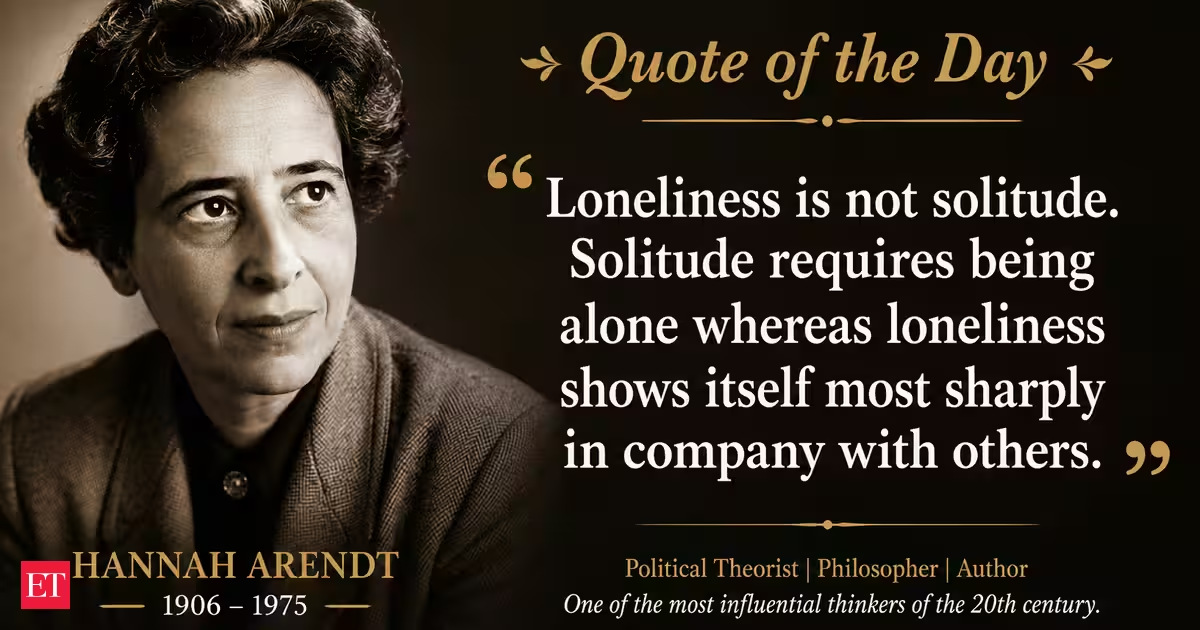
In this era, being alone is often mistaken for being lonely. Social media constantly reminds us to stay connected, making solitude seem like something to avoid. But decades ago, poet and novelist Mary Sarton offered a different perspective, one that continues to feel relatable with readers even today. Her powerful words encourage us to rethink what it truly means to spend time with ourselves. Instead of treating solitude as a weakness, she presents it as a source of strength, peace and self-discovery.Quote of the day goes: "Loneliness is the poverty of self. Solitude is the richness of self."This memorable quote comes from Mary Sarton's celebrated book Journal of a Solitude. Through these few words, she draws a clear line between two experiences that are often confused. According to Sarton, loneliness is not simply about being physically alone. It is the painful feeling of being disconnected from yourself and others. Solitude, however, is something entirely different. It is the ability to enjoy your own company, reflect on your thoughts and feel content without needing constant distraction.What does the Mary Sarton's quote mean?Mary Sarton's quote reminds us that being alone does not automatically mean feeling lonely. Loneliness is a feeling of emptiness, where a person may feel isolated or emotionally disconnected, even in a crowded room. Solitude, on the other hand, is a conscious choice to spend time with yourself because you are comfortable with who you are.The quote reframes our relationship with being alone. Instead of seeing it as something negative, Sarton suggests that solitude can become a space for healing, creativity and personal growth. When we stop fearing our own company, we begin to understand ourselves better. Time spent alone can help us reflect on our goals, emotions and experiences without outside noise.What does the quote teach us?One of the biggest lessons from this quote is that happiness does not always depend on the presence of other people. While relationships are important, our relationship with ourselves matters just as much.Sarton encourages readers to build inner peace instead of constantly seeking external validation. Spending time alone can help us think clearly, understand our emotions and grow into more confident individuals. Solitude gives us the chance to recharge, learn new things and become emotionally stronger.The quote also reminds us that self-worth should not depend on how busy our social life is. Learning to enjoy moments of quiet can improve mental well-being and help us develop a deeper understanding of ourselves. Rather than fearing solitude, Sarton invites us to embrace it as an opportunity for self-discovery.Loneliness vs solitude: What's the difference?Although the two words are often used interchangeably, they describe very different emotional experiences.Loneliness is the painful feeling of emotional emptiness or disconnection. A person can feel lonely even while surrounded by friends, family or colleagues because loneliness is an emotional state rather than a physical one. It often brings sadness, isolation and the feeling that something important is missing.Solitude, by contrast, is peaceful and intentional. It is the choice to spend time alone because you enjoy your own company. Solitude offers a chance to reflect, recharge and reconnect with yourself. Instead of creating emptiness, it creates clarity and calm.In simple terms, loneliness feels like a lack of connection, while solitude feels like a meaningful connection with yourself. That is the powerful contrast Mary Sarton captures in just one sentence.Who was Mary Sarton?According to the Poetry Foundation, Mary Sarton was an American poet, novelist and memoir writer whose work often explored love, friendship, self-discovery and the search for inner peace. Although literary critics overlooked much of her early writing, she built a devoted readership over the years. Later in her career, critics and feminist scholars recognised her as one of the most important contemporary American writers. Her books also explored subjects such as feminism, sexuality, aging, illness and the impact of political events on everyday life.At the age of 19, Sarton travelled to Europe and spent a year in Paris, where she met several prominent literary figures, including Virginia Woolf and Elizabeth Bowen. During this period, she published her first novel, The Single Hound (1938). In 1945, she met Judith "Judy" Matlack, who became her partner for the next 13 years. Sarton later reflected on their relationship in her memoirs. In 1958, she was elected a Fellow of the American Academy of Arts and Sciences in recognition of her literary achievements.Sarton continued writing even after suffering a stroke in 1990. Unable to write comfortably by hand, she dictated her journals using a tape recorder, showing her determination to continue creating despite health challenges. She received the Levinson Prize for Poetry in 1993 and remained active as a writer throughout her later years. Mary Sarton reportedly died of breast cancer on July 16, 1995, but her poems, novels and journals continue to inspire readers around the world.
Quote of the day by Mary Sarton: 'Loneliness is the poverty of self. Solitude is the richness of self' - The difference between loneliness and solitude explained by Belgian-American novelist and poet
Poet Mary Sarton's timeless wisdom distinguishes between loneliness and solitude, a crucial difference often missed today. She argues that while loneliness signifies a poverty of self, solitude offers richness and self-discovery. Read on to know what it teaches us and why it feels relatable even after years.
803 words~4 min read