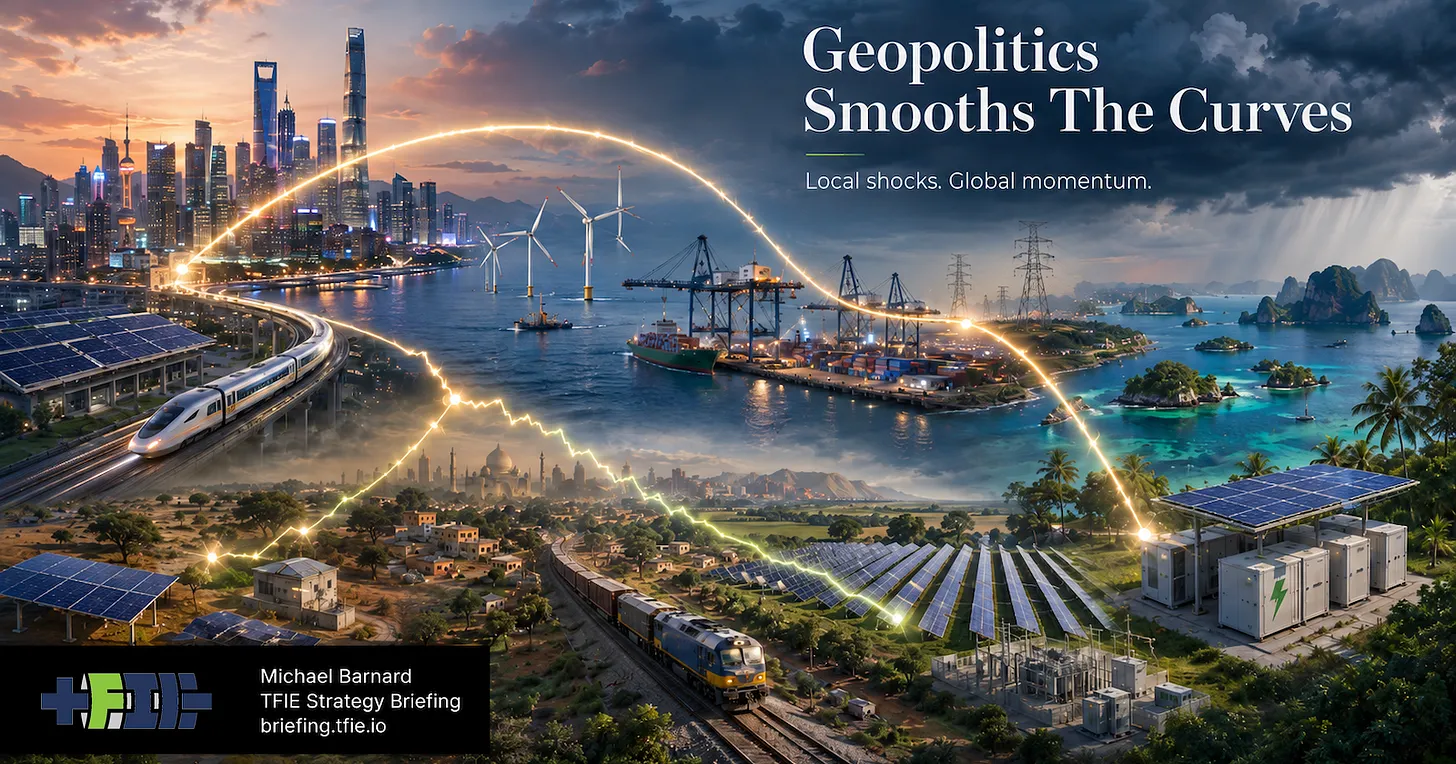
The global transition is not one country’s curve, but the aggregate of many jagged national pathways.
Support CleanTechnica's work through a Substack subscription or on Stripe.
One of the easiest ways to misread the energy transition is to stand inside one country and mistake local political weather for the global climate. A U.S. reversal, European permitting drag, Indian coal and grid constraints, Indonesian diesel politics, Pakistani fuel-price exposure, Chinese overbuild, Gulf hedging, African distributed solar and Latin American commodity cycles can each look decisive from the inside. They are not trivial. They are also not the global transition by themselves.
The global curve is the aggregation of many jagged local curves. Countries stall, surge, obstruct, compete, subsidize, fragment supply chains and make bad short-term decisions. At the same time, they build factories, grids, ports, rail, storage, electric vehicles, processing capacity and deployment experience. That is the point. The transition is not governed by one country’s election cycle or one region’s permitting failure.
This does not depend on elegant global coordination. There is little evidence that the world has suddenly become wise. The transition is increasingly driven by competition, resilience, energy security, affordability, industrial policy, trade advantage, climate damage and the continuing improvement of solar, wind, batteries, grids, motors, heat pumps, electric vehicles and digital controls. Some of that competition is wasteful or protectionist. Some produces announcements instead of assets. Enough of it still produces learning, manufacturing scale and infrastructure.