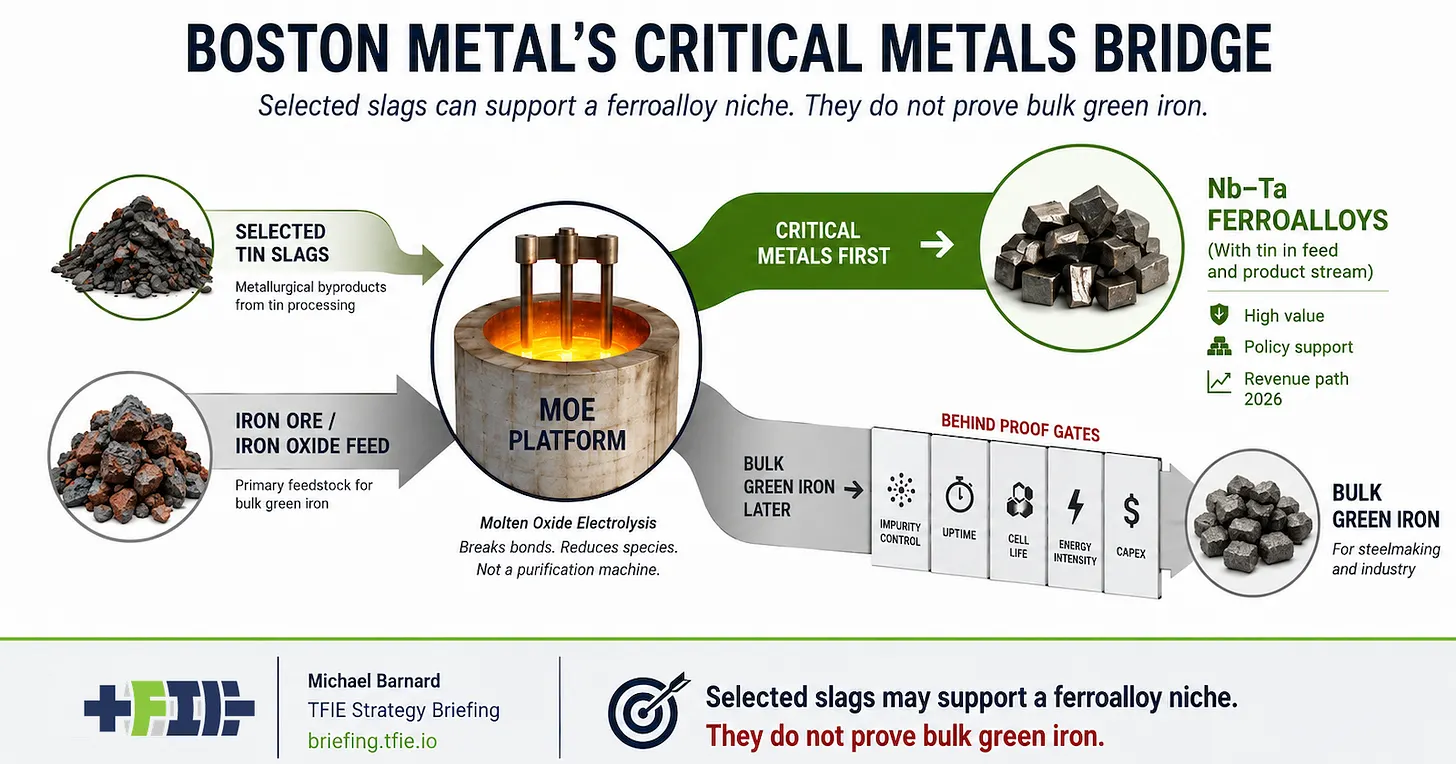
Boston Metal’s near-term evidence points to selected critical-metals recovery, while bulk green iron remains a separate proof burden.
Support CleanTechnica's work through a Substack subscription or on Stripe.
Boston Metal’s public story has shifted in a way that makes the company more credible in the near term, but less sweeping as a green-steel story. The company is still built around molten oxide electrolysis, or MOE, an electrically driven process for reducing metal oxides without coal. The near-term commercial evidence now points more strongly toward selected critical-metals recovery from suitable slags than toward bulk green iron.
That distinction is important because the public mental model for Boston Metal is still shaped by green steel. MOE is an elegant idea in that context. Use electricity, reduce metal oxides directly, produce oxygen instead of carbon dioxide and avoid the coal-based chemistry that dominates today’s primary steelmaking. As an industrial decarbonization concept, it is worth taking seriously, and it remains one of the more interesting approaches in the long list of pathways competing to clean up primary iron.
Steel, however, is not a forgiving market. Commodity iron has to be produced at enormous scale with high uptime, long cell life, stable feedstock behaviour, durable refractory systems, manageable anodes, competitive energy intensity, bankable capex and customers willing to qualify the product. It is not enough for the chemistry to work in a cell. The equipment has to become normal industrial plant, and it has to do so inside the brutal cost structure of a commodity market.