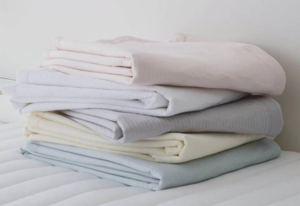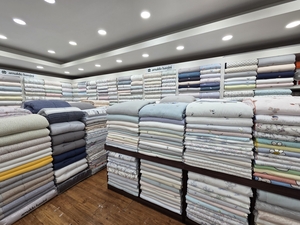
From cooling summer blankets to traditional floor bedding, foreign visitors are increasingly taking a piece of Korea's sleep culture home A stack of blankets at Gwangjang market in Seoul (Park Yuna/The Korea Herald) At Seoul’s Gwangjang Market, a destination long associated with textiles and fabrics, a growing number of foreign visitors are shopping for something unexpected: Korean bedding.Inside one bedding store, stacks of colorful quilts and blankets lined the walls while recently purchased items were being vacuum-packed for travelers preparing to take them overseas.“About 70 percent of our customers are foreigners these days,” said the owner, surnamed Kim, of the bedding store at the market. “Many foreign customers say they first encountered Korean bedding through television dramas or social media.”According to Kim, many visitors come from Taiwan, Hong Kong and Southeast Asian countries.A nearby branch of bedding brand Evezary has witnessed a similar trend.“The number of foreign customers looking specifically for Korean bedding began to rise around two years ago,” said Kim Jong-su, the store manager.“Taiwanese customers account for the largest share, followed by visitors from Hong Kong, Singapore and Thailand. Many come to Korea and make a point of buying bedding before they leave.” Summer bedding set made of 'ingyeon,' rayon fabric made from wood pulp (evezary) Summer bedding set made of 'ingyeon,' rayon fabric made from wood pulp (evezary) The manager attributes the appeal of Korean bedding to the country’s distinct four seasons, which have encouraged the development of a wide variety of products tailored to different weather conditions.Korea’s advanced textile manufacturing industry has also played a role.“Korea still manufactures a significant amount of its bedding domestically, particularly in Daegu, which is known as a textile hub,” the manager said.“There is a high level of trust in Korean-made bedding. Some Chinese-speaking customers even ask whether a product is made in China because they specifically want one that is made in Korea.”Summer bedding is also popular among foreign shoppers during the season.Among the most sought-after products are modal blankets made from a fiber derived from beech tree pulp with a silky-soft texture and a lightweight cooling comforter made with cool-touch fabric.Punggi ingyeon, a rayon fabric made from wood pulp and named after the southeastern town famous for its textile industry, is another popular summer bedding material, according to merchandisers. A scene of Mr. Queen featuring a traditional Korean sleeping arrangement, including a yo, floor mattress, and ibul, blanket (tvN, Midam) More than just something to sleep underIn Korea, bedding has traditionally carried a significance beyond its practical function.For centuries, Koreans slept on heated floors warmed by 'ondol,' the traditional underfloor heating system. Rather than serving as an accessory to a bed, bedding itself formed the foundation of the sleeping environment.A typical arrangement consisted of a 'yo,' a padded floor mattress, and an 'ibul,' or blanket, both of which were folded away during the day and laid out again at night. An embroidered pillow featuring auspicious motifs symbolizing marital harmony, longevity and abundant descendants. (Seoul Museum of Craft Art) Traditionally, blankets were an important part of a bride’s dowry, known as 'honsu.' Carefully prepared bedding represented not only household necessities but also wishes for comfort, prosperity and a stable married life.The history of Korean bedding dates back at least to the Baekje Kingdom, as evidenced by a pillow discovered in King Muryeong’s tomb, according to the National Folk Museum of Korea."While traditional Korean bedding is largely preserved through wedding gift sets, everyday bedding has become increasingly modernized. As lifestyles have westernized, with consumers preferring bedding designs that harmonize with contemporary interiors rather than traditional styles," the Encyclopedia of Korean Folk Culture notes.
How Korean bedding became a coveted souvenir
At Seoul’s Gwangjang Market, a destination long associated with textiles and fabrics, a growing number of foreign visitors are shopping for something unexpected
603 words~3 min read