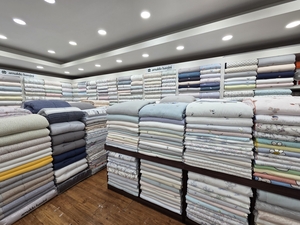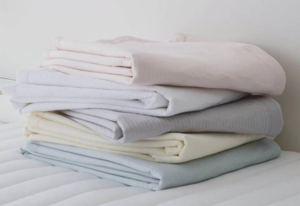
Cooling blankets made of modal sourced from beech trees (Arnaldo Bassini) Korean bedding has gained international attention over the past few years, fueled by social media exposure and word-of-mouth hype for its quality. Here are answers to some of the most frequently asked questions following The Korea Herald's recent feature on Korean bedding.Q. How does Korean bedding change with the seasons?Korean bedding is highly seasonal. Lightweight blankets made from rayon, such as ‘ingyeon’ made from wood pulp, or cooling fabrics are popular during the hot and humid summer months.For spring and autumn, comforters made from modal, sourced from beech trees, or Tencel, derived from eucalyptus, are popular for their breathability and softness. In winter, thicker cotton comforters and goose-down bedding are favored for warmth.According to bedding retailers, modal and tencel comforters or blankets are the most sought-after products among foreign visitors looking for bedding they can use year-round.Q. Where can I buy Korean bedding and can I have it shipped abroad?Korean bedding can be bought at traditional markets, department stores and specialty bedding shops throughout the country.Gwangjang Market in Seoul is one of the best-known destinations for bedding and fabric shopping. Merchants there say visitors from Taiwan and Hong Kong make up a large share of foreign customers, followed by travelers from Southeast Asia. Customers from the United States and Europe also visit in search of Korean-made bedding.Many stores offer vacuum packaging so customers can take purchases home in their luggage. Buyers can also opt for overseas delivery through the store's distribution partners if luggage space is scarce.For overseas customers who do not visit Korea, inquiries often arrive through Instagram, WeChat and Line."If we used to receive one or two inquiries a day through Line or WeChat, now we often get several every day," said Kim Yong-sun, manager of Arnaldo Bassini at Gwangjang Market.Besides Gwangjang Market, bedding stores can also be found at Dongdaemun Market and Namdaemun Market in Seoul. While prices may sometimes be negotiable at traditional markets, bargaining is generally not possible at department stores. Korean bedding displayed at Evezary at Gwangjang Market in Seoul (Courtesy of the store) Q. What size Korean bedding should I buy?Korean bedding is typically sold in single, super single, queen and king sizes. While dimensions vary by manufacturer, a super single mattress usually measures about 110 centimeters by 200 centimeters, while queen and king mattresses are generally around 150 by 200 centimeters and 160 by 200 centimeters, respectively.Korean sizing does not always correspond directly to equivalents in other countries, so it is recommended to check measurements carefully before making a purchase."The comforter or blanket size itself is usually not a problem, but it is important to know the exact dimensions of your mattress for the pad," said Kim Jong-su, a manager at Evezary in Gwangjang Market.Q. How do Koreans wash and store their bedding?Most modern comforters or blankets can be washed with water, but retailers often recommend avoiding using high-heat dryers, which may damage the fabrics or inner.
Questions answered: Korean bedding, sizes and overseas shipping
Korean bedding has gained international attention over the past few years, fueled by social media exposure and word-of-mouth hype for its quality. Here are answ
497 words~2 min read