Choi Jeong-yoon
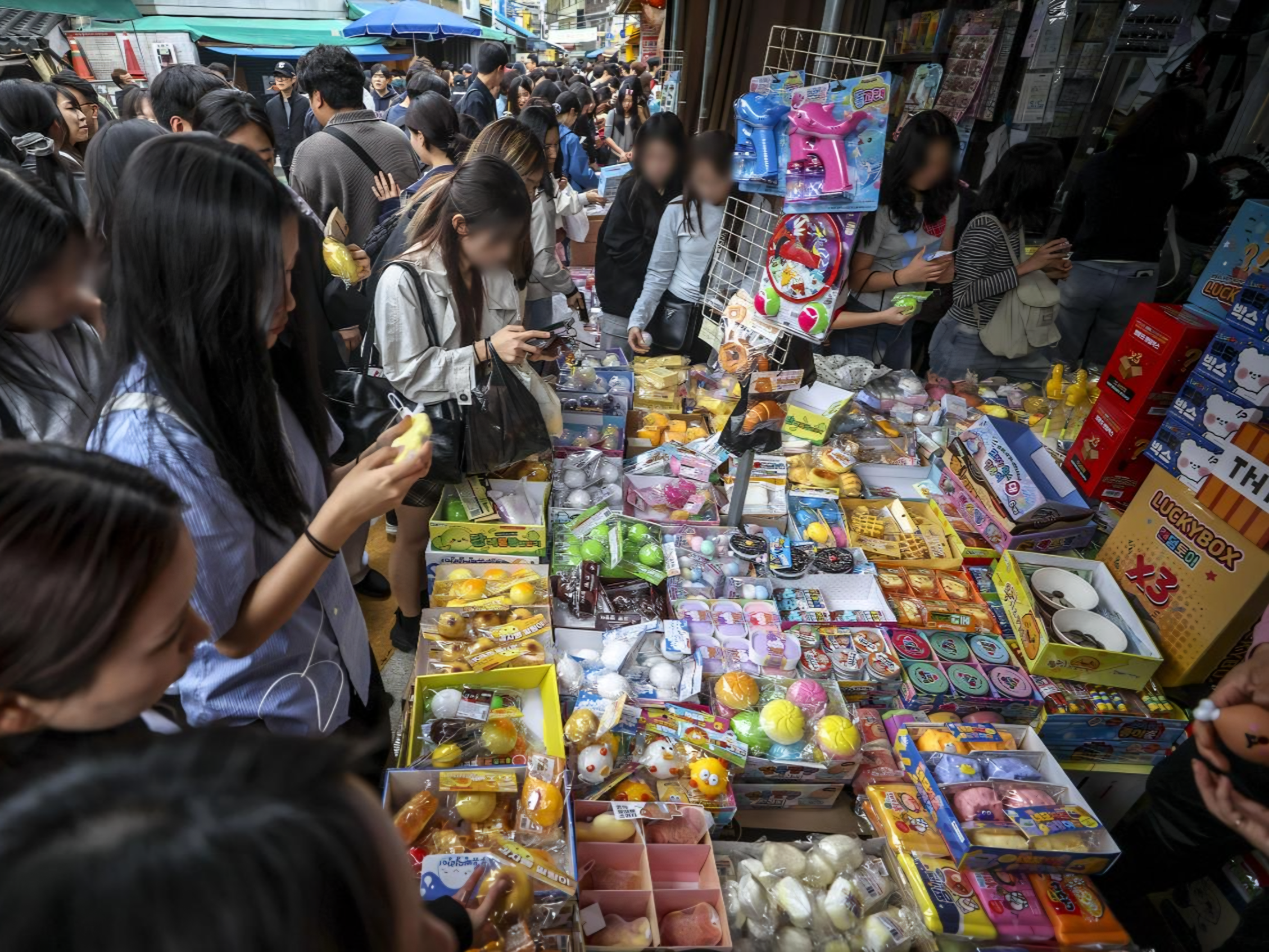
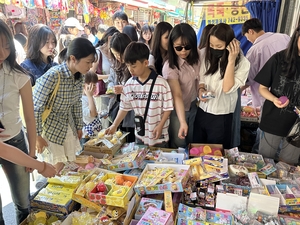
Dongdaemun and Dongmyo are drawing new visitors with low-cost experiences, social media appeal and the thrill of in-person discovery Customers browse wax squishies and stress balls at Dongdaemun Stationery Store Street in Jongno-gu, Seoul. A newly stocked box of stress balls sold out within three seconds of being put on display. (Choi Jeong-yoon/The Korea Herald) The line outside a toy wholesaler in Seoul’s Dongdaemun Stationery and Toy Street on a recent weekend looked more like one outside a trendy cafe than a decades-old market.Shoppers crowded around bins of squishies, comparing textures and squeezing them before making their choice. Nearby, others tested clicking keycap toys and cracked the wax shells of stress balls, delighting in the crisp popping sound.Most of the customers were not children. They were adults in their 20s and 30s.Just a few subway stops away, Dongmyo’s flea market was equally packed. Young couples rummaged through piles of secondhand clothing, browsed vintage cameras and hunted for retro trinkets. A captured image shows comedian Lee Eun-ji trying on vintage clothing in Dongmyo. The growing popularity of Dongmyo as a trendy destination is evident in the recent wave of celebrity vlogs filmed in the area, which is known for its rows of vintage clothing shops. (YouTube) A captured image shows singer and television personality Mijoo browsing toys along Dongmyo’s toy street, an area known for its assortment of vintage collectibles and retro items. (YouTube) What was once considered a destination for older bargain hunters in their 50s to 70s has become one of Seoul’s hottest weekend outings for younger generations.According to Naver Data Lab, searches combining Dongmyo with date-related terms surpassed comparable searches for Seongsu for the first time in May, underscoring the area’s growing appeal among young consumers.Dongmyo and Dongdaemun may seem to be riding separate trends, but both are benefiting from the same shift: young consumers are seeking inexpensive experiences that offer quick emotional satisfaction.In Dongdaemun’s toy district, that satisfaction often comes in the form of “mallang-i,” soft squeezable toys that range from donut and dumpling shapes to capybaras and cartoon characters.Prices typically range between 2,000 won and 3,000 won, making them one of the cheapest forms of entertainment available. Hundreds of types of Wax Squishy and stress balls are displayed in Dongdaemun Stationery Store Street, Jongno-gu, Seoul. (Choi Jeong-yoon/ The Korea Herald) Donut-shaped stress balls are displayed in Dongdaemun Stationery Store Street, Jongno-gu, Seoul. (Choi Jeong-yoon/ The Korea Herald) “I was surprised by how many people are here to shop for mallang-i,” said Kim Na-yeon, a 24-year-old college student. “I buy mallang-i because they come in so many different shapes and textures. Most of all, they are cheap compared to the pleasure I get from them,” she said.Koh Hyo-kyung, a 30-year-old office worker, said she bought several squishies after discovering the area through social media.“They help relieve stress,” she said. “At work, I often find myself kneading them. It’s a cheap way to release stress.”The appeal extends beyond the toys themselves. For many visitors, the experience of searching for, testing and comparing products is as important as the purchase.“You can order these online,” said Koh. “But coming here and choosing one in person is part of the fun. Finding the perfect squishy feels like a treasure hunt.”Merchants say the change has been dramatic.Lee, 70, who has operated a toy shop in the district for decades, said young women in their 20s and 30s were rarely seen in the area until recently.“A year ago, there were almost no young women here,” he said. “Then I think people started posting about the area on social media, and now the number of adult customers has more than tripled.”The craze has reshaped sales patterns throughout the street as well. According to Lee, the most sought-after squishies and wax-coated stress balls often disappear from shelves within minutes of being displayed on weekends.“If we put out a newly trending squishy, it’s gone almost immediately,” he said. “Sales have increased significantly. The popularity is so strong that even neighboring stores are changing what they sell.”“The shop next door used to sell only military supplies,” he said. “Now they’ve started putting squishies out front because that’s what people are looking for.”The trend has created a ripple effect across the market. Shops that once focused on school supplies, hobby goods or niche merchandise have begun allocating more shelf space to tactile toys. Customers' age range from little children to adults who come to Dongdaemun Stationery Store Street, Jongno-gu, Seoul., for shopping. (Choi Jeong-yoon/ The Korea Herald) Fidget toysThe phenomenon is part of a broader rise in popularity of so-called fidget toys among adults.Fidget toys are objects designed to engage repetitive hand movements and sensory stimulation through touch, sound or motion. Squishies slowly regain their shape after being squeezed, while wax balls provide the satisfaction of cracking a hard outer shell.Psychologists say such products can offer temporary stress relief by engaging the senses and redirecting attention.“The appeal lies in the immediate sensory feedback they provide,” said Choi Young-eun, a professor of psychology at Chung-Ang University. “When people squeeze a squishy toy or crack a wax-coated ball, they receive an instant tactile response. That can briefly redirect attention away from stressful thoughts and create a feeling of relief or satisfaction.”Experts say the phenomenon is also tied to the rise of “micro-pleasures” — small, inexpensive experiences that deliver a sense of reward without requiring a significant financial commitment.“Younger consumers are increasingly seeking moments of happiness that are both accessible and affordable,” said Lee Hong-joo, professor of consumer economics at Sookmyung Women’s University. “A squishy toy costs only a few thousand won, but the process of choosing it, touching it and sharing it on social media creates value beyond the product itself.”Lee said the trend reflects a broader shift from ownership-based consumption to experience-based consumption.“People are no longer purchasing only for utility,” she said. “The shopping process itself has become part of the entertainment. Consumers visit places like Dongdaemun not simply to buy something, but to explore, compare products and create content. The experience becomes the product.”The toys also tap into growing nostalgia among younger generations. While millennials might associate stationery shops and toy stores with childhood memories, many members of Generation Z are discovering such spaces for the first time through social media. Dongdaemun Stationery Store Street is fiiled with people trying to buy Wax Squishy or stressball. (Choi Jeong-yoon/ The Korea Herald) Can the boom last?Yet beneath the crowds and sold-out displays, many merchants remain cautious about celebrating the boom.For decades, Changsin-dong’s stationery and toy district had a reliable customer base among children, schools and neighborhood stationery stores. Those foundations have steadily eroded as South Korea’s birth rate has fallen, online shopping has expanded and schools have increasingly bought classroom materials in bulk.“Even at the start of a new school year, nobody comes looking for notebooks or planners anymore,” Lee said. “Before the squishy craze, there were times when I seriously considered closing the business.”The numbers reflect the broader decline. According to the Korea Stationery Distribution Cooperative, the number of stationery retailers nationwide fell from around 10,000 in 2018 to fewer than 4,000 in 2025. During the same period, online purchases of stationery and office supplies more than doubled, exceeding 2.1 trillion won ($1.4 billion) last year.Longtime merchants note that squishies themselves are hardly new.“There’s always a trendy toy every year,” Lee said. “Squishies were popular last year too. The difference is that now people are coming here to buy them in person.”That distinction raises a larger question: whether the district’s newfound popularity can outlast the social media cycle that helped create it.Some merchants worry that demand remains tied to products whose popularity can fluctuate with the seasons. Squishies can harden in cold weather, while wax-coated stress balls may be vulnerable to heat. What is selling out today may be forgotten a few months from now.Experts say the long-term challenge is turning viral foot traffic into repeat visits.“The visitors who come because something is trending can disappear just as quickly once the trend fades,” said Jung Ran-soo, an adjunct professor of tourism at Hanyang University. “The key is to create reasons for people to stay, explore and return, rather than simply purchase a single item.”For now, the popularity of squishies, wax-breaking balls and other fidget toys has given the neighborhood an unexpected second life. Whether that momentum proves temporary or transformative may depend on whether visitors continue to see the district not merely as a place to buy the latest viral toy, but as a destination worth returning to long after the trend has passed.