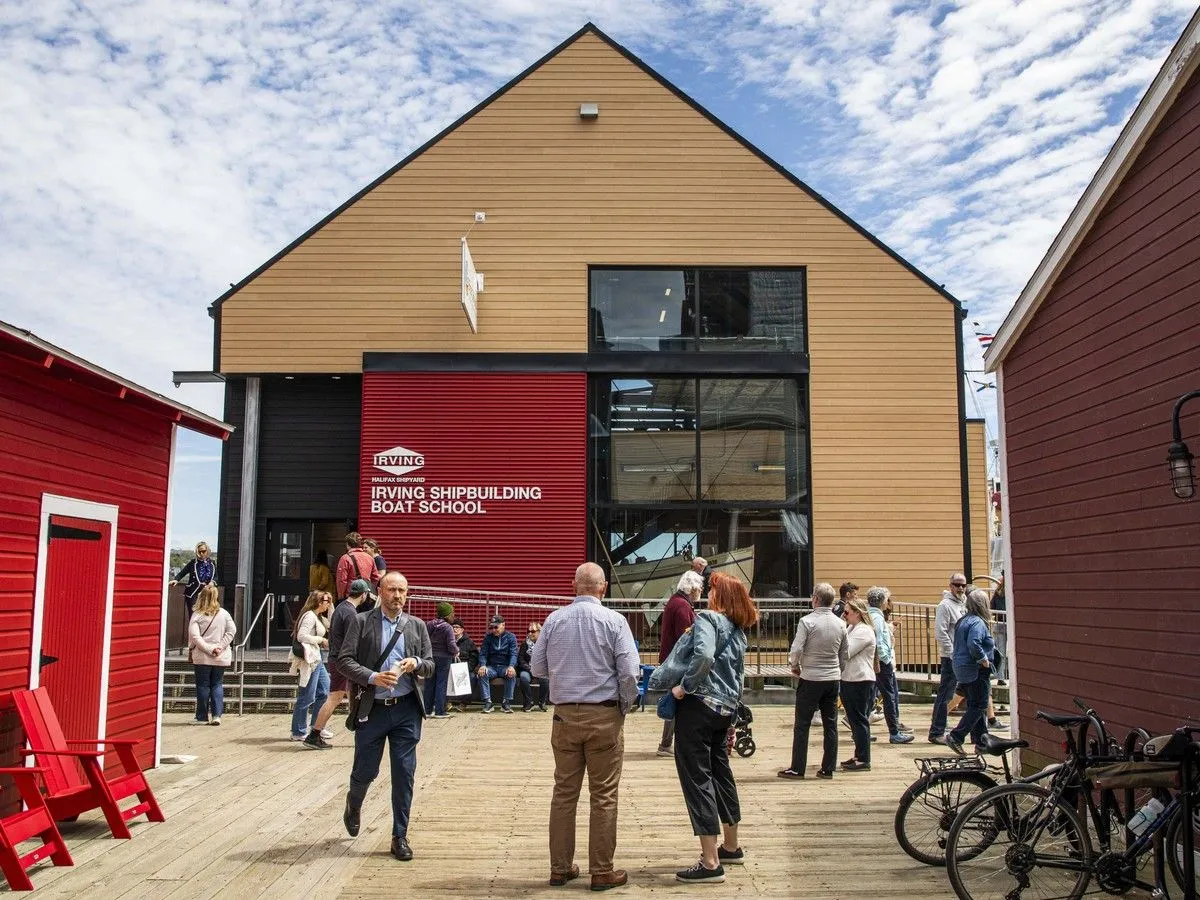
Skip to Content News Archives Economy Energy Oil & Gas Renewables Electric Vehicles Mining Commodities Agriculture Real Estate Mortgages Mortgage Rates Finance Banking Insurance Fintech Cryptocurrency Work Wealth Smart Money Wealth Management Investor Personal Finance Family Finance Retirement Taxes High Net Worth FP Comment Executive Women Puzzmo Newsletters Financial Times Business Essentials More Innovation Information Technology FP500 Podcasts Small Business Lives Told Tails Told Shopping Financial Post Store Obituaries Place a Notice Advertising Advertising With Us Advertising Solutions Postmedia Ad Manager Sponsorship Requests Classifieds Place a Classifieds ad Working Profile Settings My Subscriptions Saved Articles My Offers Newsletters Customer Service FAQ News Economy Energy Mining Real Estate Finance Work Wealth Investor FP Comment Executive Women Puzzmo Newsletters Financial Times Business Essentials HomeNewsTransportationHow Irving Shipbuilding is tackling a coming labour shortageCompany opens boat school to create an early talent pipeline for an industry facing shortage of skilled tradespeopleLast updated 5 hours ago You can save this article by registering for free here. Or sign-in if you have an account.The newly opened Irving Shipbuilding Boat School on the Halifax waterfront is designed to introduce hundreds of young people each year to boatbuilding, maritime skills and life on the water. Photo by Ryley GaraganThe principal yard in Canada’s National Shipbuilding Strategy is looking further upstream – all the way to middle school – in its search for future workers.Subscribe now to read the latest news in your city and across Canada.Exclusive articles from Barbara Shecter, Joe O'Connor, Gabriel Friedman, and others.Daily content from Financial Times, the world's leading global business publication.Unlimited online access to read articles from Financial Post, National Post and 15 news sites across Canada with one account.National Post ePaper, an electronic replica of the print edition to view on any device, share and comment on.Daily puzzles, including the New York Times Crossword.Subscribe now to read the latest news in your city and across Canada.Exclusive articles from Barbara Shecter, Joe O'Connor, Gabriel Friedman and others.Daily content from Financial Times, the world's leading global business publication.Unlimited online access to read articles from Financial Post, National Post and 15 news sites across Canada with one account.National Post ePaper, an electronic replica of the print edition to view on any device, share and comment on.Daily puzzles, including the New York Times Crossword.Create an account or sign in to continue with your reading experience.Access articles from across Canada with one account.Share your thoughts and join the conversation in the comments.Enjoy additional articles per month.Get email updates from your favourite authors.Create an account or sign in to continue with your reading experience.Access articles from across Canada with one accountShare your thoughts and join the conversation in the commentsEnjoy additional articles per monthGet email updates from your favourite authorsSign In or Create an AccountorIrving Shipbuilding has opened a boat school on the Halifax waterfront. The facility is designed to introduce hundreds of young people to boatbuilding, maritime skills and life on the water each year, creating an early talent pipeline for an industry facing long-term demand for skilled tradespeople.According to a January article by Ki’Talent, an international management and executive search firm, Nova Scotia’s marine sector requires “1,200 additional certified workers by 2027 just to maintain the National Shipbuilding Strategy timeline.”Breaking business news, incisive views, must-reads and market signals. Weekdays by 9 a.m.By signing up you consent to receive the above newsletter from Postmedia Network Inc.A welcome email is on its way. If you don't see it, please check your junk folder.The next issue of Posthaste will soon be in your inbox.We encountered an issue signing you up. Please try againThe boat school won’t meet that demand, but could help address future labour shortages.“The new boat school represents a meaningful investment in the future of Nova Scotia’s marine sector,” said Dirk Lesko, president of Irving Shipbuilding Inc. Harbourside view of Irving Shipbuilding Boat School, which is creating more opportunities for young Nova Scotians to learn valuable skills and connect with the province’s rich maritime heritage. Photo by Maritime Museum of the AtlanticIrving Shipbuilding is a principal shipyard for the National Shipbuilding Strategy, the largest and most complex shipbuilding initiative in Canada that comes with a price tag between $56 billion and $60 billion.“The boat school will have a positive impact on the lives of Nova Scotia’s youth while strengthening connections to our maritime heritage,” Lesko continued.“We’re trying to create a pipeline.”Backed by a five-year, $2.5-million commitment from Irving Shipbuilding, the boat school is intended to do more than teach young people how to work with wood. It’s an early entry point into a broader workforce development strategy aimed at addressing long-term skilled trades shortages while being enrolled in one of the coolest educational opportunities.Jean-Francois Seguin, vice-president of communications and government relations at Irving Shipbuilding, said the pipeline is “to build up the industry in Canada,” not just shipbuilding.“It’s not just about combat ships or urban shipbuilding,” Seguin said. “The community colleges, the province, have really tried to bring more people to the shipbuilding sector into the marine industry.“So, whether they go to work for (Marine and Offshore) or for Hawboldt industries, if you’ve got somebody that’s coming in that’s learning to be to become a part of the shipbuilding ecosystem, we see that as very positive. And that’s how the boat school fits in.”A select number of middle school students will learn in the new facility, which was built to address a rising demand for programs that had outgrown their original home in a series of small boat sheds operated by the Maritime Museum of the Atlantic next door.For the past decade, the cramped space of the museum workshops has constrained participation. But the demand continued to grow despite the space limitations, which restricted how many students could participate.The museum’s programs typically served between 50 and 90 young people annually. With the expanded facility, participation is projected to eventually grow to between 800 and 1,000 youth each year through a combination of boatbuilding instruction and on-the-water experiences.The school’s lofted workshop will allow students to start with raw materials and, over the course of several weeks, work together to construct a boat before launching it.“They get a pile of wood at the beginning of the term. At the end of it, they have a boat,” said Aaron Plamondon, Irving Shipbuilding’s director of industrial participation.“It’s just learning how to be part of a team, our maritime heritage, and using power tools. My son is 13. If you saw him using a drill, you’d know they need things like this.“It’s about attracting the next generation of skilled tradespeople and the opportunity to do that here in Nova Scotia. They will take those skills and interests into high school, and we’re helping support the infrastructure.”Beyond technical skills, organizers say the programs are designed to build confidence, foster mentorship and create a sense of belonging among participants who may have had limited exposure to the waterfront or marine industries.The school also represents the earliest stage of workforce development that industry leaders say is becoming increasingly important.Across North America, shipbuilders and manufacturers have struggled to replace retiring tradespeople after decades of declining participation in skilled trades education.“The challenge for the U.S., like Canada, is trades education and production skipped a generation or two,” Lesko said. “All of the folks who were in those trades have retired over the last 10 or 15 years, and there are not enough people in the pipeline to replace them.”Irving Shipbuilding has spent years developing apprenticeship and training programs to meet workforce demands associated with the National Shipbuilding Strategy. Lesko said the company has doubled its workforce over a four-year period, largely by recruiting and training people who were entirely new to the industry.The boat school is intended to spark interest long before students reach apprenticeship age. The interior of Irving Shipbuilding Boat School where boats are built from scratch before their inaugural sail. Photo by Maritime Museum of the Atlantic“Whether or not what they learn about how to build a boat lasts, you’re picking up skills in that process and an interest in something that you might not have had before, something at the end that could lead to a job,” Lesko said.“For two to three years, we have been talking about how best we deploy resources to create awareness, that leads to interest, so people will consider careers in manufacturing here in Nova Scotia, keep them in the province. But it can’t be flashy, colourful slides. It’s got to be real.”That strategy appears to be paying dividends. Irving reports annual workforce attrition of about 6.7 per cent, significantly below rates experienced by many industrial employers.“When we talk about that to some of our colleagues, their attrition is in the teens or 20s,” Seguin said. “Nova Scotia workers coming back to Nova Scotia, learning to be shipbuilders, and then seeing 30 years’ worth of work here, they just stick around.”Whether graduates pursue careers with marine manufacturers, offshore companies, naval contractors or other skilled trades employers, the goal is to strengthen the broader industrial ecosystem.The boat school complements existing initiatives such as Skills Canada’s trade exploration programs Try-A-Trade and Skilled Futures in Nova Scotia high schools and Irving’s own two-year apprenticeship pathways, which regularly attract several hundred applicants for a limited number of training seats.“They can go work at a hospital. They can go to the dockyard next door,” said Plamondon. “It’s all the same ecosystem that we’re feeding.”The roughly $15-million boat school project was funded through a combination of public and private investment, including $7 million from the Province of Nova Scotia, more than $3.2 million from the federal government, $4.6 million from donors to the Canadian Maritime Heritage Foundation and Irving Shipbuilding’s $2.5-million operational commitment.The building incorporates climate-resilient features designed to withstand hurricanes and rising sea levels, ensuring the facility can serve future generations of students.“(The) boat school supports young Nova Scotians as they build skills, confidence and a sense of belonging,” Dave Ritcey, the Nova Scotia minister of communities, culture, tourism and heritage said at the unveiling of the boat school. “It creates a welcoming space for the kind of inclusive, experiential learning that can open new pathways and make a lasting difference.”The stand-alone building on the Halifax waterfront forms part of the larger Maritime Heritage District, which includes the museum’s historic wharves, marina, boat sheds and some of Canada’s most significant historic vessels, including the century-old survey ship CSS Acadia, the only surviving vessel from the 1917 Halifax Explosion, and HMCS Sackville, the last corvette from the Battle of the Atlantic. Join the Conversation This website uses cookies to personalize your content (including ads), and allows us to analyze our traffic. Read more about cookies here. By continuing to use our site, you agree to our Terms of Use and Privacy Policy.
How Irving Shipbuilding is tackling a coming labour shortage
New Halifax boat school aims to inspire next generation of marine workers
TL;DRAI
Irving Shipbuilding opened a boat school to build a talent pipeline for Canada's 1,200-worker shortage by 2027. The $2.5M investment shows how industrial sectors tackle skilled-labour gaps—a pattern IT leaders should monitor as engineering talent scarcity spreads.
1,788 words~8 min read