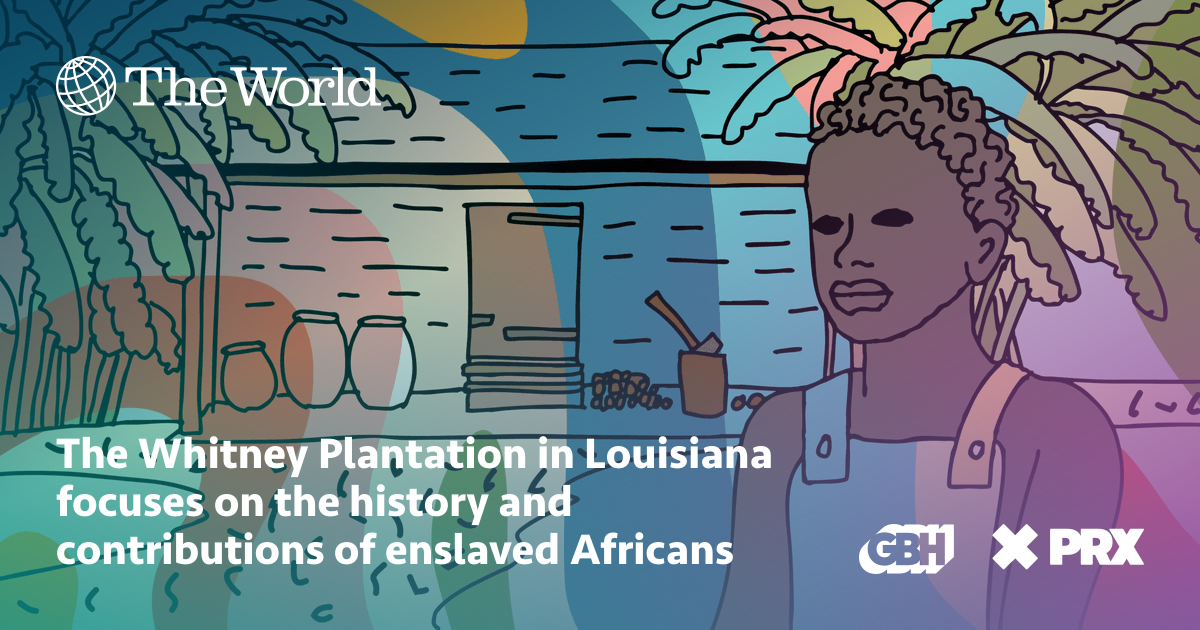
Public radio’s longest-running daily global news program.AboutContactDonateMeet the TeamPrivacyTerms of use©2026 The World from PRXPRX is a 501(c)(3) organization recognized by the IRS: #263347402.Historians say more details about the lives of enslaved Africans need to be taughtThe history and legacy of slavery in America are not often taught in great detail. That is what Professor Mary Niall Mitchell, the Midlo Endowed Chair in History at the University of New Orleans, contends. But she told The World’s Marco Werman that one trailblazing historian worked for decades to uncover the origins of enslaved Africans in Louisiana and shed light on their lives.On a trip to the Whitney Plantation in Wallace, Louisiana, visitors are likely to become acquainted with the work of the late researcher Gwendolyn Midlo Hall, one of the most influential Civil Rights figures of her time. Hall is often credited with changing the landscape of African American history and the history of slavery in the Americas.To better understand the impact of Hall’s work and why it is so important to African American history, and how it’s taught, The World turned to Professor Mary Niall Mitchell, the Midlo Endowed Chair in History at the University of New Orleans. She’s also a consultant at Whitney Plantation.According to Mitchell, little was known about the specific origins of enslaved West Africans before Gwendolyn Midlo Hall began her research in the 1980s.“She discovered that by going to small parish courthouses, going through wills and succession [records], and then colonial records, you could actually accumulate a lot of information about individual African people,” Mitchell said. “And she realized she was collecting so much information that she needed to create a database. So, she was working on one of those big, clunky old desktop computers, and her graphs and things looked very 1980s. This is pre-internet.”The World’s Host Marco Werman spoke further with Mitchell about how Hall’s work continues to resonate today in US higher education.Freedom on the Move is a collection of what we call fugitive-slave advertisements, or advertisements for freedom seekers. But these were short newspaper advertisements. That enslavers would post in local newspapers, trying to recapture people who had run away. And so, there are almost 90,000 of these ads in the database right now, and we are not by any stretch finished collecting them. And in these advertisements, they’re putting as much detail as possible. So, you learn names, you may learn countries of origin, you learn the languages that they might be speaking, what clothes they were wearing. And so, what Freedom on the Move does is create histories of resistance that can be looked at at the macro level, right? You can see hundreds of thousands of people running and look for patterns, but also find individuals who might otherwise not appear in other historical records. And it turns out that students can understand the history of slavery differently once they work with this database, because they become invested in that person’s life story and trajectory, even though, in most cases, we don’t know what happened to them.I think first you have to look at where research historians are, because it’s really their research that generates the information that can then be passed on to teachers and through museum sites and things like that. And so, I hope that more academic historians will collaborate more closely with K-12 teachers, particularly, and also descendant communities. Because when we talk to young people about slavery, we have to do that with care. We don’t only emphasize the violence and the sorrow that slavery brought, right? We want a fuller truth for these young people, that enslaved people were courageous, that they were clever [and] inventive, despite all the dangers they faced, and that all of this helped them to survive enslavement. For me, that’s the fuller picture. And certainly, as Dr. Seck indicates, cultural aspects are another way to tell that story. So, for instance, one of my colleagues here, an ethnographer, has been working with musicians in New Orleans and Senegal to perform together, talk about music together, and find commonalities between those musical forms. So, that’s another way that you can get that point across to the general public in ways that make sense and are also super interesting to them.Parts of this interview have been lightly edited for length and clarity.
Historians say more details about the lives of enslaved Africans need to be taught - The World from PRX
The history and legacy of slavery in America are not often taught in great detail. That is what Professor Mary Niall Mitchell, the Midlo Endowed Chair in History at the University of New Orleans, contends. But she told The World’s Marco Werman that one trailblazing historian worked for decades to uncover the origins of enslaved Africans in Louisiana and shed light on their lives.
721 words~3 min read