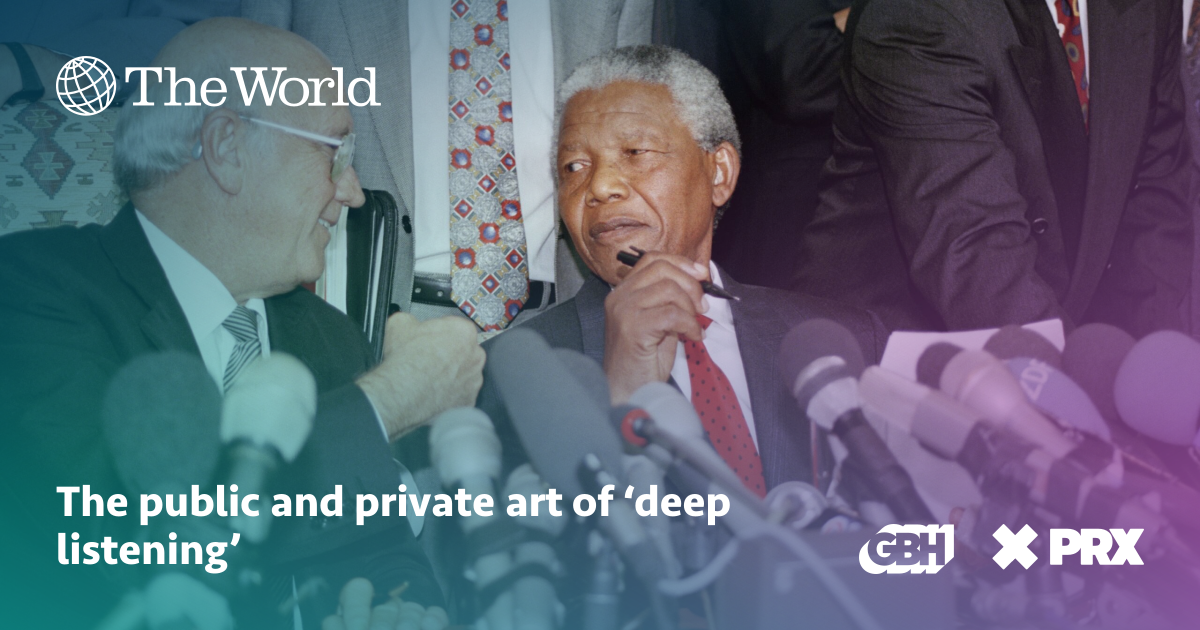
Public radio’s longest-running daily global news program.AboutContactDonateMeet the TeamPrivacyTerms of use©2026 The World from PRXPRX is a 501(c)(3) organization recognized by the IRS: #263347402.The public and private art of ‘deep listening’We tend to think of conversation as speech, but obviously listening is also a crucial part of every conversation — in theory, anyway. In practice, however, things tend to unfold quite differently, especially when conversations escalate. Joining Host Marco Werman, journalist Emily Kasriel delves into her new book about what might change if more politicians, pundits and everyday people at least tried to listen more.7:13South African President F.W. de Klerk, left, and African National congress President Nelson Mandela exchange pleasantries on Thursday, April 19, 1994 during the singing of agreement to include the Kwazulu Black homeland in South Africa’s first all-race election.It’s time to talk about listening. We tend to think of conversation as speech, but listening is just as important as talking. And in practice, listening can go by the wayside, especially when conversations start to heat up. “Deep Listening, Transform Your Relationships with Family, Friends, and Foes” delves into what could change if more politicians, pundits and everyday people at least tried to listen more. Courtesy of Emily Kasriel“In the public sphere, a lot of people feel their role is to convey a vision, explain the truth or to convince other people,” journalist Emily Kasriel told The World. “And indeed, in the private sphere, we feel we need to put the world to right. We need to explain to our kids, partners, neighbors, to a colleague, what needs to be done at this stage. Our ears aren’t open to listening.” In her new book, “Deep Listening, Transform Your Relationships with Family, Friends, and Foes,” Kasriel delves into what could change if more politicians, pundits and everyday people at least tried to listen more. She said the problem of uncivil discourse is widespread, and that we need to be more open to hearing people out. “If we’re able to take a step back, to act with curiosity, to let the whole of us listen to the whole of them, the person we’re listening to has a moment to unpack what’s going on for them, to share something far more authentic … so that at the end of it, they feel heard and we both feel far more connected. [It’s] especially important when we have different ideas from the person that we’re trying to listen to.”The World’s Host Marco Werman spoke to Kasriel more about this approach.When I had just arrived in South Africa to be the reporter for BBC Africa, I was in Johannesburg, and we heard that a story was unfolding in Pretoria. We all bundled into the BBC van and turned up because these were soldiers, uMkhonto we Sizwe soldiers, that were part of the ANC’s guerrilla army, who’d been integrated into the South African defense force, which, prior to the end of apartheid, was part of the apartheid-controlled regime. And these soldiers were angry. They were angry about the food [and] the way they’d been treated by their despised former enemies. They were angry that their rank was lower than it had been in uMkhonto we Sizwe. And so, they wanted to speak to their leader, and they turned up at the Union Buildings, the very heart of the South African establishment, to speak to Nelson Mandela. Eventually, he arrived by helicopter. I went to the erected podium to hear what he would have to say. But he wasn’t there. Instead, I found Nelson Mandela walking among the soldiers, very far from the podium. And he was trailed by his bodyguard, but he was walking and talking and greeting these angry soldiers.Absolutely! And he was trailed by his bodyguard, but he was walking, talking and greeting them. He said to one guy, “Hello, what’s your name?” And the guy responded. [Mandela continued,] “And tell me, where do you live? … Yes, I know Alexandra Township … but which street? Ah, the corner of that street. Oh yes, I get it. And now tell me why are you here?” And only after he spent a whole hour, at least, wandering among the crowd, did he get up on the podium. He told these soldiers, “I have heard from you; I understand your grievances, but now you must be disciplined. You must go back to your barracks, and you need to help us build the new South Africa.” And all the soldiers did what Mandela said. Parts of this interview have been edited for length and clarity.Editor’s note: This Q&A has been updated on June 27, 2025 to reflect additional comments from Emily Kasriel.
The public and private art of ‘deep listening’ - The World from PRX
We tend to think of conversation as speech, but obviously listening is also a crucial part of every conversation — in theory, anyway. In practice, however, things tend to unfold quite differently, especially when conversations escalate. Joining Host Marco Werman, journalist Emily Kasriel delves into her new book about what might change if more politicians, pundits and everyday people at least tried to listen more.
776 words~4 min read