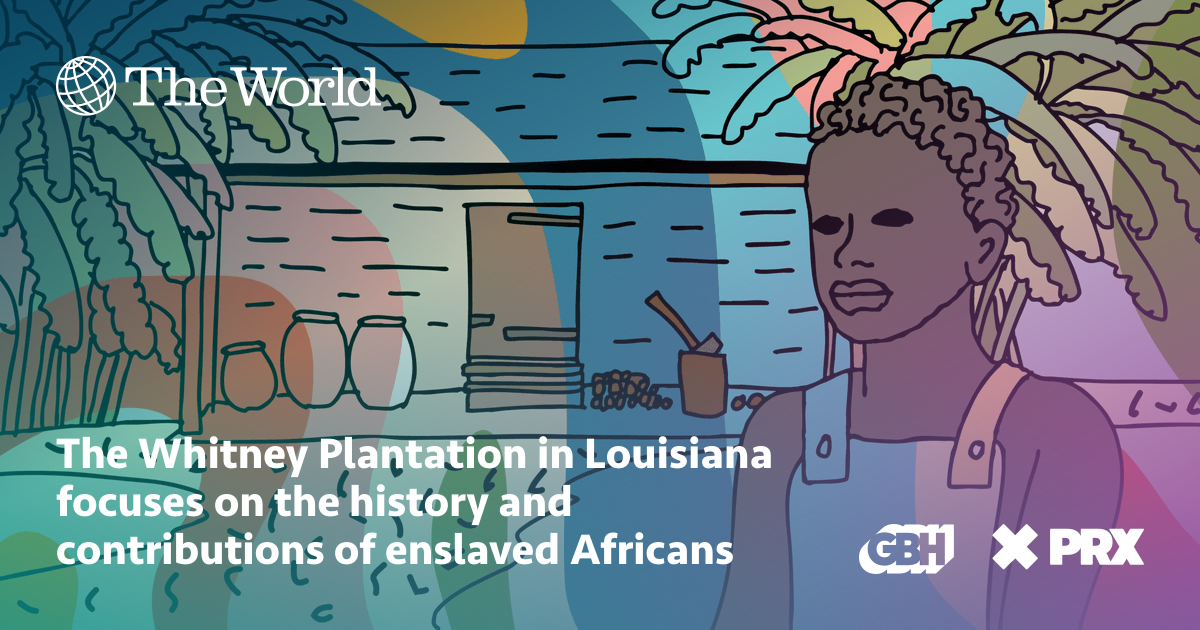
Public radio’s longest-running daily global news program.AboutContactDonateMeet the TeamPrivacyTerms of use©2026 The World from PRXPRX is a 501(c)(3) organization recognized by the IRS: #263347402.The Whitney Plantation in Louisiana focuses on the history and contributions of enslaved AfricansSome plantations romanticize the Antebellum South or ignore their role in the slave trade, but one Louisiana plantation has been educating visitors about the history of enslaved Africans and their descendants. Reporter Adeline Sire visited the Whitney Plantation and Museum in Wallace, Louisiana, to learn more about the lives and acts of courage of those who were enslaved there.Whitney Plantation and Museum, about an hour west of New Orleans, sits on lush green land, with palm trees and gigantic live oaks draped in Spanish moss. But the tranquil scenery belies the dark history laid bare there. Live oak trees canvas the plantation grounds.Adeline Sire/The WorldOn a visit there, you won’t hear tales about the grandeur of the two-story big house, or see antiques or fine dinnerware in it. The 18th-century plantation owner’s house is kept empty, and it’s actually not a big part of the story told on this site. That’s because the visit focuses on the lives of the people who were enslaved. The 18th-century plantation owner’s two-story house is kept empty, and it is not a big part of the story told at the Whitney Plantation.Adeline Sire/The WorldIbrahima Seck, retired history professor from Cheikh Anta Diop University in Dakar, Senegal, and director of research at Whitney Plantation and Museum, said he’s proud of the plantation’s historical and educational goal, where adults and children alike can learn about slavery. “This is an open classroom,” he said on a visit to the site. “I am a retired teacher, and this is my classroom now, and I love it.”On a tour of the grounds, one can see a kitchen, a forge, a rusty jail and crude enslaved people’s quarters. There are statues of little children in front of some of the cabins and inside a Baptist church. There are sculptures and memorials all around.One of the cabins that house enslaved people on the plantation.Adeline Sire/The WorldNear the entrance stands the bronze statue of a winged angel cradling a baby. It’s part of “the field of angels,” a memorial to the more than 2,000 children who died in slavery between 1823 and 1863 in St. John the Baptist Parish. The names were obtained from the Catholic Church, which kept records of causes of death at the time. A statue at the “Field of Angels” memorial.Adeline Sire/The World“Most of them died before their second birthday, of diseases like malaria, yellow fever, intestinal disease,” Seck said. “Some died accidentally by drowning or burning. There were also many children who were stillborn because their mothers, while pregnant, had to work hard in the fields. Some babies were born in the fields because the crazy slave drivers would not let them go back to their cabin in time.”The plantation was founded in 1752 by Ambroise Heidel, a German-born man whose family ran the plantation for over a century. It changed hands many times, but the plantation first grew rice and indigo, with about 20 enslaved people from West Africa. Then, around 1800, it shifted to sugar cane, considered the “white gold” of the 19th century.“That shift was made possible by the arrival of 5,000 enslaved people from Haiti,” Seck said. “The enslaved people came here with their masters. The French left Haiti because of the revolution [of 1804 in Haiti], and they brought over here those skills of sugar making.”The demand for sugar fueled the slave trade for decades. Sugar cane was the most grueling and deadly crop to harvest, and it took vast amounts of labor to manage the fields. By the mid-19th century, Louisiana produced roughly a quarter of the world’s cane sugar. And in 1860, there were over 100 enslaved people on Whitney Plantation, producing 400,000 pounds of sugar a year.Telling that story has been part of Whitney Plantation’s educational mission since it opened as a museum in 2014, Seck said, and that mission is especially important today.“Right now, we have some officials in power who are trying to take slavery out of the curriculum,” he said, “to erase history, and even to dismantle exhibits related to slavery. This country is great. Everybody wants to come here. But you have a big problem related to the legacies of slavery. How can you solve that problem if people are not educated about it? There is no shame teaching people about slavery.”Seck walks to a large open area surrounded by walls with engraved granite slabs. It’s a memorial enclosure named after the trailblazing historian Gwendolyn Midlo Hall. When Midlo Hall visited Senegal to lecture about her research in 1993, Seck saw her speak and decided to study the history of the slave trade and the African diaspora in the United States.Midlo Hall, who died in 2022, was the author of the 1992 book “Africans in Colonial Louisiana.” She also created a database that holds the thousands of enslaved people’s names she collected during her research in Louisiana. Those names are engraved in this memorial. Hundreds of these individuals were part of the 1811 rebellion, also known as the German Coast uprising. It was the largest revolt by enslaved people in American history. They marched with arms and drums toward New Orleans in hopes of creating a free Black state. But local militias and federal troops brutally crushed the uprising, and it ended in a slaughter. Dozens were executed and beheaded.History professor Mary Niall Mitchell of the University of New Orleans and Faith Carr, one of her graduate students, share details about what visitors will learn from the exhibition: “AMONGST OURSELVES-Resisting Slavery at Whitney Plantation,” currently on view at the Whitney Plantation in Wallace, Louisiana. Prof. Mitchell speaks first.Seck says the story of these freedom fighters and their bravery is not told enough. Looking at a memorial wall, he pointed to the names of some men killed in the uprising.“This is Charles Deslondes, the leader,” he said. “This is Amar, one of the leaders from Senegal; Quamina, one of the leaders from the Bight of Benin, and this is Lindor. Lindor was a drummer.”Holding on to African birth names, Seck said, was one of the many acts of resistance enslaved people engaged in. An exhibit currently on display at the plantation showcases others — some large, like the uprising, and some smaller, like maintaining their native language, playing their own music and practicing their religion. Learn more and view the panels at the “Amongst Ourselves: Resisting Slavery” exhibit at Whitney Plantation. Courtesy of the Midlo Center for New Orleans Studies.Most of the people on the plantation were Bambara from Senegal, according to Seck. “The Fulani people were cattle-raising specialists, like Samba,” he said, “of the Pular Nation.” Many people also came from Mali, Mauritania, Gambia and Guinea.Pak Nakeza, who hails from Democratic Republic of Congo, said visiting the Whitney Plantation makes her curious about the similarities between colonization and the slave trade.Adeline Sire/The WorldVisiting the plantation, Pak Nakeza, a young woman from Democratic Republic of Congo, a former Belgian colony, said it makes her curious about the similarities between colonization and the slave trade. She thinks there is a problem back home when it comes to teaching the history of slavery.“I think that’s because the educational system in Africa is modeled after the European one,” Nakeza said in French, “… and it would rather not discuss Europeans’ misdeeds in the world.”For Seck, it’s essential to tell the story of the horrific suffering and mistreatment that enslaved Africans endured. But he said it’s also important to highlight the ways they — and their descendants — shaped American culture.“Along the Mississippi River was born blues, jazz, zydeco, rock ’n’ roll,” he said. “And what about the cuisine? Always Black hands in the pot, African women and their children, mixing African, Native American and European recipes to create that wonderful cuisine, Creole cuisine, gumbo, jambalaya, crawfish étouffée, smothered okra. …”Seck hopes that by sharing more of the cultural aspects of the history and legacy of slavery, as well as the stories of individuals, a fuller image of enslaved people will emerge.“We have to teach slavery as part of the history of civilization,” he said. “Africans brought over here their humanity, their skills, their cultures. Not only [did they build] the foundations of the economy of this country, but they also contributed tremendously to defining the culture.”
The Whitney Plantation in Louisiana focuses on the history and contributions of enslaved Africans - The World from PRX
Some plantations romanticize the Antebellum South or ignore their role in the slave trade, but one Louisiana plantation has been educating visitors about the history of enslaved Africans and their descendants. Reporter Adeline Sire visited the Whitney Plantation and Museum in Wallace, Louisiana, to learn more about the lives and acts of courage of those who were enslaved there.
1,413 words~6 min read