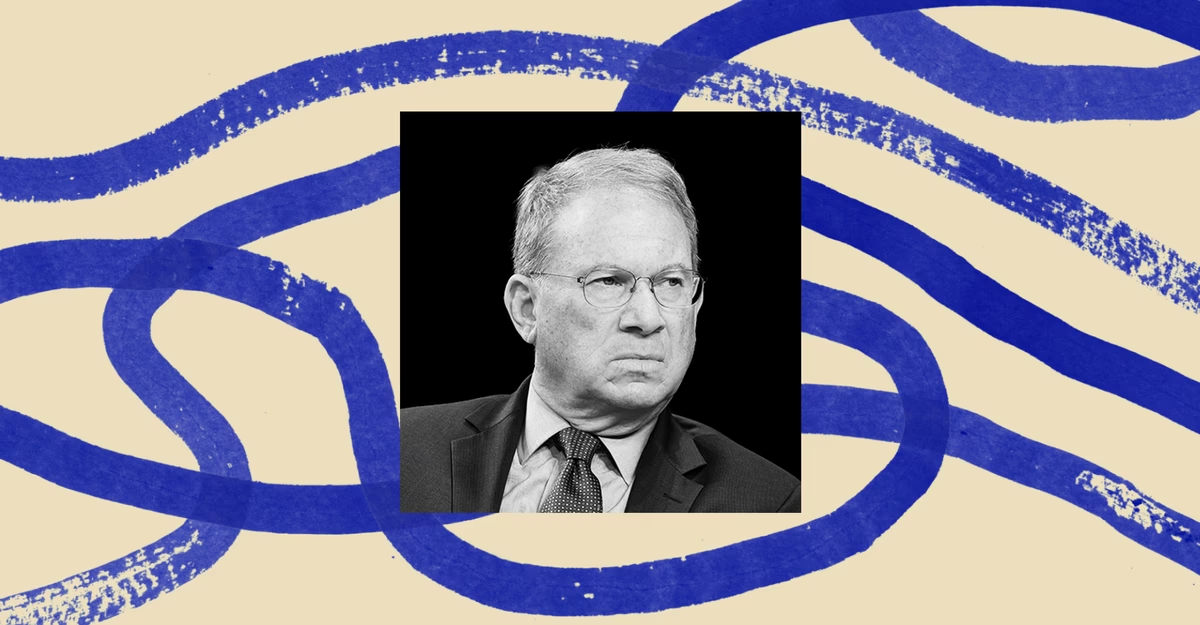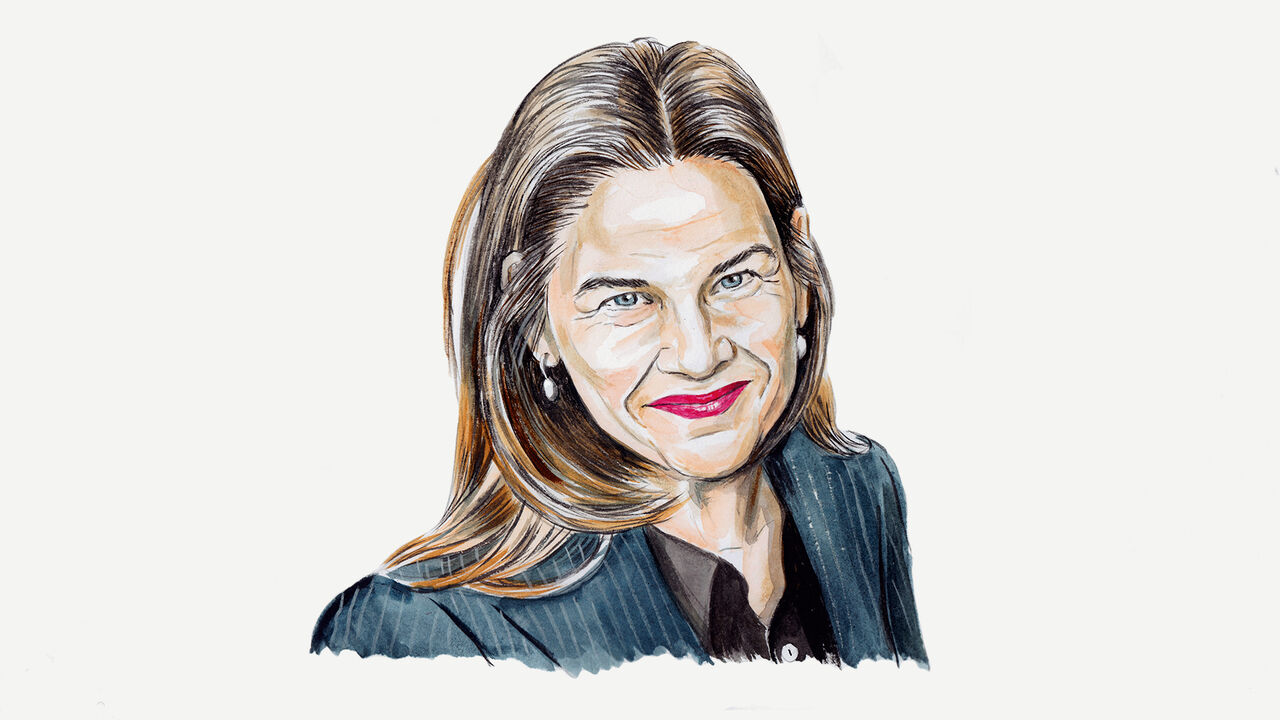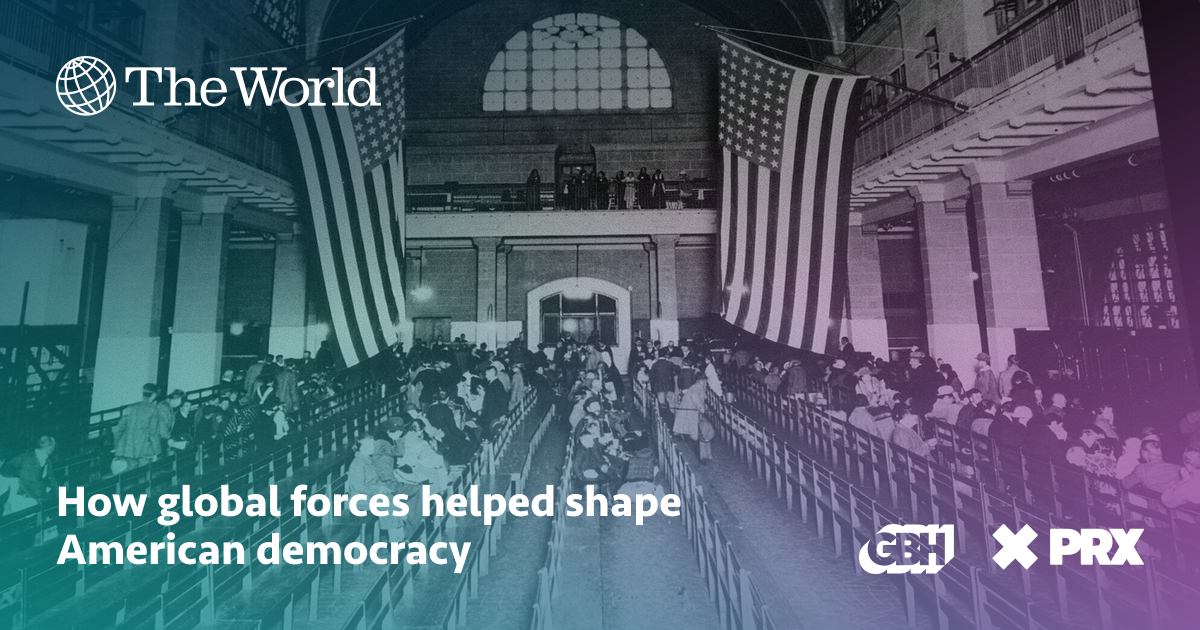
Public radio’s longest-running daily global news program.AboutContactDonateMeet the TeamPrivacyTerms of use©2026 The World from PRXPRX is a 501(c)(3) organization recognized by the IRS: #263347402.How global forces helped shape American democracyTwo-hundred and fifty years ago, the American revolution sent shockwaves around the globe. At the same time, events taking place outside the US impacted how democracy grew in America. The World’s Host Carolyn Beeler spoke with historian Heather Cox Richardson about how the contradictions inherent in the American experiment have played out on the global stage. HistoryJuly 2, 2026Updated: July 2, 202613:45In this 1924 file photo, immigrants from Europe sit in the registry room at Ellis Island in New York harbor. Throughout history, the United States has used all sorts of physical or mental exams for immigrants seeking just to get into the country outside of becoming a citizen.This Fourth of July marks 250 years since the Declaration of Independence was adopted. But life, liberty, and the pursuit of happiness were not strictly American pursuits, and the Declaration wasn’t written just for an American audience. The World’s reflection on the United States at 250 is all about the global reverberations of that document. To go deeper into this, The World spoke to Heather Cox Richardson, a history professor at Boston College. She is best known for her nightly Substack newsletter, “Letters from an American.“Recently, she spoke to Host Carolyn Beeler about the gap between the founding ideals of the US and the society that was actually built.In this July 29, 2010, file photo, with the Statue of Liberty behind them, a coalition of immigrant groups and their supporters march across the Brooklyn Bridge in New York. Seth Wenig/AP FileWell, I would take the position that every country is unique, every system is unique by definition. But there is something, I think, in the practice of American democracy at its fundamental level that did, in fact, help to develop a certain kind of American history. And that is those principles that are articulated in the Declaration, the idea that everybody is created equal and has a right to be treated equally before the law, that everybody has a right to a say in their government and that everybody has a right to equal access to resources is in fact written and articulated by a group of men who exclude the majority of the people in the colonies from those rights.That sets up a fundamental tension between those principles and the people who actually get to practice it. So, from the very beginning, as soon as they articulate the Declaration of Independence, you already have people like Benjamin Banneker, who is a Black scientist, writing to Thomas Jefferson and saying, “Hey, that’s a great set of ideas, What about me?” And that tension between the people who have those rights and the people who don’t have those rights have created a tension in American society between the idea of having rights and not having rights that has propelled a lot of the changes that we have lived through in the last 250 years, a lot of the criticisms of the country and a lot of the hope that we can do better.The Alsatian Society of France places a bouquet of flowers at the Statue of Liberty’s base, Liberty Island, New York, Oct. 28, 1946, the statue’s 60th anniversary. From left to right in front row: Gustave Moutet; Raymond Offroy; Marie Bertini; Lorraine Kaiser, 8 years old, laying flowers; Jeffrey Du Pin; and Arnold Wapler.Harry Harris/APThat’s a really interesting moment. And I’m glad you brought it up now because that’s Emma Lazarus’s poem, and it goes onto the base of the Statue of Liberty at the end of the 19th century. And it does so at a time when immigrants, especially from Europe, are pouring into the United States with the idea that they can do better in the United States than they can do in their own countries, where the international grain markets are badly hurting farmers in those regions.So, they come to the United States, which is a big producer of those grains, and they come with the idea that they can do better over here. It’s not a good time for immigrants in the sense that a lot of native-born Americans are against the idea of what they see as these outlandish immigrants, many of whom they do not consider white, by the away. They don’t like their clothing. They don’t like their language. They don’t like their religion. But what you get in that moment is a conflict between those people who are saying, “We need immigrants. We need people here. And we need people not just to work in the factories, but we need people to write new books and to speak new languages and to think of new inventions and to move in new ways out to the West where they’re going to grow different kinds of crops.”And you see this in the literature in the late 19th and early 20th centuries, things like Willa [Cather’s] “My Ántonia,” for example, or “Death Comes for the Archbishop,” this championing of the American grouping of people from all around the world to create something new. America has always had a tension, of course, between native-born Americans and immigrants, but we have often celebrated the influx of new people. And at the times when we celebrated those new people, those were the times when we grew the most, when we had the best economy, when we had the opportunity to create something new.Gen. Joseph Stilwell pins the Distinguished Service Cross on the dress of Mary Masuda in honor of her brother, S/Sgt. Kazuo Masuda, a Japanese-American who won the posthumous award for his single-handed attack on a Nazi position at Casino, Italy, in 1944. Watching are presentation at Santa Ana, Calif., Dec. 8, 1945 are the parents and brothers of the young sergeant. Left to right: Pfc .Masao Masuda, Mr. And Mrs. Gensuke Masuda, and Mitsuo Masuda, a recent dischargee.APOh, sure. And how could you miss it, right? You know, you have this idea that the United States of America is fighting for democracy, something that President Franklin Delano Roosevelt talks about a lot, at the same time that Americans themselves are living under both Jim Crow and the incarceration of Japanese Americans. The thing about World War II that I think is interesting in its time but also prescient for where we are in the United States today is the degree to which being engaged in an international moral endeavor held up a mirror to Americans, so that they had to then grapple with their own inconsistencies. And one of the things we see both during World War II, and especially after it, is the language and the efforts of Black and brown Americans especially, but to some degree also women, to say, “Hey, you know, we were in this fight for democracy, and literally, you’re imposing the same sorts of systems on us that, the Nazis used in Germany. So, how about we clean things up back here in the United States?”And of course, once you get the rise of international communism on the world stage, communists hold up the Jim Crow laws, for example, in the United States and say, “Hey, wait a minute, we’re a lot more equal over here than people in the United States are.” And that need of the Americans to grapple with the opinions of people outside the country really mattered in the 20th century for sure, but in this moment, when people at home are grappling with the rise of authoritarianism here, it’s interesting to watch the degree to which the American news and people in the country now look at places like Hungary and say, “Look, if [President Péter] Magyar and his people can overturn an entrenched authoritarian, so can the United States.” And that internationalization of the principles that America articulated 250 years ago, in some ways gives me hope of renewing those principles again today, 250 years later.You can’t really even divorce them. I mean, what happens is that Black and brown Americans come back from fighting overseas, and, you know, in some pretty horrific incidents, people who were still wearing their uniforms are lynched by white mobs or even by white police officers. And with that obvious inconsistency between the idea that they were fighting for an America that stood on principle and then got home and were killed, that was one of the driving forces for the taking off of the second civil rights movement really in 1948, when President Harry Truman takes a look at what’s happened to a returning World War II veteran and says, “Hey, we can’t have America look like this. When our laws don’t answer to the lynching of a Black man who has just defended America in World War II, then obviously we have to do something here.” And that’s when he gets onboard with the desegregation movement, and when people who previously had participated in the Jim Crow-era racial discrimination and the Juan Crow, as well, sort of started to say, “You know, we really can’t be like this.”And then, of course, when the communists really start to emphasize it, you get people like [President] Dwight Eisenhower — a Republican president who took office in 1953 — saying, “You know, we can’t have this. We are losing against international communism because they have this leverage over us.” Now, that being said, one of the things that you do see coming out of that period is the rhetoric on the part of the reactionary right-wing to say that those Black Americans who are demanding equality in the United States are somehow participating in communism. Now, that’s got a much longer history in the United States, but the support of international communism for racial equality does in fact have at least some repercussions in the United States, where those people trying to achieve Black equality get called and treated as communists.Large crowds showing support for the civil rights movement gather to protest in Washington, DC on August 28, 1963.APThat is not the kind of question that you can answer in three sentences. But there is, I think, the comparison of America’s ideals of equality before the law, a right to a say in your government and equal access to resources that is highly attractive to people who come from other countries who don’t have those things. So, that’s the first thing. There is also the idea that is obtained in America until very recently that if you were willing to work hard, you would be able to succeed in the United States of America, something that has been dubbed the American Dream, and that brought a lot of people to the country.And then there was also the idea of families who came here. We have a lot and have always had a lot of chain migration. So, this idea that America was a place where you could come and you could succeed and you could make a life has always been the thing that made America great. The idea that people from all around the world could come to this country who believed that they were created equal and were willing to work hard and make a future for themselves and their children. That was the dream that made America seem to be a shining beacon.I mean, if you think about it, one of the things that is always a little bit of a surprise to me, but the last public speech that [President] Ronald Reagan gave before he left office was to talk about how you could move to France, but you could never become a Frenchman. But if you came from France to America, you could become an American, and that was what made America great. And if America ever lost that, America would cease to be the America we knew and would cease to be great.Parts of this interview have been lightly edited for length and clarity.
How global forces helped shape American democracy - The World from PRX
Two-hundred and fifty years ago, the American revolution sent shockwaves around the globe. At the same time, events taking place outside the US impacted how democracy grew in America. The World’s Host Carolyn Beeler spoke with historian Heather Cox Richardson about how the contradictions inherent in the American experiment have played out on the global stage.
2,008 words~9 min read