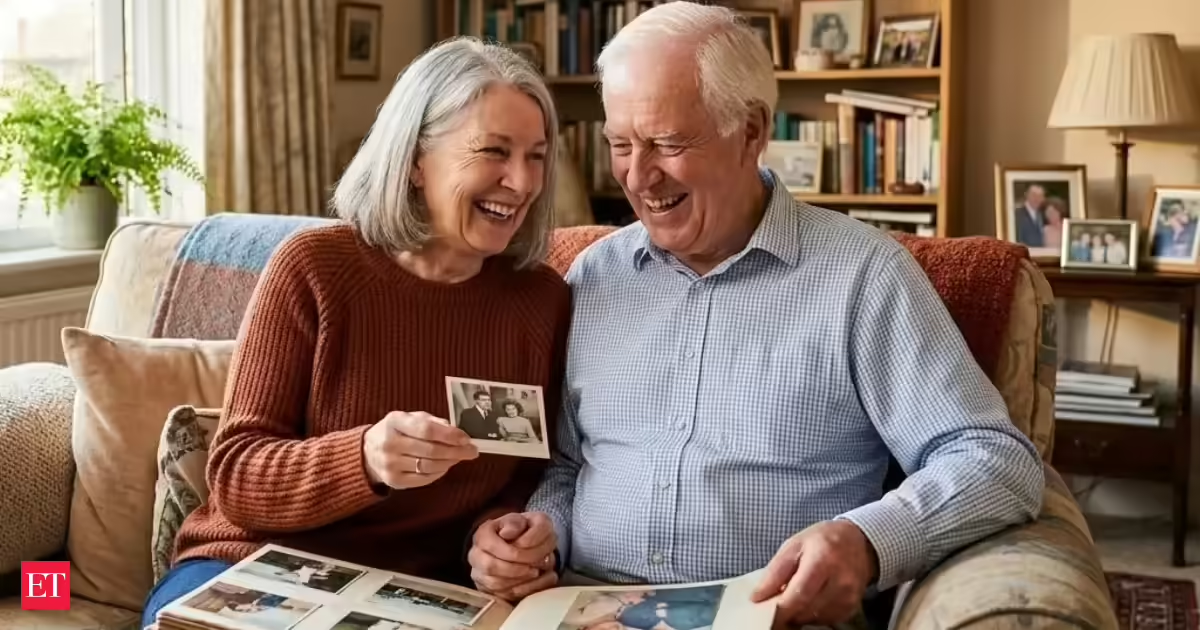
Many people occasionally find themselves scrolling through old text messages, rereading years-old emails, or revisiting conversations they thought they had forgotten. From the outside, this habit can appear nostalgic, sentimental, or even self-indulgent. Psychology offers a different interpretation.Research on autobiographical memory suggests that people do not simply remember the past for entertainment. They often revisit it because memory plays an important role in maintaining a sense of identity across time. Old messages preserve language, emotions, decisions, relationships, and concerns that once shaped everyday life. When people reread them, they are often comparing who they were with who they have becomeThe process can help transform disconnected memories into a more coherent understanding of personal history, making past experiences feel less like isolated moments and more like chapters within a continuous life story.Unlike vague recollections, old conversations contain exact words, timestamps, and context | Pexels Specific memories often reveal more than general onesA paper written by Noboru Matsumoto named “Autobiographical memory retrieval in the context of self-schema updating: Does specific recall have power?” found that retrieving specific autobiographical memories influenced self-schemas more strongly than recalling broad or general memories. This finding is particularly relevant to old text messages and emails because such records are highly specific.Unlike vague recollections, old conversations contain exact words, timestamps, and context. They can transport a person back to a particular moment with surprising clarity. A message sent during a difficult period, a new relationship, or a major life transition often preserves details that ordinary memory has softened or forgotten. Revisiting those details allows people to compare their present perspective with their earlier one, creating opportunities to refine how they understand themselves and their personal history.Identity depends partly on continuityPsychologists use the term self-continuity to describe the feeling that a person remains connected to their past, present, and future selves despite constant change. A 2022 review described self-continuity as one of the foundations of a stable sense of identity. Old digital conversations can support that process because they reveal both change and consistency at the same time. A person may notice differences in confidence, priorities, or communication style while also recognizing familiar patterns that have persisted across years. That combination can be reassuring. It allows people to see that growth does not require abandoning previous versions of themselves. Instead, older and newer selves become parts of the same unfolding story.Re-reading is often a form of meaning-makingAutobiographical memory researchers have long argued that remembering involves more than retrieving information. It also involves interpreting experiences and fitting them into a broader narrative. Reviews published in journals studying autobiographical memory describe this process as central to building a coherent life story. This helps explain why old messages can feel so compelling. A short exchange may represent a friendship, a breakup, a career decision, or a period of personal uncertainty. The words themselves are often less important than what they symbolize. By revisiting these fragments, people can organize events into a sequence that makes greater sense from their current perspective. The process is less about reliving the past and more about understanding how different experiences fit together.Emotional distance changes interpretationOne reason old conversations can feel surprising is that people rarely read them with the same emotional perspective they had when they were written. Research on autobiographical memory and emotional regulation suggests that the meaning of memories often changes as circumstances change. An email that once felt embarrassing may later seem courageous, and a painful conversation may become evidence of resilience rather than failure. The content remains identical, but the interpretation evolves. Revisiting old messages can therefore function as a form of reappraisal, allowing people to reconsider experiences using information and perspective they did not possess at the time. This process often helps transform difficult memories into more balanced and meaningful ones.Digital records preserve details that memory often losesResearchers studying memory consistently note that autobiographical memory is reconstructive rather than photographic. People remember fragments and then rebuild narratives around them, which means many details disappear over time.Old text messages and emails provide unusually rich memory cues because they preserve exact language, chronology, and context. A conversation from several years ago can restore details that would otherwise remain inaccessible. In this sense, digital records function as external memory supports, helping people reconstruct periods of life that might otherwise feel fragmented or incomplete. The result is often a stronger sense of continuity between past and present.People remember fragments and then rebuild narratives around them, which means many details disappear over time | Pexels The habit is often about integration, not nostalgiaIt is easy to assume that rereading old messages means someone is stuck in the past. Research on autobiographical memory suggests a more nuanced interpretation. Reflection frequently serves the purpose of integration rather than retreat.People revisit earlier experiences because they are trying to understand them, place them within a broader narrative, and connect them to their current identity. The goal is often not to remain in the past but to bring the past into a form that makes sense today. By linking different chapters together, individuals create a more coherent understanding of who they are and how they arrived there.People often revisit personal records because they help connect separate moments into a coherent life story. Old conversations preserve details that memory alone may struggle to retain, making them powerful tools for reflection. When people scroll through those messages, they are often doing something surprisingly constructive: examining who they used to be, understanding how they changed, and strengthening the thread that connects past and present into a single continuing self.
If you re-read old text messages or emails you’ve sent, psychology says you’re not being self-absorbed. You may be trying to understand who you used to be, because identity often becomes clearer when the past is revisited with new perspective
It's common for people to explore old messages and emails, creating a bridge to their past experiences. This reflective practice aids in recognizing how they've evolved over time. The digital footprints they leave behind retain moments the mind may forget, weaving a rich tapestry of their ongoing life narrative and anchoring their sense of self.
924 words~4 min read