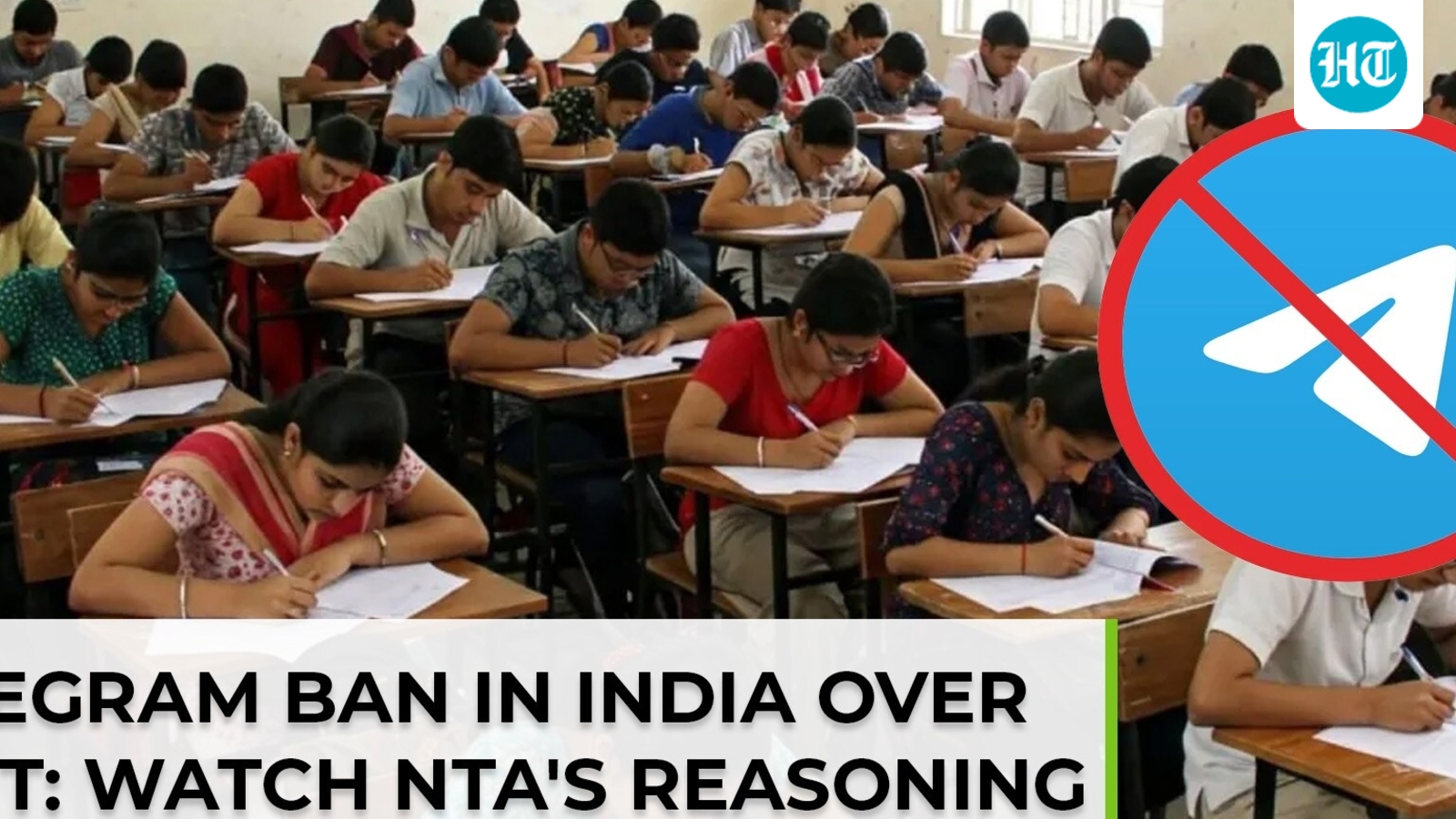
The ban on messaging platform Telegram has triggered mixed reactions. Critics of the move, along with opposition parties, have slammed the government's decision, while the Centre has maintained that the temporary restriction is necessary to ensure the smooth conduct of the re-NEET examination scheduled for June 21.NTA will hold the re-Neet exam on June 21. ((Photo by Santosh Kumar/ Hindustan Times) )To understand the government's rationale, it is important to examine the two directives issued to Telegram following interventions by the National Testing Agency (NTA).The first order suspends access to the platform until June 22, a day after the examination. The second, and arguably more significant, order directs Telegram to disable its message-editing feature until June 30.Also Read | ‘Last resort’: Telegram blocked ahead of NEET retest; Centre cites changing IP address, editing featureExplaining the editing flaw flagged by NTAAccording to the government, this restriction addresses a technical loophole that allows fraudsters to not only conceal manipulation but also create the impression that a question paper was leaked before an examination.The restriction on message editing targets a method that, according to the NTA, has been used to manufacture false evidence of paper leaks.The flaw can make students and parents believe that an examination paper was leaked in advance. Explaining the issue, the NTA said that a channel administrator can post an innocuous message before an examination and later edit it to insert the actual question paper after the exam has concluded. Because Telegram's editing function does not change the original timestamp in the linked discussion group, the altered post appears to have been shared before the examination.“The resulting chat is then circulated as purported evidence that the paper was in circulation before the examination,” NTA said.Also Read | The 'time-travel' flaw that prompted India to block Telegram ahead of NEET-UG retestHow the manipulation worksTo understand the process, consider the following step-by-step sequence:1. A channel administrator creates a public Telegram channel and links it to a discussion group where subscribers can comment. Whenever a document is posted in the main channel, Telegram automatically mirrors the same post in the linked discussion group.2. Days before an examination, the administrator uploads a blank or dummy PDF. The post receives a timestamp — for example, June 18 at 10 am — and the mirrored copy appears in the discussion group with the same timestamp.3. After the examination, when the actual question paper becomes publicly available, the administrator edits the original channel post and replaces the dummy PDF with the real question paper.In the main channel, Telegram displays an "edited" label next to the original timestamp. However, while the updated file is also reflected in the discussion group, the platform does not display the "edited" tag there.4. Fraudsters then lock comments and direct users to view the discussion group version of the post. To a student or parent, the document appears in the chat with a timestamp from before the examination and no indication that it was edited later. This creates the illusion that the paper was leaked in advance, allowing scammers to demand money from families and candidates by claiming to have insider access to examination papers.Duo, who ran 8 such Telegram channels, arrested on fraud chargesHT reported on Monday that Ahmedabad's Cyber Crime Branch arrested two Rajasthan-based men — Sumer Singh, an ITI graduate from Jaipur, and Akash Meena, a BA graduate from Kota — for allegedly operating an inter-state Telegram scam targeting NEET aspirants. Investigators said the duo ran eight Telegram channels with artificially inflated subscriber counts, charged candidates up to ₹49,999 for purported access to question papers, and allegedly laundered nearly ₹1.5 crore through multiple bank accounts.In a separate case, police traced and arrested Bihar resident Navinkumar Yadav for allegedly siphoning off refund payments meant for NEET candidates by redirecting them to his own bank account.According to investigators, Yadav targeted nearly 350 student accounts on the NEET portal across multiple states and successfully gained access to around 150 of them. Police said he exploited weak and easily guessable passwords to breach the accounts. Once inside, he allegedly altered the registered bank account details and replaced them with his own, with the intention of diverting eligible refund amounts into his personal account.
How Telegram’s ‘edited’ feature became a tool for scammers targeting vulnerable NEET students
To understand government's rationale, it is important to examine the two directives issued to Telegram following interventions by the NTA. | India News
700 words~3 min read