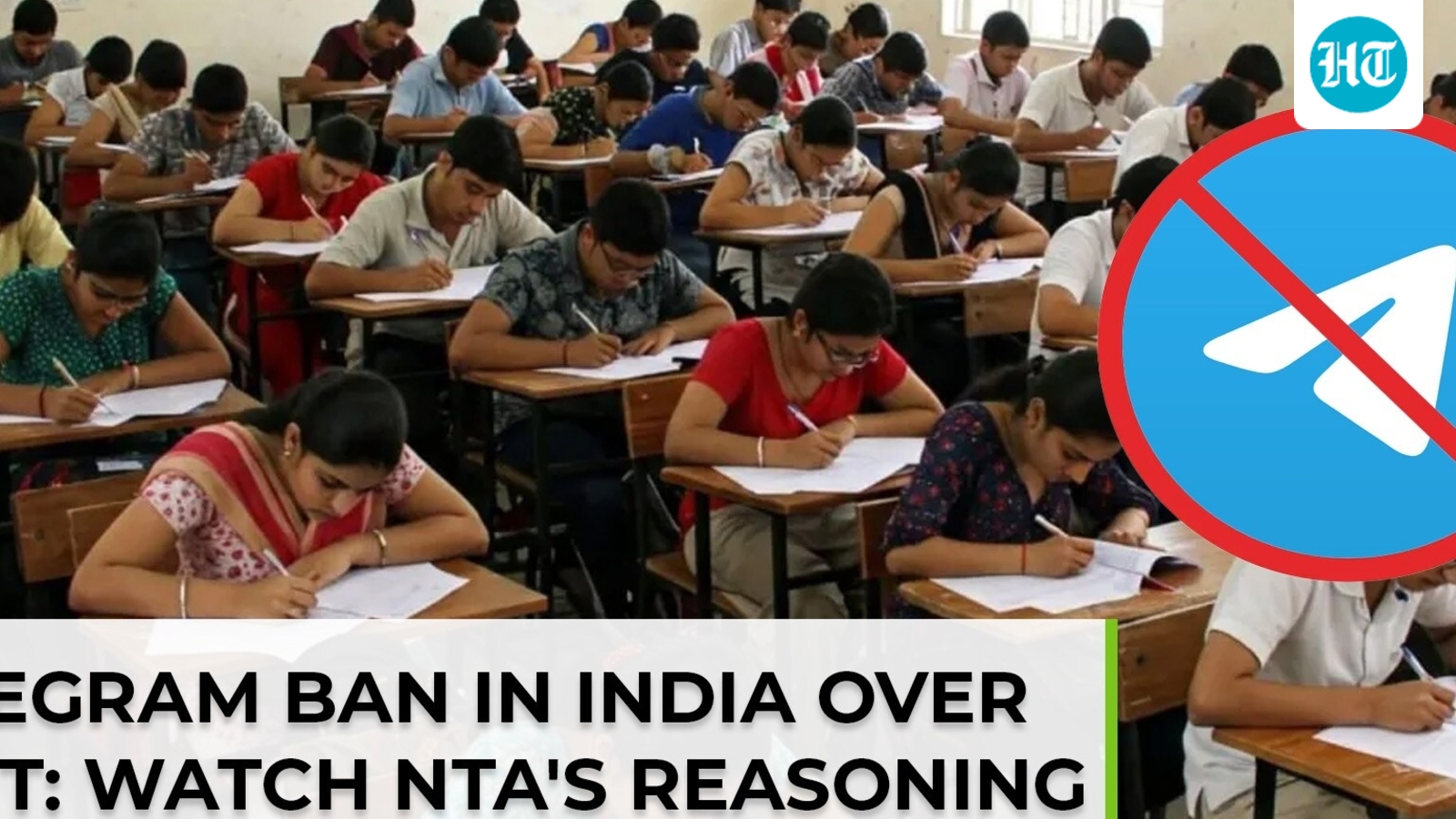
The Centre has blocked Telegram across India until June 22 and ordered the platform to disable its message-editing feature until June 30 — two separate interventions on NTA’s recommendations, the first to disrupt organised fraud ahead of the NEET-UG 2026 re-examination on June 21, the second to prevent the retroactive fabrication of paper-leak evidence.The ministry of electronics and information technology (MeitY) issued both orders under Section 69A of the Information Technology Act. (Reuters/Representative)The editing-feature restriction addresses a technique NTA, in a statement describing the orders, said had been used to manufacture false proof of advance leaks. A channel administrator posts an innocuous message before an examination, then edits it after the exam to insert the actual question paper — Telegram’s editing function does not alter the message’s original timestamp, making the doctored post appear to have predated the examination. “The resulting chat is then circulated as purported evidence that the paper was in circulation before the examination,” NTA said.ALSO READ | ‘Leaks moved to other apps’: Telegram CEO Pavel Durov criticises temporary ban ahead of NEET-UG re-examThe ministry of electronics and information technology (MeitY) issued both orders under Section 69A of the Information Technology Act. A MeitY official, who asked not to be named, confirmed the orders exist and that a copy had been shared with NTA, but said they were not publicly available — directions under Section 69A are treated as confidential under blocking rules.‘Cat and mouse chase’According to people aware of the matter, Apple and Google received directives from MeitY to remove Telegram from their respective app stores in India, while several major ISPs enforced blocks that prevented the application from establishing connection. Telecom operators were also receiving batches of IP addresses to block from the government. “The catch is that Telegram can also change its IP address. When that happens, the government then sends us the latest IP addresses to block. So it’s like a cat and mouse chase,” said an executive of a major telecom company.Calling the access block a “last resort”, NTA said Telegram channels advertising themselves under names such as “PAPER LEAKED NEET”, “Re-NEET 2026”, “Private Mafia” and “REE NEET MAFIAA” had demanded ₹14,000 to ₹25,000 — and in some cases ₹10 lakh — from candidates and their families for purported access to the question paper.The agency said no question paper existed outside the secured examination chain.The June 21 re-examination follows the cancellation of the original NEET-UG held on May 3, called off on May 12 following allegations of a paper leak, including purported overlaps between a pre-circulated guess paper and the actual paper. More than 2.27 million candidates had appeared for the May 3 examination.ALSO READ | Lakhs demanded for paper, fake proof clips: NTA exposes Telegram racket ahead of NEET re-examThe Central Bureau of Investigation (CBI) is probing the leak and has arrested 13 persons, all currently in judicial custody.The access block follows weeks of coordinated action by the Indian Cyber Crime Coordination Centre (I4C), working with NTA and police in Bihar, Gujarat and Rajasthan, which had secured the removal of several Telegram channels and bots spreading misinformation and running fraud operations.‘Ban hasn’t stopped anything': Telegram CEO reacts“India’s IT ministry banned Telegram for one week because some users shared leaked exam questions. This punishes 150M+ ordinary Telegram users in India — not the insiders who leaked the exam materials. And the ban hasn’t stopped anything. The leaks just moved to other apps,” said Pavel Durov, the founder and chief executive of Telegram, in a post on X.Durov later added: “We’re also making the “edited” label more visible to prevent backdating scams.”HT on Monday reported that Ahmedabad’s Cyber Crime Branch arrested Sumer Singh, an ITI graduate from Jaipur, and Akash Meena, a BA graduate from Kota, for running an inter-state Telegram racket targeting NEET candidates. The two managed eight channels with artificially inflated memberships, charged up to ₹49,999 for purported question papers, and are alleged to have laundered approximately ₹1.5 crore through multiple accounts.NTA director general Abhishek Singh said the agency sought the block because Telegram was “continuously being misused by scamsters and fraudsters” circulating fake papers as genuine and exploiting candidates’ anxiety. Despite the removal of around 200 channels, he said, fraudsters had continued to emerge.Dhruv Garg, partner at policy advisory Indian Governance & Policy Project, raised proportionality concerns.ALSO READ | 'Band aid solution': Telegram curb ahead of NEET re-exam sparks mixed reactions“Restricting access to Telegram affects many ordinary users — students, coaching groups, teachers, professionals, journalists, small businesses — who have nothing to do with the misconduct. The harder question is whether a platform-level restriction is the least intrusive way to address a particular pattern of misuse.”He added that if Telegram was being singled out, “the justification should be Telegram-specific”, resting on particular channels, platform design features or a pattern of non-compliance that made narrower action inadequate.To be sure, Telegram remains accessible through VPNs. NTA DG Singh said that even if channels continued to operate from outside India, removing the domestic audience would protect students from losing money to fraud.This is not the first time Telegram has been under the spotlight for content on its service. In March, the Ministry of Information and Broadcasting directed Telegram under Section 79(3)(b) of the IT Act to remove more than 3,000 channels distributing pirated content within three hours. Tuesday’s orders, issued under Section 69A, cover the entire platform.MeitY and I4C did not respond to HT’s queries.
‘Last resort’: Telegram blocked ahead of NEET retest; Centre cites changing IP address, editing feature
The editing-feature restriction addresses a technique NTA, in a statement describing the orders, said had been used to manufacture false proof of advance leaks. | India News
902 words~4 min read