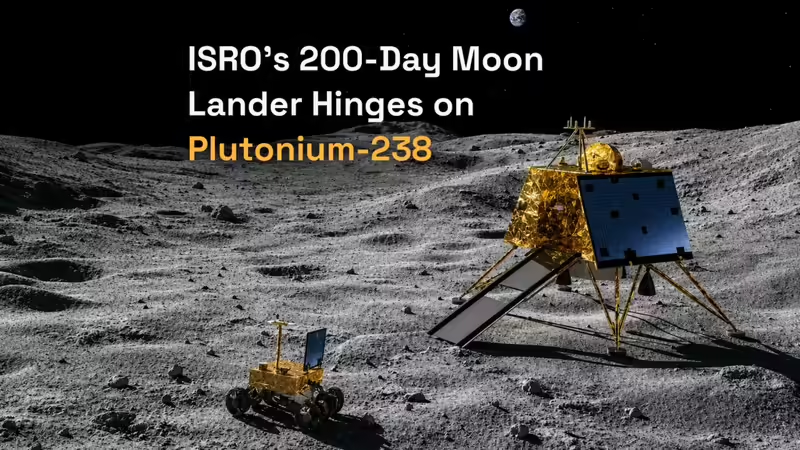
In August 2023, when Chandrayaan-3's propulsion module separated and stayed up in lunar orbit, it carried two small metal cylinders that drew little notice at the time. Each held a few grams of plutonium-238. Each gave off about a watt of heat, the warmth of a sleeping mouse, and kept doing it as the spacecraft swung around the Moon. India's atomic-energy establishment had built them. They worked. ISRO logged the result and left it at that — the first nuclear material the country had ever flown in space, treated as a footnote.Three years on, that quiet experiment has a sequel with an ambition bolted to it. The 200-day lander ISRO Chairman V. Narayanan described in Bengaluru on 13 June is that experiment scaled up. Strip away the careful phrasing — "artificial heaters", built with the Department of Atomic Energy — and what remains is radioisotope heating, the same physics, sized for a machine meant to outlast a dozen lunar nights rather than a single one. The engineering, India has shown it can do. The fuel is the question. Plutonium-238 ranks among the scarcest manufactured substances on Earth, made at scale by two countries, and India is the third hoping to join them.Key TakeawaysISRO and the Department of Atomic Energy (DAE) are developing radioisotope heaters to let lunar landers survive 100 to 200 days, against Chandrayaan-3's roughly 14. Narayanan stopped at the words "artificial heaters"; the DAE link makes the nuclear reading near-certain.India has already flown the technology. Two DAE-built radioisotope heater units (RHUs) rode the Chandrayaan-3 propulsion module in 2023 as a trial, and performed.The bottleneck is fuel. Plutonium-238, the heat source, is produced at scale only by the United States and Russia. India has made it in pellet quantities.Plutonium-238 is a heat isotope, separate from the weapons isotope plutonium-239. India's bomb-grade stockpile delivers zero benefit to the lunar effort.China has fielded this since 2013. Its Chang'e landers and Yutu rovers have survived lunar nights on radioisotope heat for over a decade. India begins the climb now.The two weeks that freeze everythingThe Moon keeps slow time. A lunar day runs about 14 Earth days, and the night that follows runs just as long. Vikram, the Chandrayaan-3 lander, drew its power from sunlight, so when the Sun set over the south pole the machine faced a fortnight of dark with a battery emptying into it. ISRO put the night temperature at minus 129 degrees Celsius. The polar reality runs colder — equatorial lunar night drops past minus 170, and the permanently shadowed crater floors India covets for their water ice sit colder still.Picture a car left out through a Ladakh winter, except the winter lasts two weeks and the nearest garage is 384,000 kilometres away. Lubricants stiffen. Solder joints contract until they crack. A lithium cell at minus 150 holds a charge of roughly zero, and the electronics it was meant to wake stay cold. Vikram was built for one lunar day and got one. When the Sun returned, ISRO listened for the lander. The lander stayed silent.That silence is the whole problem the heater programme exists to solve. Keep a small box around the brain and the battery warm enough through the dark, drawing barely any power, and the machine that went to sleep can open its eyes again at dawn. Do it for fifteen dawns and a fortnight visitor becomes a season-long resident.What is an "artificial heater", and why does it need the atomic energy department?A radioisotope heater unit is a simple object: a sealed pellet, a tough casing, and heat that arrives on its own. A pellet of plutonium-238 oxide about the size of a pencil eraser sits inside a shell of platinum-rhodium and graphite, and as the plutonium decays it throws off warmth — close to a watt per unit, for decades, on demand or otherwise. Bolt enough of them around the cold-sensitive parts of a lander and you have a thermal system with the reliability of a brick. NASA has flown them since Apollo 11.The bigger sibling is the radioisotope thermoelectric generator, the RTG, which adds one trick. It runs the decay heat across a thermocouple to make electricity, the same Seebeck effect that feeds the temperature gauge in an engine bay. Heaters keep the patient warm; an RTG keeps the lights on as well. India's RTG work at the Bhabha Atomic Research Centre (BARC) sits at lab scale for now, modelled on the proven plutonium-238 designs.When Narayanan told the CSIR-RISE Conclave that ISRO and the DAE would "develop artificial heaters", he stopped short of the word nuclear. The decode takes little stretching. The Department of Atomic Energy makes exactly one thing a spacecraft has any use for, and it is radioactive heat. The same department built the two units that flew on Chandrayaan-3. Read the sentence with that history attached and the "artificial heater" becomes what it is — a radioisotope heater, scaled from a two-unit science demo to a system meant to carry a lander through ten or fifteen nights instead of none. Narayanan added the condition out loud: succeed at this, he said, and landers could last 100 to 200 days rather than 14.DeviceWhat it doesOutputFuelIndia's statusRadioisotope heater unit (RHU)Keeps components warm through the lunar nightAbout 1 watt of heat per unitPlutonium-238Two flown on Chandrayaan-3 (2023), trialRadioisotope thermoelectric generator (RTG)Heat plus electricity to run the landerTens to hundreds of wattsPlutonium-238Lab-scale prototypes at BARCThe fuel only two countries makeHere the project meets its wall, and cleverness has little to say about it. Plutonium-238 exists only where someone manufactures it, in reactors and separation lines that a handful of national laboratories have ever operated. The United States halted production in 1988 and restarted in 2015, and even now turns it out by the gram, working toward a target near 1.5 kilograms a year. Russia makes it. That pair is the supply side of the entire planet.One clarification earns its place, because the word plutonium does a lot of frightening work it has not come by honestly in this case. The isotope that heats spacecraft, plutonium-238, is a different material from plutonium-239, the one that goes into weapons. India holds hundreds of kilograms of weapons-grade plutonium. The lander wants the other isotope, and that stockpile sits on the wrong side of the problem. India has so far made plutonium-238 in pellet counts — enough for two heaters and a trial.The open question is whether the DAE can lift that from pellet quantities to the kilograms a lander fleet would draw on. A 200-day lander asks for more heaters, perhaps a generator, which means more material. The distance between "we made two" and "we run a steady supply" is the distance between a science demo and a programme. NASA spent years rationing missions against this exact substance, its scientists choosing destinations around how much fuel the stockpile could spare. India starts that climb from the smallest foothold there is.China has held this line since 2013While India flew its two-heater trial in 2023, China had already spent a decade keeping machines alive through the long lunar dark. Chang'e-3 set down in 2013 carrying plutonium-238 heaters and a radioisotope generator; when night fell its lander powered down, held its electronics near minus 40 on radioisotope warmth, and woke when the Sun came back. The Yutu rover ran the same drill. Five years on, Chang'e-4 reached the far side, terrain that had defeated every craft before it, and its generator has carried it through one lunar night after another since 2019.Picture two houses on the same frozen frontier. One has manned the wall through every winter for ten years — fuel stocked, garrison drilled, the routine of survival worn smooth. The other has just proved it can light a single fire and keep it going one night. That gap is the honest measure between China's lunar-night record and India's, and a clear-eyed reading of it serves better than flattery. India leads on other counts. Chandrayaan-3 put the country first onto the south-polar ground, a soft landing China has yet to match in that exact terrain. The shortfall is narrow and specific: the ability to keep a machine thinking through the cold. On that one capability, China holds a ten-year start.CapabilityChinaIndiaFirst radioisotope heat on the MoonChang'e-3, 2013 (RHUs plus an RTG)Two trial RHUs on Chandrayaan-3, 2023Surviving lunar nightsYutu rovers and Chang'e-4 generator, many nights since 2013 and 2019Goal stage; no lander has survived a night yetLander revived after the nightDemonstrated (Chang'e-3 woke after hibernation)Vikram attempted a wake-up; it stayed silentWhat 200 days buysA lander that survives the night stops being a fortnight tourist and turns resident. That shift changes what India can attempt next, and the campaign past Chandrayaan-3 is already drawn up and dated. Chandrayaan-4, cleared by the Union Cabinet at Rs 2,104 crore and aimed at roughly 2027-28, will fly a lunar sample back to Earth through a sequence of orbital dockings only China has so far achieved. Chandrayaan-5, the LUPEX mission run with Japan's space agency and approved on 10 March 2025, sends an ISRO lander and a JAXA rover to drill the south-polar ice — and ISRO has cast it as the mission to prove lunar-night survival for the longer work that comes after.Beyond those sit the markers India's leadership keeps repeating: the Bharatiya Antariksh Station by 2035, an Indian crew on the Moon by 2040. Each of them rests on holding through the dark. A space station and a crewed landing demand more than a single shift; they assume hardware that lives through the cold and keeps its watch. The heater programme is the armourer's work behind the banners — the forging that has to finish before any house marches on the throne it keeps announcing for the end of the next decade.MissionTimingWhy night-survival mattersChandrayaan-4 (sample return)~2027-28, Rs 2,104 croreLonger surface operations want the lander to outlast a nightChandrayaan-5 / LUPEX (ISRO-JAXA)~2027-29ISRO's named demonstrator for lunar-night survivalBharatiya Antariksh StationBy 2035Sustained operations as the baselineCrewed Indian Moon landingBy 2040Long-duration surface presence depends on it entirelyHeaters were one item on a longer listNarayanan's Bengaluru address ranged well past the Moon. He set out 40 areas of work with the Council of Scientific and Industrial Research, 17 already cleared for a first phase, and pointed to the biology India ran on the International Space Station in 2025, when Group Captain Shubhanshu Shukla flew the Axiom-4 mission as the first Indian aboard the station and the second Indian in space since 1984. Shukla spent about 18 days in orbit and completed seven ISRO experiments designed with the Department of Biotechnology — work on muscle loss, on sprouting methi and moong, on microalgae as a food crop.The muscle study, myogenesis, traces the molecular path by which bodies waste in microgravity, and its payoff points back to Earth as much as outward: therapies for the muscle loss of ageing and immobility. The microalgae work tests a food and life-support source for missions long enough to need one. Threaded together, the announcements share a spine — keeping a living or thinking thing working far from home, for longer than any Indian effort has managed before. The heater is that same problem wearing a thermal jacket.Strip away the 2040 banner and the partnership list, and one number decides whether any of it flies: how much plutonium-238 the Department of Atomic Energy can make in a year. Two heaters rode to the Moon in 2023 on a pellet apiece. A fleet of long-night landers, each carrying more, some carrying generators, runs on kilograms the country still has to prove it can produce. ISRO has shown the heater works. The harder demonstration belongs to the atomic-energy establishment, in a building closed to cameras, and it will be counted in grams per year long before it is counted in days on the Moon.Frequently asked questionsWhat is ISRO's plan to keep lunar landers alive for 200 days?ISRO, working with the Department of Atomic Energy, is developing radioisotope heaters that keep a lander's electronics warm through the two-week lunar night, when solar power vanishes and temperatures crash. Chairman V. Narayanan said in June 2026 that success would extend lander life from about 14 days to between 100 and 200. The approach matches what the United States, Russia and China already fly.Did Chandrayaan-3 use nuclear power?In a limited way, yes. Chandrayaan-3's propulsion module carried two radioisotope heater units built by India's Department of Atomic Energy, each using a few grams of plutonium-238, flown in 2023 as a trial that worked. The Vikram lander itself ran on solar power, which is why it lasted a single lunar day.What is the difference between plutonium-238 and plutonium-239?Plutonium-238 is a heat source: it decays quickly and gives off warmth, which makes it ideal for space heaters and generators and useless for a bomb. Plutonium-239 is the weapons isotope. A country can hold a large stockpile of one and almost none of the other, which is India's exact position.How does China keep its Moon landers alive through the lunar night?China has used plutonium-238 heaters and radioisotope generators since the Chang'e-3 lander and Yutu rover in 2013, holding their electronics near minus 40 degrees Celsius through the night and reviving them at dawn. Chang'e-4 has run a radioisotope generator on the lunar far side since 2019. The record gives China roughly a ten-year lead on lunar-night survival.When is India's next Moon mission?Chandrayaan-4, a sample-return mission cleared at Rs 2,104 crore, targets roughly 2027-28. Chandrayaan-5, the LUPEX mission flown with Japan and approved in March 2025, follows around 2027-29 to drill for water ice at the south pole, and ISRO has named it as the mission to demonstrate lunar-night survival.end of article
Can ISRO Overcome Its Plutonium-238 Bottleneck to Enable Long-Duration Lunar Lander Survival?
India is advancing its lunar exploration capabilities by developing radioisotope heaters. These devices will allow landers to survive the harsh lunar nights, extending their operational life significantly. This technology, powered by plutonium-238, is crucial for future missions like sample return and crewed landings. India's atomic energy establishment faces the challenge of scaling up fuel production to meet these ambitious goals.
2,275 words~10 min read