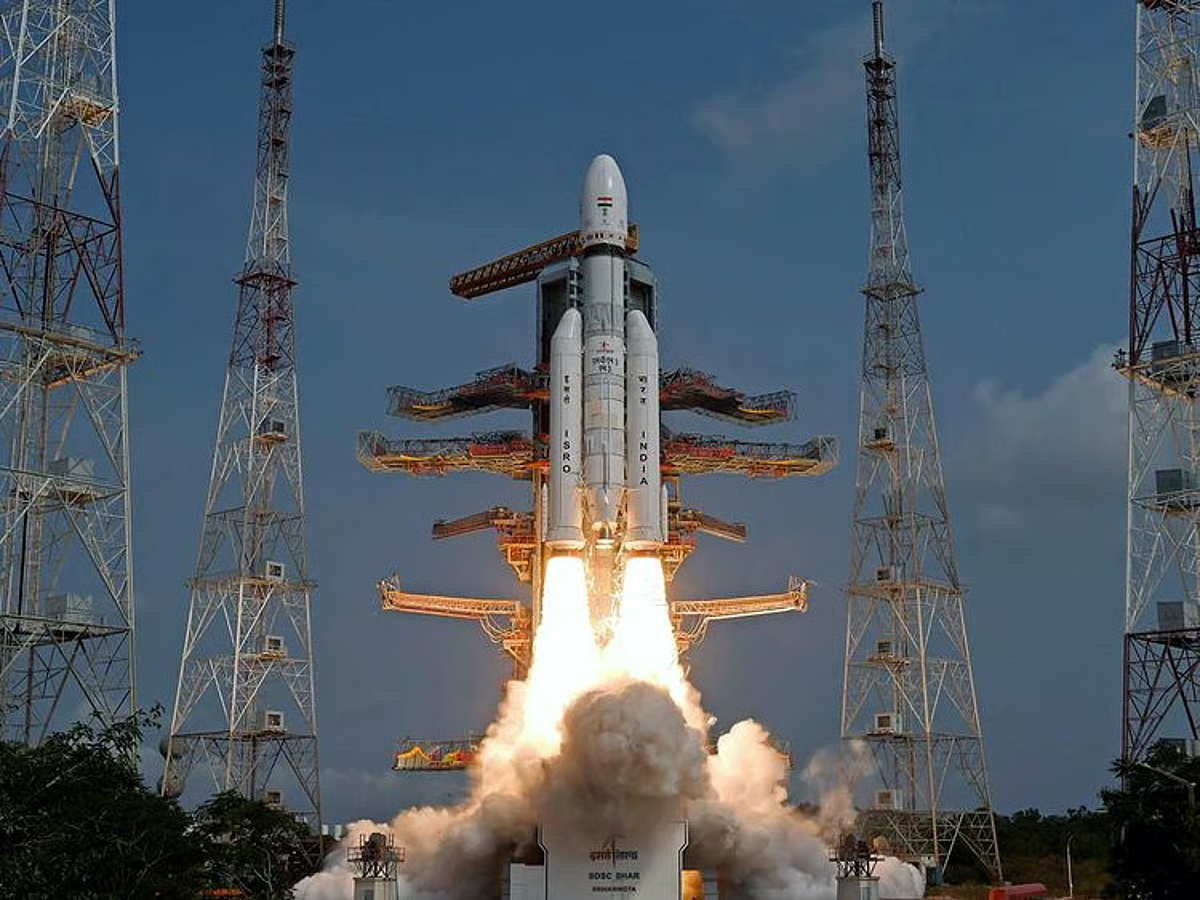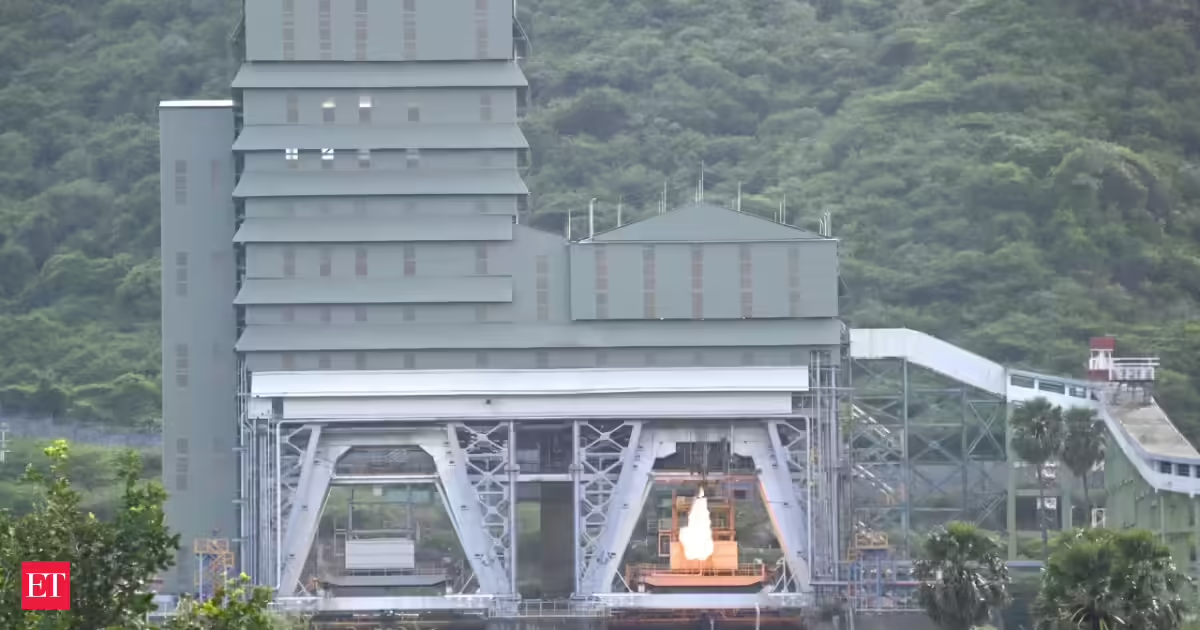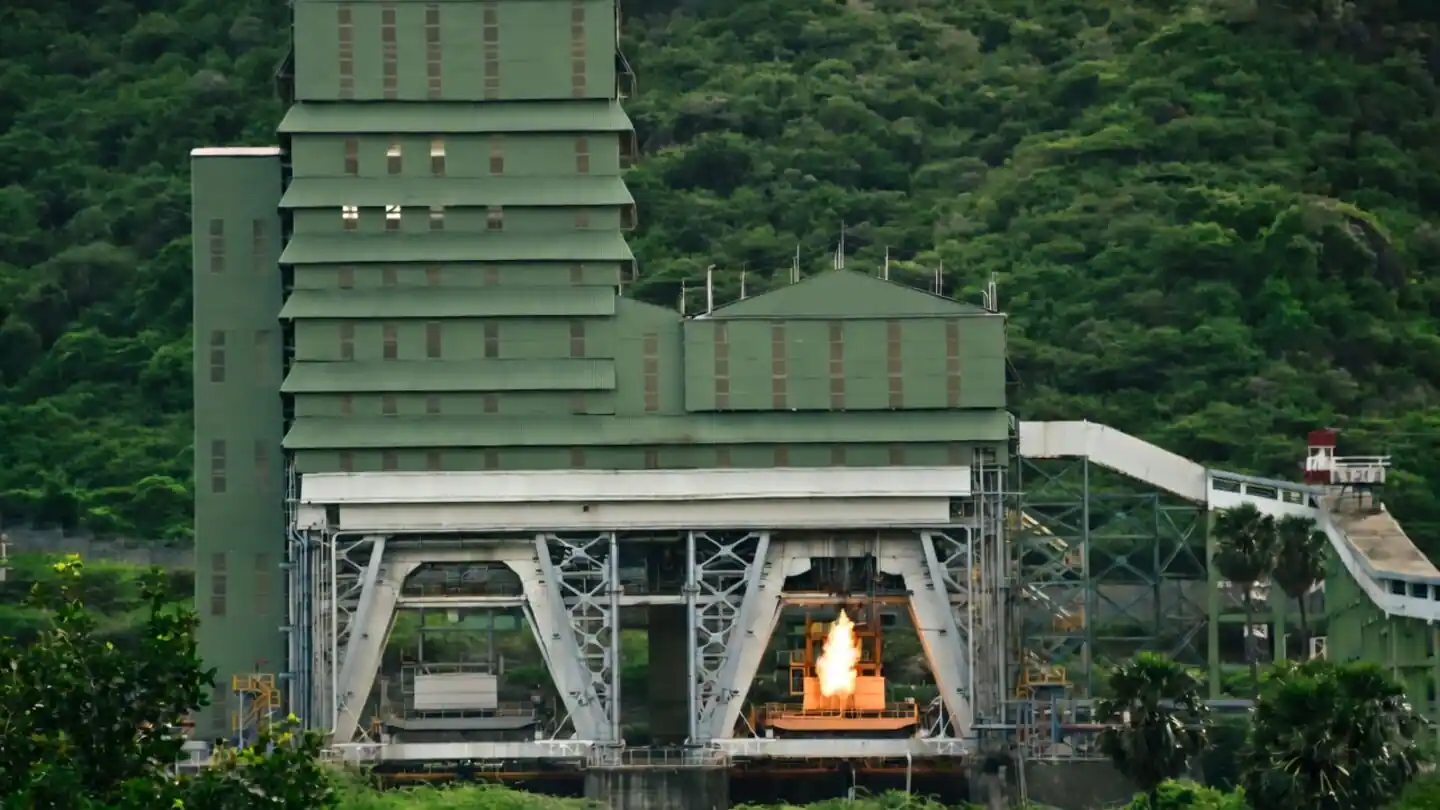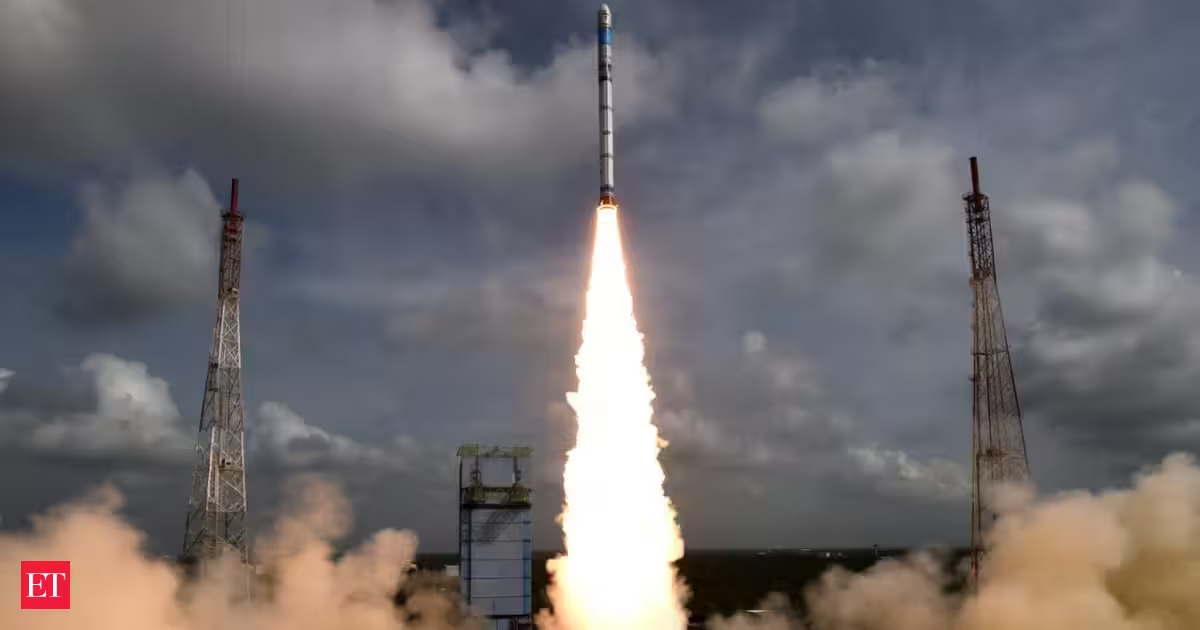
The semi-cryogenic breakthrough is a prelude to India’s ambitions well beyond Gaganyaan On June 24, at the Indian Space Research Organisation (ISRO) Propulsion Complex in Mahendragiri, Tamil Nadu, an engine roared to life, for barely a few seconds. In those seconds lay years of patient, unglamorous engineering that will shape the next two decades of India’s journey into space. ISRO successfully hot-tested its indigenous semi-cryogenic engine at 175 tonnes of thrust. It was the most powerful such firing yet, the eighth in a series that has been building steadily in thrust since March 2025. It was at 88% of the target demonstration of steady-state performance of the engine powerhead at 200 tonnes. Steady state performance refers to how the engine functions once it is at a constant throttle, speed, and load — this evaluates stability, fuel consumption and output under steady conditions.A domestically designed semi-cryogenic engine shows that India’s propulsion science has matured — engine by engine, test by test — to match the demands of an ambitious exploration programme for decades to come. (Shutterstock)ISRO has rightly hailed this as a major milestone. To the casual observer, a few seconds of fire and smoke over a test stand may seem unremarkable compared to the drama of a rocket launch. Yet, this apparently inconspicuous event brings India appreciably closer to a propulsion capability that only a handful of nations possess, and one that will underwrite everything from Gaganyaan’s follow-on missions to India’s own space station and, eventually, journeys beyond Earth orbit.What exactly is a semi-cryogenic engine, and why does it matter? Most of ISRO’s workhorse engines burn storable propellants such as unsymmetrical dimethylhydrazine (UDMH)-based fuels used in the Vikas engine that powers the second stage of ISRO’s PSLV and GSLV. The other, more recent alternatives have been fully cryogenic combinations such as liquid hydrogen and liquid oxygen, which power the upper stage of the Launch Vehicle Mark-3 (LVM3). A semi-cryogenic engine lies in between: It burns refined kerosene, similar to aviation turbine fuel, together with the more eco-friendly liquid oxygen, which must be stored at extremely low temperatures. This combination is denser and easier to handle than liquid hydrogen, allows for more compact tankage, and, crucially, delivers a higher thrust for a given engine size. The engine under development, called SE-2000, uses what is called an oxidiser-rich staged combustion cycle, a highly efficient but technically demanding design that only Russia, the US, and China have mastered at this scale.Also Read | SpaceX Falcon lands on legs, China's on a net — how will Isro's reusable rocket come home?What made this test significant was not the full engine, but a critical subsystem called the Power Head Test Article, which includes everything except the thrust chamber: The turbopumps that feed propellant at enormous pressure, the pre-burner, the ignition system, and the associated control components. Getting this “power head” to start up smoothly, build thrust in a controlled sequence, and sustain stable operation is one of the hardest parts of engine development, since turbopump and combustion instabilities have historically doomed rocket engine programmes worldwide. This was the eighth hot-test in the series, following earlier firings at 47% and 60% of rated thrust. Reaching 88%, with stable and controlled performance throughout, tells ISRO’s propulsion engineers at the Liquid Propulsion Systems Centre that the design is sound and ready to be pushed towards its full 200-tonne capability.This result should be read as a licence to proceed, not as the finishing line. ISRO has indicated that it now has the confidence to attempt a full-thrust demonstration of the complete engine, integrating the thrust chamber with the power head. The Semi- Cryogenic Propulsion Stage, called SC120, that will eventually house this engine is intended to replace the L110 liquid stage that currently powers the LVM3, India’s heaviest operational launch vehicle. The upgraded configuration, working alongside an uprated CE20 cryogenic upper stage, is expected to meaningfully boost the LVM3’s payload capacity to geostationary transfer orbit. ISRO is targeting the first flight of this upgraded LVM3 for as early as 2027, an ambitious but not unreasonable timeline given the pace of testing over the past year.Prime Minister Narendra Modi hands-over wings to astronauts-designate Shubanshu Shukla, Prashanth Balakrishnan Nair, Angad Prathap and Ajit Krishnan who have been selected to be the astronauts on India’s first crewed mission to space 'Gaganyaan Mission', at the Vikram Sarabhai Space Centre (VSSC), in Thiruvananthapuram. (PTI) (HT_PRINT)Why should this matter to a programme like Gaganyaan, whose immediate goal is simply to put three Indians into low Earth orbit and bring them home safely? The answer lies in what comes after. Human spaceflight cannot afford any shortfall in margins. A crew module, its life support systems, consumables, escape systems, and the additional structural mass needed to keep astronauts safe, all add up quickly, eating into the payload that a rocket can actually lift. The LVM3 that carries India’s first gaganyatris this decade is already human-rated, and sufficiently powerful for that specific mission. But, flights after the initial Gaganyaan mission will demand considerably more lift capacity, sending heavier and better-equipped crew and service modules, and eventually supporting longer-duration missions that carry more fuel, more shielding, and more redundancy. Advanced propulsion is not a luxury for a mature human spaceflight programme; it is the foundation upon which everything else, including the crucial ingredient of safety, is built.This is where the semi-cryogenic breakthrough is a prelude to India’s ambitions well beyond Gaganyaan. ISRO’s roadmap envisages the Bharatiya Antariksh Station, with its first module targeted for launch by 2028 and the full station operational by 2035, followed by a crewed lunar mission by 2040. It will have to be carried up in modular pieces and assembled in orbit. None of this is achievable with today’s launch vehicles alone. ISRO’s Next Generation Launch Vehicle, still on the drawing board, is designed around a cluster of five SCE-200 semi-cryogenic engines powering a single core stage carrying some 400 tonnes of propellant, a configuration that would place India in the league of nations capable of heavy-lift, and eventually super-heavy-lift, launches.The semi-cryogenic engine tested last week at Mahendragiri is a fundamental building block for that entire future architecture. It is also the kind of propulsion technology that will eventually carry heavier communication satellites, interplanetary probes, and space station modules, quietly expanding what Indian industry and science can attempt in orbit and beyond.There is a broader point about how technological maturity accumulates. Chandrayaan and Mangalyaan showed that India could navigate deep space with precision and frugality. Gaganyaan will show that India can safeguard human life in the harshest of environments. A domestically designed, staged-combustion, semi-cryogenic engine now shows that India’s propulsion science has matured, engine by engine, test by test, to match the demands of an ambitious exploration programme for decades to come. Each such capability, once acquired, does not stay confined to a single mission. It becomes part of the permanent toolkit available to Indian scientists and engineers.A few seconds of fire on a test-stand in Tamil Nadu would hardly make for dramatic television. But such moments are how spacefaring nations are actually built — with patience and in measured steps, long before an astronaut boards a spacecraft. As ISRO now turns towards a full-thrust firing of this engine, it is worth remembering that the road to the Bharatiya Antariksh Station, and eventually to the Moon and beyond, runs directly through test stands like this one.Somak Raychaudhury is vice-chancellor and professor of physics, Ashoka University. The views expressed are personal
Road to Bharatiya Antariksh Station, Moon and beyond: ISRO shows how tech maturity accumulates
The semi-cryogenic breakthrough is a prelude to India’s ambitions well beyond Gaganyaan
1,245 words~6 min read