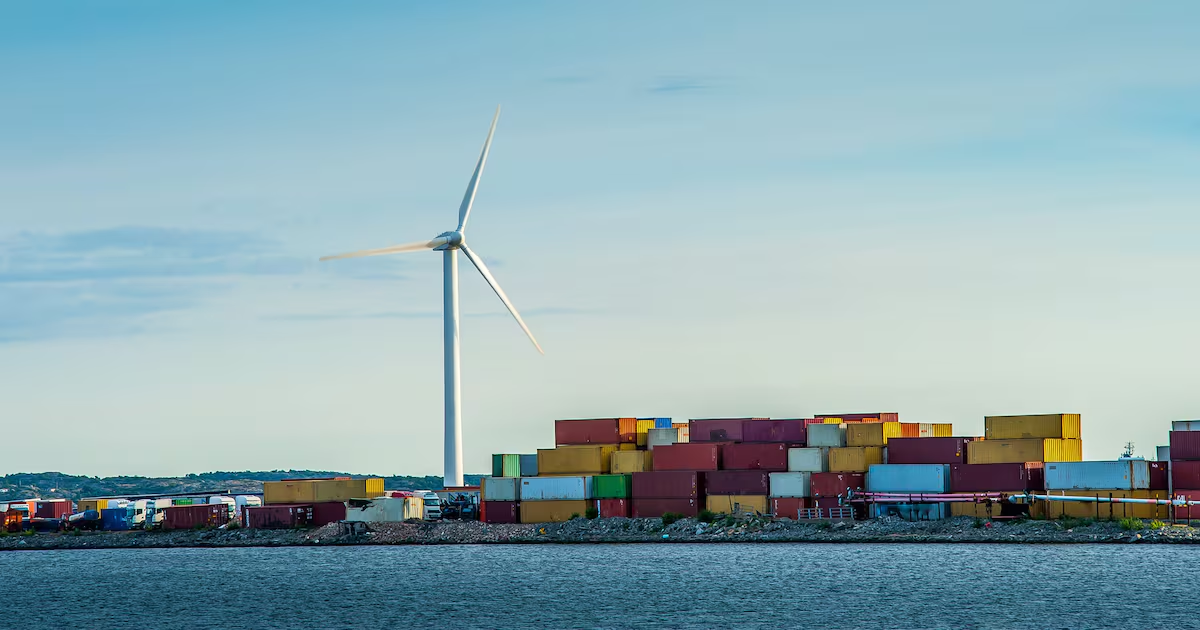
Africa’s renewable energy transition is most often framed in terms of capital: how much has been committed, how much more is needed, and what financing structures might bridge the gap. That framing captures only part of the picture. What it leaves out is the operational reality that follows financial commitment. Capital secures a development, but execution determines whether energy is actually delivered.About the author: Niron Rampersad is divisional executive of Trade at Nedbank Corporate and Investment Banking (Nedbank) Between financial close and first generation lies a demanding execution sequence that receives far less scrutiny than the capital mobilisation that precedes it. Equipment must be manufactured to order, exported from supplier countries, insured at multiple points in transit, cleared through customs, and delivered to the site in line with construction schedules that allow little tolerance for slippage. Each stage compounds the one before it. Most developers know this but few structure their financing around it.Imported components, local constraintsRecent disruptions to maritime corridors, notably along the Red Sea and Suez route and at the Strait of Hormuz, have made this harder still, driving freight rates higher, tightening insurance terms, constraining vessel availability, and extending lead times for cross-border cargo. The immediate pressure falls on hydrocarbon markets, but renewable energy equipment moves through the same congested ports and elevated-cost logistics networks.A fully funded development can still face material delay when its components cannot be sourced, cleared, or delivered on schedule. Across Africa, where port infrastructure and customs procedures vary considerably, and freight connectivity between corridors is uneven, this is not a contingency risk. It is the operating environment. The supplier base feeding these projects is itself shifting, with Chinese and Indian manufacturers now dominant in solar and battery components, and European specialists handling grid technology and engineering. Disruption anywhere in that network lands on an African project site.A delay in a single consignment can suspend an entire construction phase— Niron Rampersad, divisional executive of Trade at Nedbank CIBAfrica’s structural position compounds this exposure. Most renewable energy projects still depend heavily on imported equipment. Continent-wide, the trade finance gap is estimated at around $100bn annually, a structural shortfall that sits directly in the path of any serious transition ambition.Supply chains fracture where logistics, liquidity, and risk converge, and the sequencing of renewable-energy buildouts is particularly unforgiving. Components sourced across multiple jurisdictions must arrive in the correct order for installation to proceed. A delay in a single consignment can suspend an entire construction phase.Equipment manufacturers must fund production well ahead of payment, and contractors carry exposure across transit, warehousing, and installation. Freight operators require settlement assurance before committing capacity in tight markets. When reliable financing terms are unavailable, each party slows its commitments. While rational individually, collectively it stalls the build.The friction extends beyond physical logistics, and this is the part that tends to surprise people. Documentation failures and cross-border compliance requirements introduce execution risk that project planning consistently underweights. A mismatch between a commercial invoice and the terms of a letter of credit can hold a shipment at a port for days, even when the goods are ready to move.Settlement timing misalignments between supplier payment obligations and project disbursement schedules create liquidity gaps that smaller contractors are ill-positioned to carry. In Africa, where banking systems, regulatory frameworks, and trade documentation standards remain uneven, these are not edge cases — they recur. In practice, most clients absorb the disruption quietly and resolve around it. The visibility sits with the suppliers and the banks, not the project sponsors.In a recent renewable-energy project, a weeks-long shipping delay was enough to misalign a client’s letter-of-credit payment obligations, foreign-exchange hedge maturities, and contractor settlement deadlines simultaneously. This exposed the gap between how these instruments are structured and how physical delivery actually unfolds.Trade finance is central, not secondary Trade and supply chain finance can address these constraints directly. Aligning payment obligations with physical delivery milestones gives suppliers, contractors, and logistics operators the certainty to commit to a development’s timeline. The practical effect is that the interval between financial close and commissioning narrows in ways that additional capital alone cannot achieve.Across Africa, long-term transition planning is gaining policy traction. But ambition at that scale depends entirely on the ability to procure, move and install equipment efficiently across borders. Trade finance is foundational to that delivery. Treating it as a secondary consideration misreads where execution risk actually sits.The consequences of getting this right are measurable, as are those of getting it wrong. When renewable energy components move predictably through procurement, shipping, and installation, generation capacity comes online as planned. When trade slows, the effects move quickly downstream.A deferred commissioning date is not a construction footnote. In an energy-constrained economy, the deferral of industrial output and growth compounds with each passing month. Investors, developers, and governments who track megawatts and capital commitments without tracking supply chain performance are measuring the wrong thing.Nedbank Corporate and Investment Banking’s trade business operates at this execution layer, financing the movement of goods, managing cross-border risk, and ensuring that settlement structures support delivery. The work is transactional and less visible than project mandates or capital market activity, yet essential to keeping renewable-energy developments on track.An inclusive energy transition across Africa will depend on the volume of capital mobilised, and equally on the financial infrastructure that converts it into operating assets. Trade and supply chain finance provides that infrastructure. Because ultimately, the success of the energy transition will not be measured by capital raised, but by energy delivered.The 2026 Africa Energy Forum is on in Cape Town from June 16 to 19.This article was sponsored by Nedbank Corporate and Investment Banking.
NIRON RAMPERSAD | The energy transition won’t be measured by capital raised, but by power delivered
SPONSORED | Central to this is trade and supply chain finance, which can help align payment obligations with physical delivery milestones
932 words~4 min read