Scientists have created pseudo-planar heterojunction organic solar cells with one of the highest efficiency scores ever for that structure. To do so, they had to overcome solvent-induced swelling and erosion of the donor. Their solution: a novel interfacial buffering strategy.
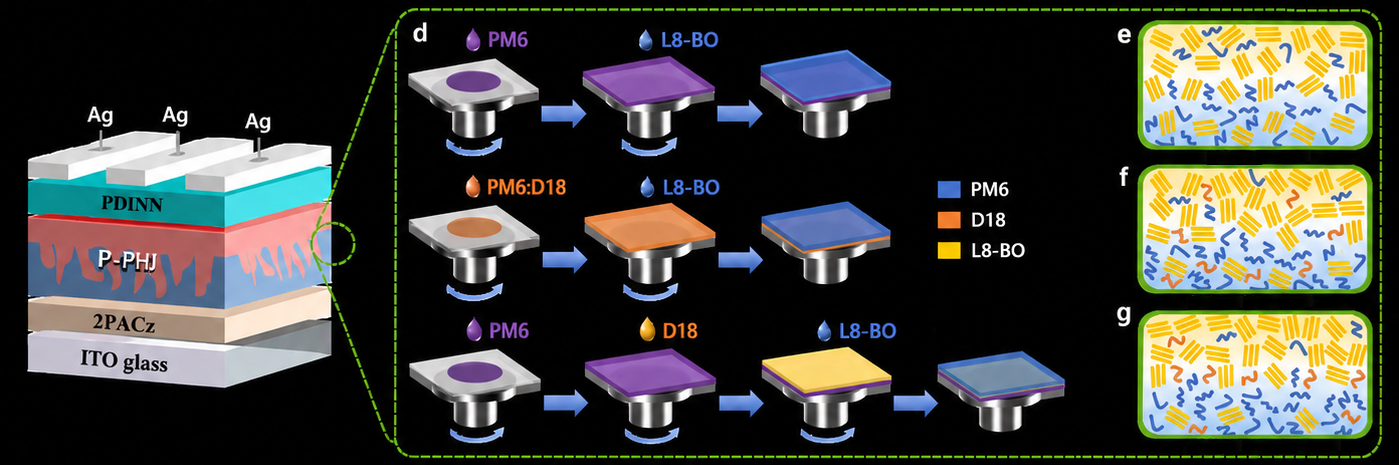
A research team from China has proposed a novel interfacial buffering strategy for pseudo-planar heterojunction (PPHJ) organic solar cells (OSCs), aiming to improve device stability and fabrication reliability. PPHJ architectures, which combine features of both planar and bulk heterojunction designs, are widely used in high-performance OSCs because they enable efficient charge separation while maintaining relatively well-defined donor–acceptor interfaces.
PPHJ cells are typically fabricated via layer-by-layer (LBL) deposition, in which donor and acceptor materials are sequentially deposited. This creates a favorable vertical phase separation that promotes charge transport and exciton dissociation. However, during acceptor deposition, the solvent can swell or partially dissolve the underlying donor layer, causing excessive intermixing, degraded morphology, increased recombination, and reduced device performance. The proposed interfacial buffering strategy introduces a protective layer that minimizes direct solvent–donor interaction, preserving film integrity and enabling more controlled and reproducible interface formation.