Story audio is generated using AI
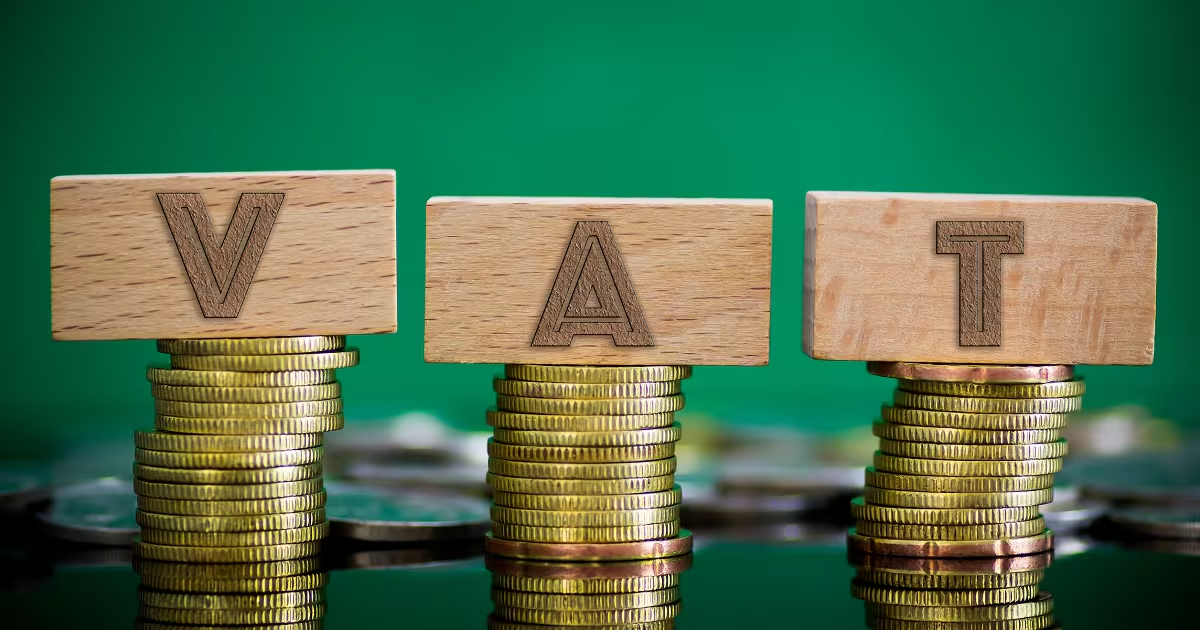
South Africa is lagging behind Organisation for Economic Co-operation and Development (OECD) countries in value-added tax as a percentage of GDP, with an underreported domestic VAT gap averaging 40.6% between 2016 and 2020.This is according to a working paper compiled by Southern Africa — Towards Inclusive Economic Development (SA-TIED), which Business Times has seen.South Africa’s VAT-to-GDP ratio is about 6%-7%, exceeding the average for upper-middle-income and Brics countries of 5%-6%, but falling below the OECD average of 7%-8%.“The consequence is an increase in the overall VAT-to-GDP ratio, but levels remain below the OECD average, mainly due to structural factors, including a narrower tax base due to exemptions and zero ratings, informality in domestic consumption, and reliance on import VAT.”The report comes as VAT as a driver of revenue remains a politically fraught mechanism after finance minister Enoch Godongwana’s 2025 budget had to be redrafted upon the rejection of a VAT hike.In the 2026 budget, Godongwana announced that the compulsory VAT registration threshold for businesses would be raised to R2.3m, while the voluntary threshold increases from R50,000 to R120,000. This aims to reduce administrative burdens on small, medium and micro-enterprises and allow them more cash flow.The SA-TIED working paper was penned by Amina Ebrahim, Ada Jansen, Zoleka Jaxa, Winile Ngobeni and Wynnona Steyn and notes that VAT accounts for about 25% of tax revenue — a significant source.“VAT on capital goods purchased recorded negative average real annual growth, while the total input tax claimed grew on average in 2018 real terms by 4.1% for the period from 2019 to 2022.”The paper notes that VAT as a percentage of GDP peaked at 6.5% in 2006 and slipped to just more than 5% in 2009, but never recovered to 6.5%. VAT in OECD countries and upper-middle-income countries sits at 7% of GDP, while VAT in Brics countries average a notch higher than South Africa, at just under 6.5%.“The net VAT payable averages just 8.2% of the output VAT, and the effective VAT rate is only 0.73% of sales, underscoring the centrality of input deductions and refunds in shaping liabilities.”VAT is an indirect tax that is levied on the final consumption of goods and services, and revenues are raised by requiring vendors to register for VAT payment if their turnover exceeds a determined threshold.“Real annual growth in total sales amounted to 2.9%, on average, for the period from 2019 to 2022, driven by real annual growth in exports of 7.0% and zero-rated sales of 5.8%, with standard sales recording average real annual growth of only 2.0%.“Traders and vendors with annual sales of goods and services exceeding the minimum turnover threshold of R1m are required to register for VAT. Voluntary registration for a business can also occur if its income earned in the last 12-month period exceeds R50,000.”The paper said the average VAT refundable for the period from 2018 to 2022, as a percentage of the total average VAT payable, was 61.7%.“Since tax gap estimates should be continuously calculated and trends monitored, it is necessary to update the VAT gap estimates. Secondly, the research proposed in the present study employs a bottom-up approach to uncover the extent of noncompliance at the disaggregated level to inform compliance risk management.”Efficient Group economist Dawie Roodt told Business Times he did not believe the government should increase revenue and if there is an increase in revenue or any kind of tax collections, then it would have to reduce those specific tax rates as well.“The only potential tax that can bring in additional revenue certainly will be VAT, and increasing the VAT rate is going to be extremely difficult to do. One way of fixing the problem, I think, is to reduce the number of zero-rated items.“And at the same time, sell it politically by saying that you’re going to increase, for example, the various grants. And because that’s where the huge loss of tax revenue is, because it’s also an opportunity for tax evasion and tax fraud, and that’s zero-rated items.”He said compliance needs to be sharpened, but it is still going to be politically very difficult to increase the actual VAT rate.“South Africa is below the OECD countries; there are very, very good reasons for that. We are very much dependent on personal income taxes because of the high levels of inequality in South Africa. And that means that since personal income taxes are high, and corporate taxes are relatively high, some of the other taxes like VAT can be potentially a little bit lower.”Micaela Paschini, team lead for tax legal and Megan Langton, tax attorney at Tax Consulting South Africa, said Godongwana’s 2026 budget was shaped by the need to drive revenue, and VAT remains a dependable lever to achieve it.“With limited economic growth and a stretched tax base, VAT’s stability draws administrative attention over politically costly rate adjustments. This year, the emphasis shifts away from dramatic policy moves towards targeted, enforcement-led refinements.”They wrote that 2025’s flirtation with a VAT rate hike met with political and economic resistance; the staggered plan was signalled, contested, and ultimately reversed before implementation. The South African Revenue Service’s operational guidance acknowledged the reversal and court‑order implications.Business Times