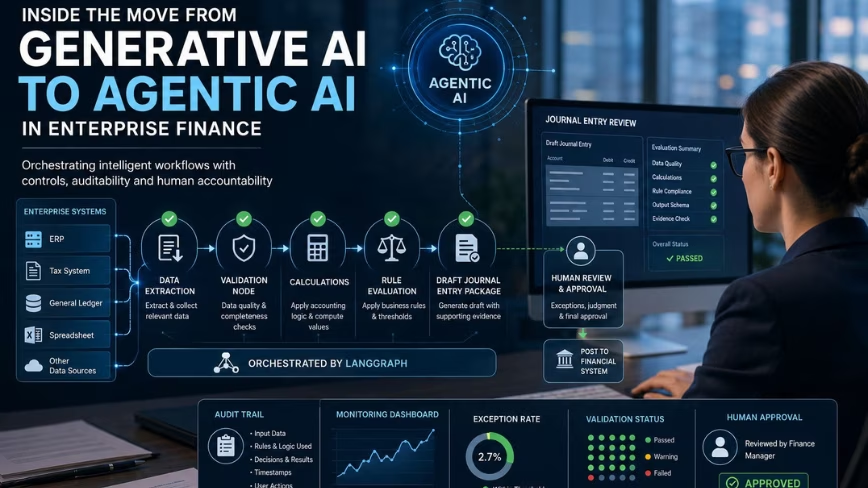
Jess Turner, Executive Vice President, Global Head of Open Banking & API at Mastercard.gettyGenerative AI can write code. Agentic AI can coordinate the end-to-end work of connecting, validating and operating across a living financial ecosystem, if developers design for guardrails, not just speed.In financial services, working with other companies in the sector can be harder than it looks. Before enterprise systems can connect, partnerships must meet strict requirements for security, regulation and data use. Teams review policies and paperwork, align on how data is shared and test for unusual or high-risk situations. And because there’s no plug-and-play model, this process repeats with every new partner.What’s surprising is that the hardest part isn’t writing the software. It’s getting—and keeping—everything aligned so connections remain secure and compliant as regulations evolve, technology changes and business priorities shift.Generative AI has already helped relieve some of this friction. By automating administrative work like reviewing documents, aligning requirements, translating between legal, technical and business teams and flagging risks early, it reduces the time and effort needed to get integrations up and running. It doesn’t replace trust or governance, but it makes coordination faster and more manageable.Agentic AI goes a step further. Instead of simply assisting teams, it can act on their behalf, coordinating data mapping, compliance checks, testing and updates across partners. Rather than speeding up individual tasks, it helps manage the entire integration over time. This matters in financial services, where “done” doesn’t mean the software works. It means the connection is secure, compliant, explainable and able to adapt to change. Why Agentic AI Shows Up First In Financial APIsFinancial services partnerships are a natural early proving ground for agentic AI because the work follows a familiar pattern, but the stakes are high. Every connection involves controlled access, consent, safe data sharing, clear audit trails and ongoing oversight. These steps are complex, repeatable and tightly governed, but they’re largely about coordination rather than judgment.This combination makes agentic AI especially useful. Agents can help manage the ongoing complexity while people stay firmly in charge of approvals, accountability and decision-making. In an industry where integrations are never truly finished, this support can be the difference between fragile connections and ones that improve over time.Four Ways Developers Can Use Generative And Agentic AI Responsibly1. Start with the outcome, then make the plan visible. Agents are the most helpful when the goal is clear but the path isn’t. Define the objective and require a step-by-step plan that teams can review before anything moves forward.2. Anchor agents in trusted sources. Provide approved documentation, data definitions and clear rules about what data can be used and how. Don’t let AI guess its way through sensitive decisions.3. Require evidence, not just output. Ask for test results, documentation and proof that edge cases are handled. In finance, how something works matters as much as whether it works.4. Design for control from day one. Limit access, keep production changes behind human approval and treat integrations as living systems that need monitoring and care.Here are three patterns to avoid:• Letting AI invent meaning for financial terms, instead of relying on agreed-upon definitions• Prioritizing speed over accountability and auditability• Concentrating too much power in a single, opaque systemWhat A Connected Ecosystem Looks Like In An Agentic EraUsed thoughtfully, agentic AI doesn’t just make integrations faster; it makes them more reliable. Onboarding becomes more consistent, issues are easier to trace and systems adapt more smoothly as conditions change.The next phase of financial innovation won’t be defined by only faster rails or new endpoints. It will be defined by how safely and effectively organizations can connect across banks, fintechs, platforms, merchants and data providers, with trust as the center and AI as a disciplined operating advantage.Forbes Technology Council is an invitation-only community for world-class CIOs, CTOs and technology executives. Do I qualify?
Agentic AI Is Changing How Developers Connect Financial APIs
Agents can help manage the ongoing complexity while people stay firmly in charge of approvals, accountability and decision-making.
TL;DRAI
Agentic AI orchestrates financial API integrations end-to-end—mapping, compliance, testing—under human oversight and governance control. Financial integrations must stay secure and compliant forever; agentic coordination reduces friction and improves auditability across partnerships.
634 words~3 min read