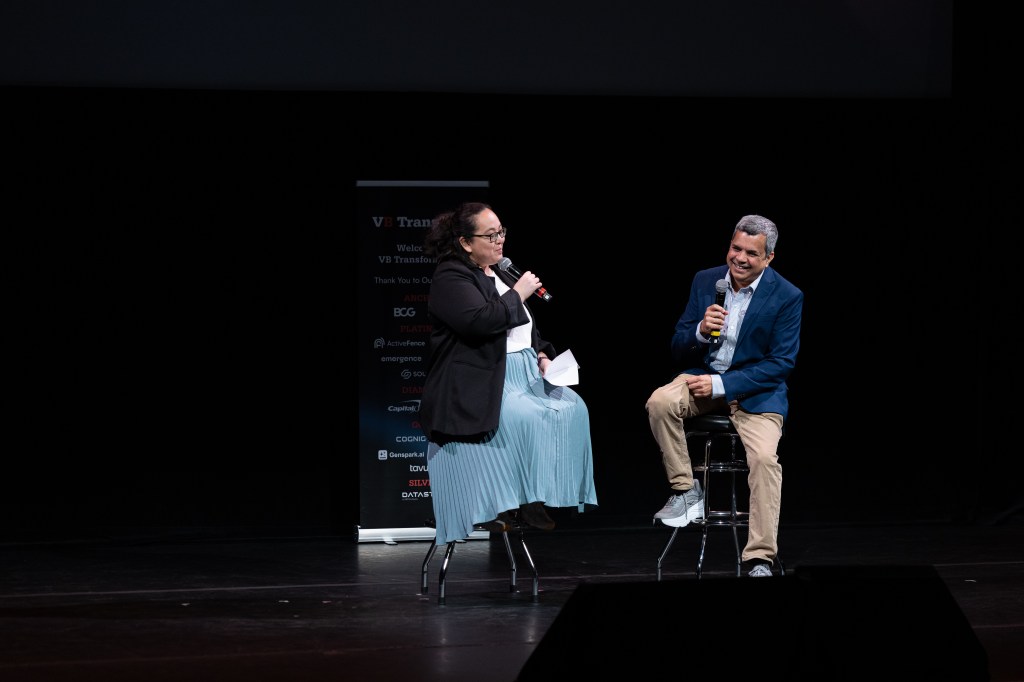
Mark Mathewson, Executive Vice President and Divisional CIO for Bank Technology at Capital OneCapital OneWritten by Jeff Koyen, Edited by Mallory GafasSince the start of generative AI’s enterprise proliferation, it has been largely regarded by executives and employees alike as a productive assistant more than an engaged collaborator. Certainly useful, but ultimately passive. Agentic AI is the next major evolution of artificial intelligence that will not just advise action — but take it. A recent Forbes interview highlights how enterprises must evolve their technology foundation and business thinking to capitalize on agentic AI and stay competitive in the market. “[Becoming an agentic enterprise] means building AI that understands its environment and can make decisions … in a secure, active environment,” said Mark Mathewson, executive vice president and divisional CIO for bank technology at Capital One, in a live interview with Forbes.Speaking to Janett Haas, senior vice president of executive thought leadership at Forbes, Mathewson shared his path to strategic success that offers evidentiary proof that early movers and adopters have a head start seizing competitiveness. Years before agentic AI was even a concept, Capital One made a bet on cloud technology, becoming the first U.S. financial institution to go all-in on the public cloud. The benefits that drove that decision — on-demand resources, dynamic scaling, elastic compute — turned out to be precisely what large-scale AI development requires today.“Our history on the cloud has been foundational to preparing us for this next transition,” Mathewson said.What that transition actually demands — and how Capital One is meeting it — is worth examining closely.Below, explore Mathewson’s strategic insights to power the future of the agentic-ready enterprise. 1. Build On A Modern, Data-Powered FoundationEvery evolution in AI has asked more of enterprise infrastructure than the last. Agentic AI asks the most, requiring vast amounts of centralized, accessible data paired with the compute power to process at scale.For Capital One, the cloud made those demands answerable. Years of investment in cloud infrastructure created exactly the kind of environment agentic AI needs to operate.“Data, which is such an important component of being an agentic enterprise, is now available in the cloud with access to all the variety of different compute services and models in a seamless, on-demand, elastic environment,” said Mathewson. “That’s an incredible foundation.”Capital One’s AI readiness wasn’t built overnight. “We have a long history of implementing machine learning and AI,” Mathewson noted.Today, Capital One runs hundreds of AI and ML use cases across disciplines ranging from fraud detection to customer servicing to software development. A combination of modern technology and data infrastructure, deep experience in AI and machine learning and exceptional talent made the leap to agentic AI more of a next step than reinvention.None of it would be possible, Mathewson explained, without an organization-wide conviction in the importance of artificial intelligence.“Moving towards the frontier of AI is embedded in the heart of our business” Mathewson said. “Regardless of role … my peers recognize that it’s part of their job to reimagine the future [by] leveraging AI.”2: Embrace Proprietary Data As A Competitive AdvantageThe AI revolution has raised the stakes on how companies use data. The companies that succeed in the future will be the ones leveraging deeply customized models based on proprietary data. “Open weights models are great generalists, but to make them specialists requires that you use your own proprietary data,” said Mathewson. “[You must] train those models to take advantage of those proprietary data points to be deployed against very specific tasks that are unique in the context of your business.”Capital One has spent years building exactly that kind of specificity. The company’s deep history in data and analytics has yielded rich, proprietary data that can be used to train models toward genuinely differentiated performance.Proprietary data is also the prerequisite for multi-agentic workflows custom-built for specific business cases. For example, Capital One is leveraging its own multi-agentic AI workflow to help bank customer service call center agents handle complex fraud resolution calls with more speed and quality than ever before.Because this workflow is trained on real data, call center agents can significantly reduce the time spent researching a customer’s issue and the cognitive load required to summarize long-form discussions. This improves both customer and agent experience, while still meeting rigorous business standards around accuracy, reliability, and risk management. The workflow also has extensibility to a variety of other agentic use cases, including the company’s Chat Concierge tool which enhances the customer experience for car buyers and dealers.“It’s our own proprietary agentic workflow that’s been built behind the scenes,” Mathewson noted.General models will continue to improve, but they will improve for everyone in equal measure. Proprietary data, by definition, is something competitors cannot access. For agentic enterprises, the edge is found in this asymmetry.“[Having] a series of tightly intertwined agents that are specialized in their task [will] separate winners from losers,” said Mathewson.3: Prioritize Scalable, Embedded AI SystemsThe difference between AI that transforms a business and AI that merely assists one often comes down to where it lives. Artificial intelligence that’s bolted on can create islands of capability, whereas embedded AI enables an entirely different kind of organization.Capital One’s approach is built around an enterprise platform model — standardized AI capabilities that can be deployed across all areas of the business and adapted to multiple use cases.For example: Search, summarization, chat, content creation, prediction, forecasting and classification aren’t isolated tools; they’re standardized capabilities drawn from a shared resource pool and can be applied to various applications.“It fits seamlessly in our stack versus feeling like a bolt-on or an add-on,” Mathewson said.The impact on software development illustrates the scale of what’s possible. Engineers at Capital One can use AI tools to help them automate rote tasks and focus on high-leverage aspects of their work, delegating the kind of repetitive, time-consuming coding work that once consumed entire days.“The constraint of writing code is no longer really a constraint,” Mathewson said. “Our engineers can ask an agent to do this on their behalf [and they] work on three different things all at the same time.”Mathewson added: “We’re taking a holistic approach to look at how it can transform the way we build software.” 4: Foster AI-Fluent Talent And Specialized ExpertiseBuilding an organization capable of developing, deploying and evolving AI at scale requires two investments in equal measure: broad AI fluency across the workforce and deep technical specialization at its core.For many leaders, however, the path to both is obscured by the sheer velocity of change. Models leapfrog each other week to week. Tools that didn’t exist last quarter are now standard. Forecasting based on historical precedent is no longer enough.Mathewson sympathizes.“I’m having to relearn how to chart a future when you really don’t have comparable frameworks from history to rely on, because many of the foundations of those things are actually changing today,” he said. “Some days it looks chaotic, but in all the best ways.”In response, Capital One treats AI fluency as an organizational virtue, not an individual credential. Its culture is built on continuous learning and innovation, providing associates with not only access to the latest tools available in the market, but also robust training, learning, and development opportunities to enable practical and powerful gains with these solutions.Mathewson noted that merely keeping abreast of the latest developments is no substitute for working with them directly.“It’s one thing to read about what’s happening,” he said. “It’s another thing to get these tools in your hands and actually start working with them and seeing what their limitations are and seeing what capabilities they have that actually surprise you.”The other half of the equation is specialization, and building customized AI models with business-specific context requires a modern tech stack and data ecosystem, proprietary data, and top talent.“Leaning into redefining how work processes and technology stacks are going to need to change, as well as experimenting with tools, will separate organizations in the future,” Mathewson said.
4 Insights From A CIO Innovator To Catalyze Enterprise Agentic AI Adoption
Agentic AI, the next evolution, enables systems to take action, not just advise. Capital One's Mark Mathewson highlights the need for enterprises to adapt their tech and thinking.
1,320 words~6 min read