Ji Da-gyum
For over a decade, I’ve navigated the complexities of North Korean affairs, security, and foreign policy from both Seoul and Washington, D.C. As the National Desk Political Team Lead, I track the pulse of geopolitics, closely following developments from the Unification Ministry and the Foreign Ministry. My mornings start with Rodong Sinmun—North Korea’s state mouthpiece—before diving into the day’s headlines from Seoul and Washington.
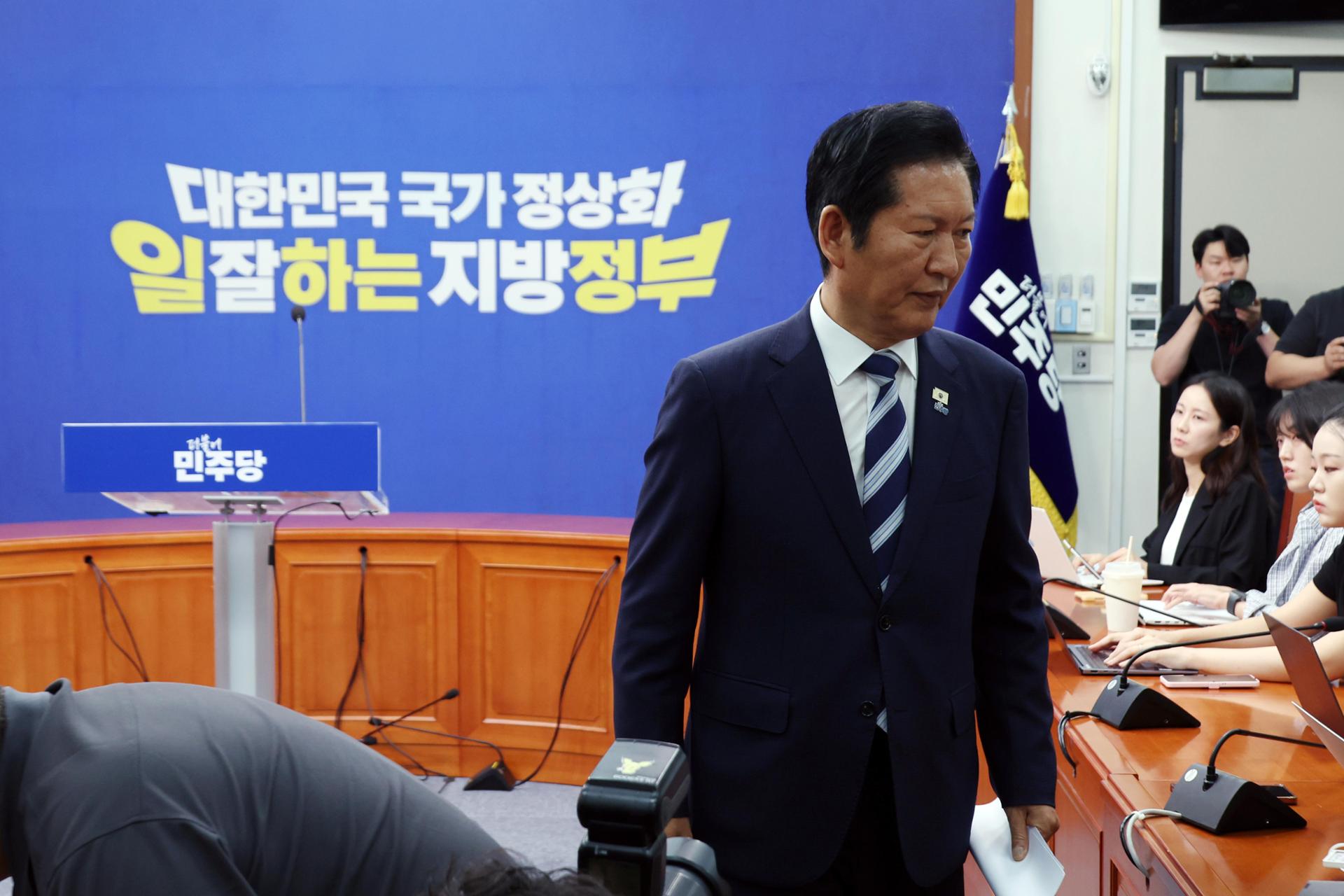
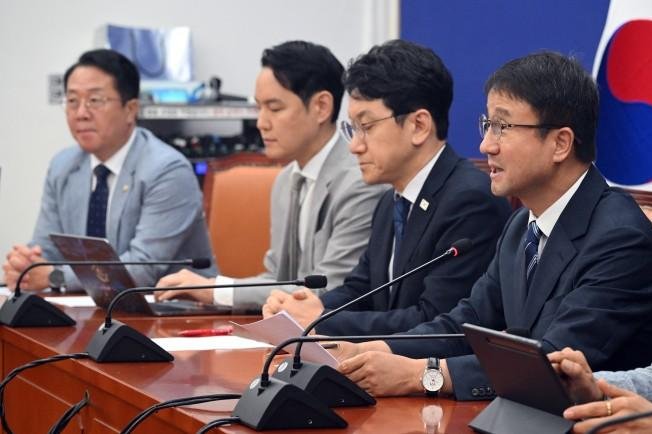
Democratic Party Chair Rep. Jung Chung-rae (right) speaks after paying respects at the National May 18 Democratic Cemetery in Gwangju on Friday. (Yonhap) South Korea’s ruling and main opposition parties are both sliding into postelection turmoil, with their embattled leaders seeking to survive growing calls for resignation following the June 3 local elections.Democratic Party of Korea Chair Rep. Jung Chung-rae on Friday traveled to Gwangju, part of the party’s liberal stronghold of Honam in the country’s southwest, following his visit to North Jeolla Province on June 9.Jung's move has been widely seen as signaling his intention to seek reelection at the party’s Aug. 17 national convention, despite mounting criticism over his responsibility for the local election results.Chung, who has championed a “one member, one vote” system, is considered to have a strong incentive to court the Honam region, home to roughly one-third of the party’s registered voting members and widely regarded as the key battleground in the upcoming leadership race.The rule would give ordinary, dues-paying party members the same voting power as party delegates, including lawmakers, in internal party elections, departing from the previous system in which one delegate’s vote was equivalent to around 17.5 votes from ordinary dues-paying members.Chung said, "Honam is like the parents of the Democratic Party" during the party's first on-site Supreme Council meeting since the local elections, held at the Kim Dae-jung Convention Center in Gwangju."Just as parents embrace their children whether they are successful or not, Honam has always embraced and cherished the Democratic Party despite its shortcomings, and for that I am always grateful," he said. Democratic Party Chair Rep. Jung Chung-rae speaks during an on-site Supreme Council meeting for South Jeolla Province and Gwangju at the Kim Dae-jung Convention Center in Gwangju on Friday. (Yonhap) However, infighting within the Democratic Party between supporters of Jung and those backing outgoing Prime Minister Kim Min-seok, who has officially entered the race for party leader, spilled into the open during the meeting.Supreme Council member Rep. Hwang Myeong-seon said the party leadership should take responsibility for the election outcome, in which the Democratic Party won 12 of the 16 mayoral and gubernatorial races but failed to reclaim Seoul, allowing the People Power Party to retain the capital."Many people say we are a shameless leadership. At yesterday's lawmakers' meeting, many lawmakers sharply criticized us. We need to show that we are taking responsibility," Hwang said. "I urge the leadership to demonstrate accountability."Another Supreme Council member, Rep. Kang Deuk-gu, took aim at Chung’s remark that "the people endure, but governments come and go," which Chung made during public remarks at Wednesday’s Supreme Council meeting and that subsequently sparked controversy."The people and party members endure, but party leadership is fleeting," Kang said.Jung's ally, Supreme Council member Moon Jeong-bog, quickly pushed back against internal critics and singled out Kim at Friday's meeting."It is appreciated that the prime minister took time out of his schedule to congratulate (the party’s election) winners," Moon said. "But while the president is abroad, it is hard to see how delivering congratulatory remarks and taking photos at a winners’ workshop for two consecutive days qualifies as urgent duty for the person acting on behalf of the state."With President Lee Jae Myung currently on a 10-day European trip, the prime minister has essentially assumed his domestic duties. People Power Party Chair Rep. Jang Dong-hyeok speaks during a Supreme Council meeting at the National Assembly in Seoul on Thursday. (Yonhap) Meanwhile, People Power Party Chair Rep. Jang Dong-hyeok has gone on the offensive against calls for his resignation following the party's broad losses to the Democratic Party in the local elections held June 3.In a Facebook post Friday, Jang appeared to dismiss calls for his resignation, writing, "Jang Dong-hyeok is engaging in wishful thinking? No, it is they who are trapped in a defeatist mindset."Jang cited polling data commissioned by OhmyNews, a local online media outlet, suggesting that a majority of dissatisfied party supporters do not blame the leadership for the election outcome.According to the poll, among People Power Party supporters dissatisfied with the local election results, 59.4 percent said they disagreed with the argument that the leadership should take responsibility, compared with 36 percent who agreed.Jang's defiance was also on display at Thursday's Supreme Council meeting, where Rep. Woo Jae-jun, aligned with former party leader Rep. Han Dong-hoon, openly called for the entire leadership to resign.Jang responded by saying, "Before demanding any particular choice from the leadership, the party’s 110 lawmakers should first provide an answer as to how they intend to resolve the ballot shortage crisis."He was referring to a widening scandal centered on the National Election Commission concerning polling places that ran out of ballots on Election Day, which led to voting being delayed until after the polls were due to close.Later in the day, Jang sarcastically pointed to calls for the leaders of both parties to resign, saying on Facebook, "We are at the point where the leaders of the two major parties may have to settle things with a game of rock-paper-scissors."Following Woo’s public criticism, 25 lawmakers belonging to the party’s internal reformist group publicly demanded that Jang step down, bringing the party’s internal divisions into the open.