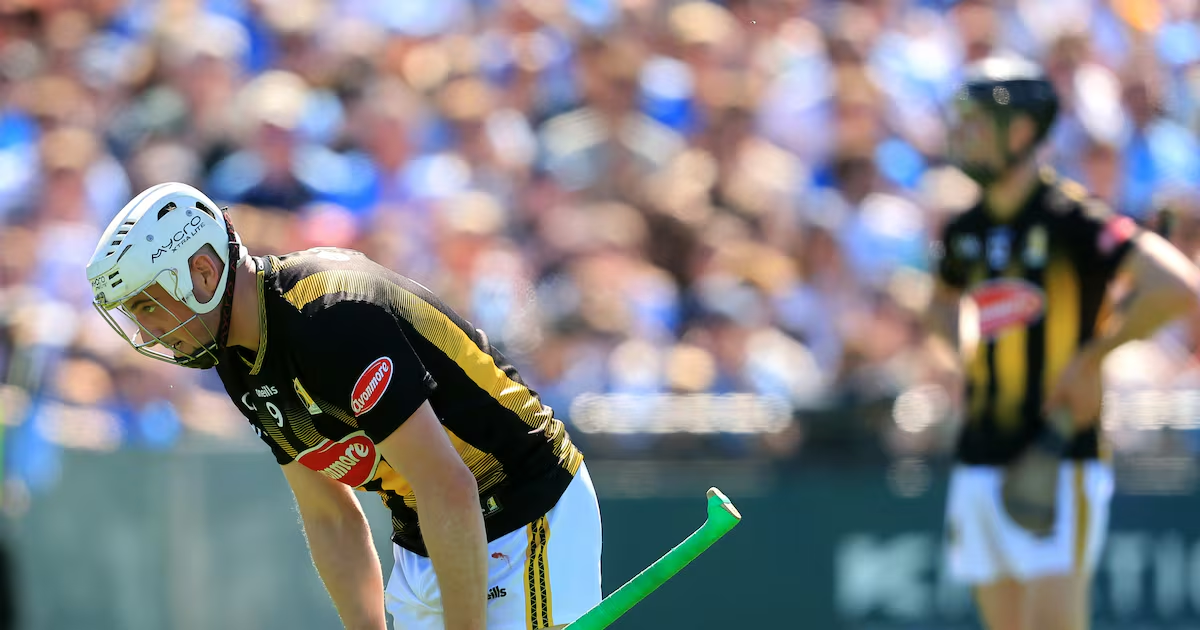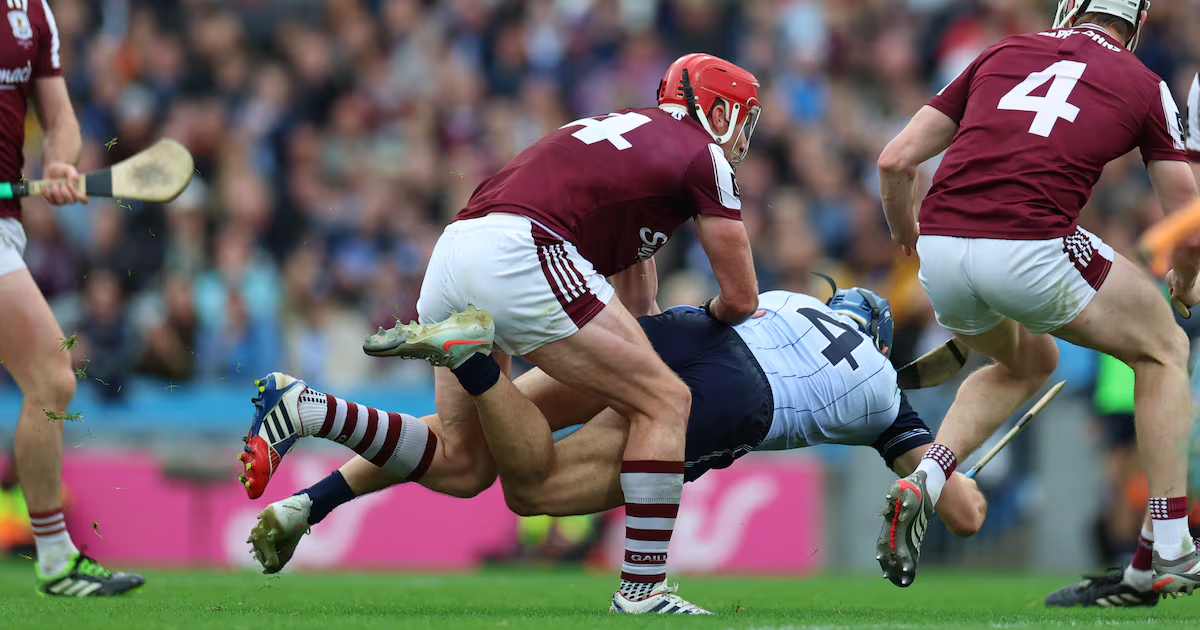
This year may well go down as the season with the most boring GAA sagas of all time.It feels like the main topics of debate in the championship have been the Ger Brennan and Jim McGuinness incidents, the merits and demerits of GAA+ and, of course, an intercounty player entering Love Island.Although each are worthwhile issues, discussions quickly end up delving into rule technicalities, solicitor statements or, in the latter case, whether the prospect of a Celtic cross outweighs a chance of true love (or something like that).So, in that spirit, a discussion should be had about the black card and penalty rule in hurling, and the common misconception around it. Galway's Conor Whelan is shown a black card by referee Michael Kennedy during the Leinster final against Dublin. Photograph: James Crombie/Inpho While it’s hardly the most riveting topic in the game, the rule has had a big effect already this season, with two black cards awarded in the Leinster final on Saturday.Galway felt particularly aggrieved by the sinbinning of Conor Whelan, despite their victory. However, a proper look at the rule book would suggest the decision was correct.So, why let bylaws be bylaws when the most important games of the championship are still to be played?What is the actual rule?Section 5.45 of the current rule outlines the scenario in which the black card should be produced and a penalty awarded. If a defending player pulls down, trips or carelessly uses the hurl on an attacking opponent “who is denied of a goalscoring opportunity”, a penalty is awarded and the offender is sent to the sinbin.What is the misconception?The phrasing of the rule is often misrepresented as “denial of a clear goalscoring opportunity”, which was the terminology that was previously used in the rule book when black cards were first transplanted over from football. The word “clear” does not appear in the current iteration of the rule.But what’s a goalscoring opportunity?Now for the fun bit – definitions. The definition of a goalscoring opportunity centres around a couple of factors, outlined in ‘Important Terms and Definitions’, section nine.First, there are the empirical factors. The player must possess, or be in control of the ball, within the small ‘D’, or inside the 20m line in a central area (at least 25m away from the nearest sideline).A grapic showing the areas of the pitch where a back card penalty can be awarded. Then, there is the subjective perspective of the referee: “In the opinion of the referee, the player fouled or ... the player’s team had and was denied of the opportunity to score a goal when the infraction was committed.”Cork’s win over Waterford in the Munster championship last month produced an example of a black card that did not meet the objective criteria for that punishment.The black card that referee Seán Stack issued to Waterford’s Mark Fitzgerald should not have been given, on the grounds that Brian Hayes did not have control of the ball when the full back hauled him to the ground in front of goal (in all likelihood, this loophole will be closed sooner rather than later).So what does this mean in practice?Effectively, it means that everyone may need to adjust their expectations of when the black card should be used in hurling.Galway’s Conor Whelan and manager Micheál Donoghue questioned Michael Kennedy’s decision to sinbin the full forward during the Leinster final.There were five Galway players well-placed to tackle the onrushing Eoghan O’Donnell, but Whelan pulled down his man and, with O’Donnell well inside the 20m line, it certainly met the objective elements of the black card rules.While still a tricky ‘goalscoring opportunity’, the absence of the word ‘clear’ from the rule book made this incident an obvious black card and penalty, and Kennedy made the right call.Regardless of whether the particularities of the black card rule is a thrilling topic, there is no doubt it could have an effect on the destination of the Liam MacCarthy Cup this year, so it’s no harm to know what the rule book states.
Can we all just admit we haven’t a clue how the black card works in hurling?
The rule surrounding the black card in hurling is actually pretty clear, but many don’t seem to know it
672 words~3 min read