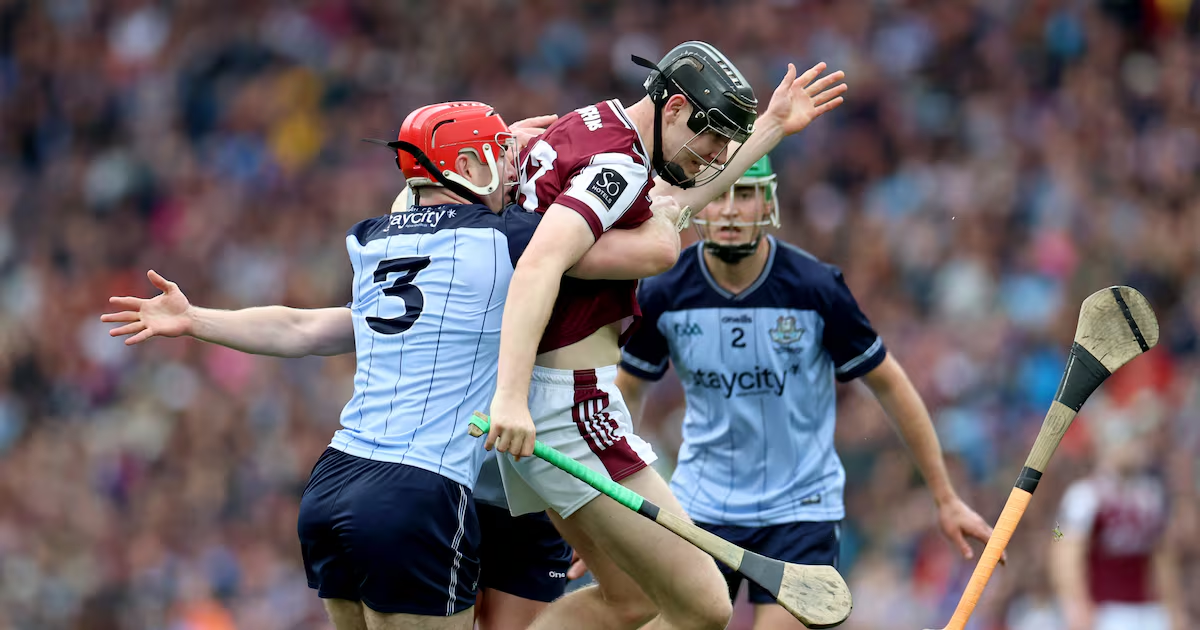
Hurling doesn’t know what it wants. Does it want a championship where winning is hard and losing is brutal? Or does it want a championship where winning is hard and losing is mitigated? Is this elite sport, with all the pressures and binary outcomes that entails, or is it some kind of protected habitat where nobody is eaten alive? Hurling has always struggled with versions of these questions and it is incapable of giving a straight answer. Because there are so few counties who take the game seriously and can field a competitive team in the top tier of the championship, hurling is always fretting about dropouts and general morale and being visible.What has the worrying caused? Constant tinkering and treating of the symptoms. Championship structures in hurling have been under fidgety review for decades, even before football started tampering.Galway played in Munster in the 1960s and have been in Leinster for the last 18 seasons. There was an All-Ireland B championship between 1974 and 2004. For many of those years, the B winners were redirected to the Liam MacCarthy Cup at the quarter-final stage. To what end? To make one of them feel part of the main event. To keep numbers up.Antrim’s minor hurlers had a spell playing in Leinster when ‘Sambo’ McNaughton was a teenager, long before their seniors landed there. A second chance for beaten provincial finalists was introduced in 1997. The very first intercounty round-robin system appeared in Leinster in 2000 as a protective measure for teams who might get an early hiding from one of the big guns. Dublin were in that group.Five years later, a losers’ round-robin group was devised for the early fallers in Leinster and Munster. That only lasted three seasons, but it showed imagination and it was another attempt to extend the summer for as many teams as possible. Everybody was guaranteed three games, most teams got four.But did it make any difference to the teams who didn’t have the players or didn’t have the work done? While that system was in place, Dublin, Offaly and Laois were eliminated at the group stages in each of the three years; Antrim were eliminated twice, Westmeath once. These were precisely the kind of teams it was designed to help. Did it?Galway before the 2023 Leinster SHC final against Kilkenny at Croke Park. A crowd of 24,483 passed through the turnstiles for the match. Photograph: Morgan Treacy/Inpho The introduction of the provincial round-robin systems was a daredevil leap. People wondered if the provincial finals would lose their lustre when three teams were guaranteed to go through. But every Munster final since the advent of the new format has been a sell-out.Historically, Leinster finals have always been a harder sell. Only 24,483 passed through the turnstiles for Kilkenny and Galway in 2023 and everyone was up in arms. But only 22,171 turned up for Kilkenny and Galway in 2012 and only 18,855 were there for Kilkenny and Wexford in 2008.Attendances at Leinster hurling finals have always oscillated according to Kilkenny’s dominance or Wexford’s competitiveness or, in recent years, the appetite of the Galway public or the floating Dubs supporters.The point is that whatever system was in place ultimately didn’t make anybody better or worse. The purpose of the championship is to identify the best team. Beaten teams, unlucky teams and miles-off-the-pace teams will be littered along the way. The reason why the championship feels different, at every level of the game, is the gut-twisting fear of not being good enough.What must be avoided at all costs is to make changes for hard cases. Waterford have been a cause celebre for the last few years because of their repeated failure to qualify from the Munster round-robin. Kildare joined them on that pedestal this year.On The Sunday Game and other platforms, there have been repeated calls for some mechanism to give teams promoted from the Joe McDonagh Cup an indemnity against instant relegation. How that might work in a condensed calendar with Leinster already hosting six teams has not been outlined by the advocates for clemency.Since the Joe McDonagh Cup was introduced in 2018, Antrim, Westmeath and Offaly have all managed to stay in the Leinster championship for a second year. In Offaly’s case, they made the necessary improvements to jump from fifth to third, but that had nothing to do with the championship structure; it was because, among other things, they had nurtured a hugely talented generation of young players over a 10-year period. When Offaly were wallowing in the Christy Ring Cup, there was no championship system that could help them until they helped themselves.Antrim's Gerard Walsh (right) and Westmeath's Niall Mitchell during the final series of round-robin fixtures in the 2023 Leinster Senior Hurling Championship at Cusack Park, Co Westmeath. Photograph: John McVitty/Inpho In Westmeath’s case, their promotion for 2022 coincided with the expansion of Leinster to six teams and they finished above Laois. In year two, they had a sensational win against Wexford, but they lost to Dublin, Kilkenny and Galway by an aggregate total of 69 points. Their failure to beat Antrim on the last day condemned them to relegation. They knew before a ball was pucked that season that the Antrim game would decide their fate, one way or another. In the championship, every team eventually arrives at a game they must win.A guaranteed second year in the Leinster championship for Joe McDonagh Cup winners is not a panacea for emerging teams: Westmeath and Antrim both went down in year two.The brutality is indiscriminate. Everybody is exposed to suffering, regardless of who they are or who they think they are. Cork were hammered by Limerick last year and were humiliated by Tipperary in the All-Ireland final. Clare have taken two thrashings in this year’s championship. Tipp have finished bottom of the Munster round-robin for the second time in three years.Kilkenny have failed to qualify from Leinster for the first time since the round-robin format was introduced. It was their earliest elimination from the championship since Wexford beat them on the first weekend of June in 1996. But that was their only championship game that year; this season they had five games to sort themselves out. In Parnell Park, they arrived at a game they needed to win and couldn’t do it. The championship gave it to them between the eyes.Isn’t that why we love it?Meddling with the championship structure to give the fourth team in Leinster and Munster an extra game or two, or to give the Joe McDonagh winners more shelter, would be a grievous mistake.The championship must be brutal. There is no other way.
Meddling with the hurling championship to soothe weaker teams misses the point entirely
Race for Liam MacCarthy is a battle to crown the best in the land – it should be ruthless and brutal
1,105 words~5 min read