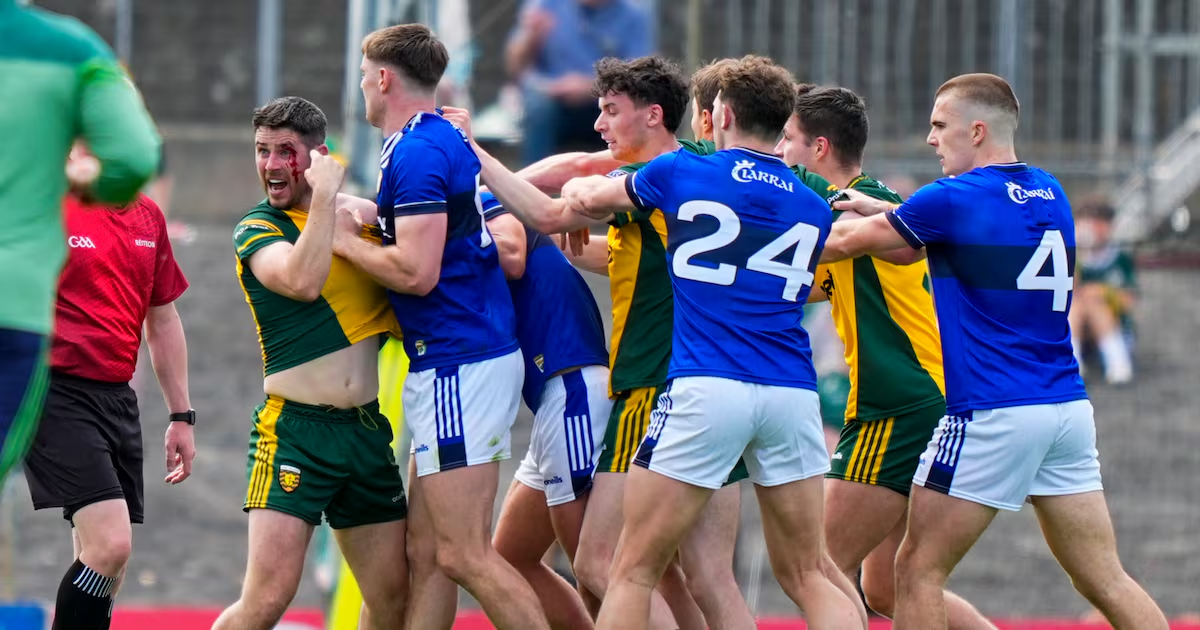
Say what you want about last Saturday’s Kerry-Donegal ballyhoo, but a lot of it was lightweight compared with what goes on in adult club games most weekends. Safety seems generally well preserved in children’s games but, speaking as someone who has watched club clashes in Dublin at senior and intermediate level regularly over the last few years, I could count on the fingers of one broken hand the number of adult games I’ve seen that didn’t feature at least one brawl. They’re so frequent a visitor might think the GAA has introduced pauses in play for melees the way other sports have introduced water breaks, although here it’s not just a summer thing: blood is always boiling on a GAA pitch.At least brawls capture everyone’s attention. The most sinister violence is more sneaky, and even more common. If you know an honest adult Gaelic footballer, ask him how many times he’s played a club game in which he didn’t give or get a sly dig in the ribs, a jab in the kidneys or an off-the-ball running shoulder-charge to the back. How about a punch to the side of the head? And then to the other side? Often these things look co-ordinated. You might even call them training-ground moves. If they happened on the street, you’d call them assaults.Most of my evidence comes from Dublin. But I’ve yet to meet anyone who has dared claim club games are cleaner in the rest of the country.Violence seems a bit rarer at intercounty level but there’s no escaping that all players must come through the club scene, where GAA may also mean Guerilla Ambush Attacks. Not dark arts, just daylight thuggery. Picture a player being wrapped up by one opponent while another lumbers over and delivers an uppercut to his face before scurrying off to hide in a “shemozzle”. This is learned behaviour. Read Darragh Ó Sé description in these pages on Wednesday about why Donegal manager Jim McGuinness might have been riled by what happened to Ryan McHugh against Kerry on Saturday –“he saw his player get split open, with one fella holding him and the other boxing him in the head”. Outrage has flowed since last Saturday about McGuinness’s pitch invasion and his pushing of a Kerry player, and he was accused, fairly, of being disingenuous when interrogated about that in the postmatch press conference. Did anyone ask Kerry manager Jack O’Connor why his players approached the match the way they did? You already know the answer.The TV cameras move in to get footage of the half-time melee during the Kerry v Donegal All-Ireland SFC game in Killarney on Saturday. Photograph: James Lawlor/Inpho When it comes to referees and their reports, it seems worse than hit-or-miss. The general standard of refereeing at club level is lower than any of the blows we saw in Killarney. The GAA is struggling to attract new refs and those in situ are not helped by the fact they are now expected to watch play unfold at one end while counting the number of bodies still in the other half; if you think players don’t exploit that impossible arrangement to land cheap shots, then congratulations on your recent birth.It’s often the most talented player who gets targeted. Nothing like a couple of on- or off-the-ball muggings to reduce a lad’s influence, or force him off the pitch. Good for the opposition, rubbish for the sport.Admittedly, the belligerence can be comical, like when a substitute sprints on to the pitch and rams straight into an opponent, who responds in kind before both barge into each other a few more times with the ball nowhere near either of them. It’s nothing scandalous, just a caveman choreography that helps set the tone for the violence to come. A bit like, come to think of it, when Louth and Meath began systematically bumping into each other before their league tryst in February and lost the run of themselves to the extent that four players were black-carded within 10 seconds of the match actually starting: amid the mayhem one Meath player was somehow stripped to his GPS sports bra. Fine, if that’s what you’re into. But don’t call it football.A scene from a Louth-Meath league match in February. Photograph: Nick Elliott/Inpho In fairness, throw-ins generally tend to be more orderly these days, since the GAA ruled they had to be contested by one player from each team rather than two. That reflected an acceptance that only two of the previous quartet had been competing for the ball anyway, while the other two manhandled each other for kicks. That confirms that rule changes can alter players’ behaviour, as we have also seen from the way dissent has abated, even in the club game, since referees were allowed penalise a team by moving the ball forward for backchat.But there’s no point introducing a rule if there’s insufficient will or way to enforce it. The most grievous offences at club games are already outlawed, but they keep happening. So, referees’ performances aside, we must wonder how many people actually want to stop the violence?The strangest thing might be that often even the victims of violence, and their friends, don’t seem minded to stamp it out. You seldom hear of a player taking an opponent to court for an on-field assault. In some cases that seems to be because they would prefer to dispense justice themselves at the next opportunity. That might be why so many GAA club fixtures take place on a spectrum between blood feud and holy war. Paudie Clifford of Kerry holds onto Finbarr Roarty and Michael Langan of Donegal during the All-Ireland SFC Round 1 game at Fitzgerald Stadium, Killarney. Photograph: James Lawlor/Inpho But in other cases it’s harder to explain. After all, it shouldn’t be difficult to build a case: not only are there usually witnesses, but many clubs record all their games for analysis. And so every week footage circulates on team group chats not just of fine scores and moves, but also of fights and assaults, some of which leave amateur players needing medical attention and/or time off work.How much of such footage ever gets forwarded to on-duty gardaí? Not much, apparently. Which is all the more curious when you know many of those group chats must include schoolteachers, social workers, doctors and, yes, gardaí. Would you be shocked if sometimes such people also appeared in the footage?People who know right from wrong, who know the damage a punch or ill-intentioned kick could do, especially to a blindsided victim, but who nonetheless remain silent. Because they’re afraid of being branded soft or treacherous? Of not being supported by their friends, clubs or association? Because of some cultural sense that it’s just not the done thing? If so, what a dangerously stupid culture.Have your say: Does the GAA have a violence problem?
Let’s talk about the GAA and a dangerously stupid culture of violence
Do you think the GAA has a violence problem? Let us know your thoughts using the form at the bottom of the article
1,144 words~5 min read