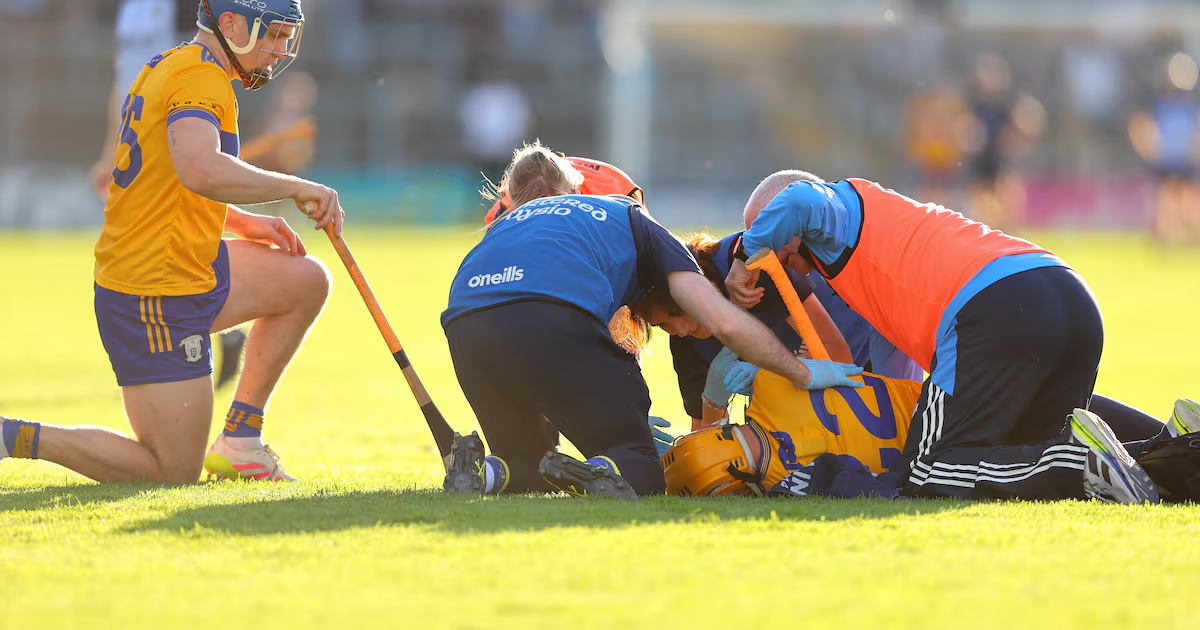
I have experienced being hit on the head on a hurling field. I wouldn’t wish it on anyone. Not all of the hits were the same. A couple of them were deliberate acts of aggression; the one that left me concussed and in hospital, though, was an accident. It happened in the 2020 All-Ireland semi-final against Limerick. Kyle Hayes barrelled into Joey Cooney, who fell into me and left me in a heap. I was stretchered off the field and taken to the Mater hospital, concussed.I had headaches for a couple of days, and I was very sore down my right side. I lost the feeling in a few of my fingers for a while, and I’d say it was like one of those stinger injuries you’d hear rugby players talking about. Even now, that shoulder goes into spasm from time to time and I have to get some dry-needling done. I wasn’t allowed drive home from the Mater but my brother Ollie waited around for me and we landed at my parent’s house at all hours of the night. I remember my mother asking me the following morning how I was and I listed all my aches and pains. She was going through cancer treatment at the time, and I asked her how she was doing.“Ah, grand,” she said. I never felt so foolish.The two deliberate hits on the head were in Galway county finals while I was lying on the ground, or trying to get up. The first was in an under-21 final when I was wrestling with a fella and just as that was breaking up I could see the butt of a hurley coming through my face guard. I still have the scar under my eye. I was lucky he didn’t catch me half an inch higher. In the other incident a player stood on my face guard while I was lying on the ground. The county board held an investigation, but they said they couldn’t see anything on the video. They didn’t have the same view I had. [ Hurling’s history of violence: ‘Some of the belts I got were criminal. My skull was fractured. It was madness’Opens in new window ]Getting a hit to the head is dangerous and disorientating. I’ve got caught myself mistiming a shoulder tackle and unfortunately these things happen in a contact sport. On a hurling pitch every player has a duty of care to their opponents. Too many things can go wrong if that duty of care is not observed. A scene from the 2020 All-Ireland semifinal between Limerick and Galway. Photograph: Tommy Dickson/Inpho In hurling, like in rugby and other contact sports, there is that balancing act between the desire for physicality and the need for care. Sometimes that comes down to very fine margins: a mistimed tackle, a sudden change of movement, a bit of clumsiness. It doesn’t have to be deliberate to have serious consequences. [ https://www.irishtimes.com/sport/gaelic-games/2026/05/30/readers-respond-to-gaa-violence-debate-die-for-your-parish-rhetoric-a-real-problem/Opens in new window ]I don’t believe Brendan Kenny had any intention to harm David Reidy in Thurles on Saturday. Given the angles that Kenny and Reidy were running at, the chances of a shoulder-to-shoulder tackle, though, were low. He clearly caught the Clare player on the head and by the way Reidy fell it was obvious to everyone watching that the contact had been bad. The way the game is played now increases the risk of incidents like that one. There are so many more bodies in condensed spaces around the ball, and everybody is trying to make contact with whoever has the ball in their hand. If you go to any game up and down the country, or any training session, you’ll hear coaches shouting, “Hold him up”. The only physical challenge allowed in the rule book is a shoulder-to-shoulder charge but the most common tackle in hurling now is a body hit. If somebody is carrying the ball they’re going to meet contact. Body hits are not accounted for in the rule book but players are conditioned to give and receive those kind of hits and in the vast majority of cases referees don’t blow for them. Players and coaches know what they can get away with. But that also brings greater risk into the equation. Players now are bigger than they have ever been in the history of the game. If you commit to a body hit, or a shoulder charge, the onus is on the tackler to get the timing right. If the timing is off by a millisecond, one way or another, the head comes into play.Padraic Maher caught me under the Hogan Stand in an All-Ireland semi-final 10 years ago. I never saw him coming. The feeling at the time was that he caught me a beaut, bang on the shoulder. Every second Tipperary person I meet still brings it up. But if the timing was so perfect, why did I have a cut over the eye? I think he got me on the front of the shoulder and the pressure on my faceguard probably caused the cut. Either way, it was fine margins. The referee didn’t give a free and we both got on with the game. Galway's Joe Canning receives treatment after a 'perfect' challenge by Padraic Maher of Tipperary during the 2016 All-Ireland semi-final. Photograph: Lorraine O'Sullivan/Inpho I have a lot of sympathy for referees in these situations. Sometimes it can be very hard to tell where the contact was made. It was obvious on Saturday night but it wasn’t so obvious when Diarmaid Byrnes caught Shane O’Donnell with a huge hit in Ennis a couple of months ago. I thought Byrnes got the timing wrong there, but no action was taken. What made the tackle dangerous for O’Donnell was that he was blindsided and he didn’t have a chance to brace himself. If you asked four referees to interpret that incident, two might have waved play on and two might have given a free. In situations like that, though, we need to err on the side of caution. In rugby they have a bunker system where a sinbinned player can have a yellow card upgraded to a red if the replays indicate the offence was worse than it seemed at first. I think a version of that system could be trialled at intercounty level, especially in the Liam MacCarthy Cup and the top two divisions of the league, where there are television cameras at every game. If a referee is unsure about contact to the head, put the player in a five minute sin bin while the footage is reviewed by the fourth official. These decisions are too important to get wrong.Nobody wants to see physicality taken out of the game, but when a player is making a body hit or a big shoulder charge, they must understand that the responsibility is on them to get it right. There will always be bits and pieces of accidental contact to the head, but the only way to reduce risk is to make players take responsibility for their conduct. If referees need help to make these calls, the GAA should give it to them. The best way to change behaviour is with heavy consequences.
Joe Canning: Hurling needs a rugby-style bunker system to help head off serious injury
The way the game is played now increases the risk of head injury, so there must be heavy consequences for those who get it wrong
1,203 words~5 min read