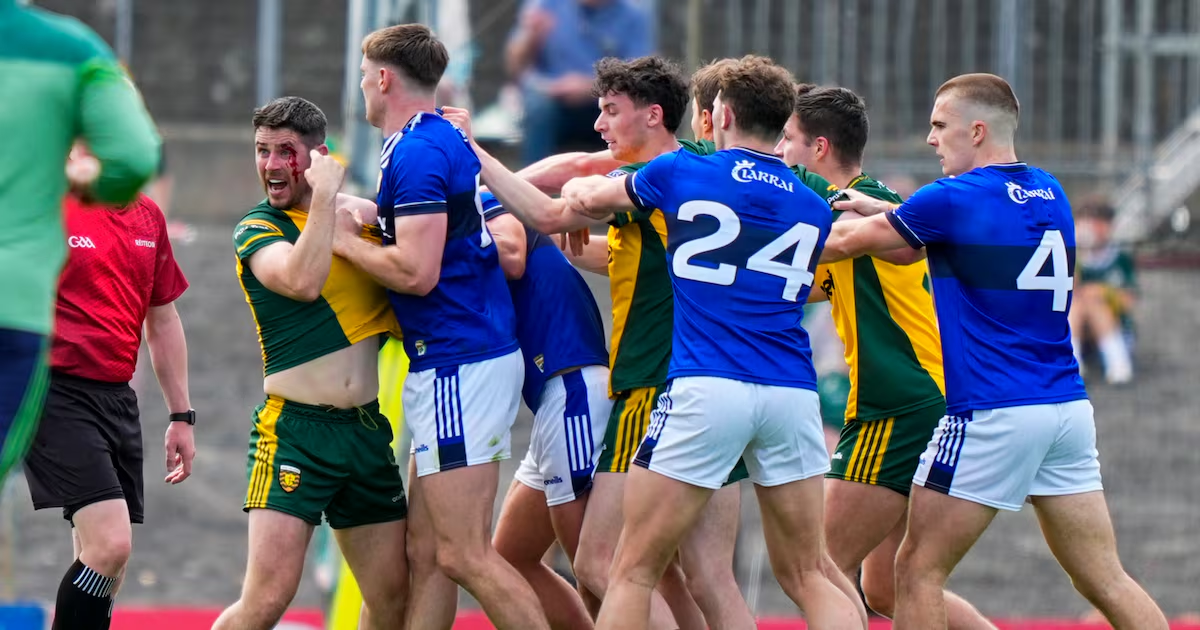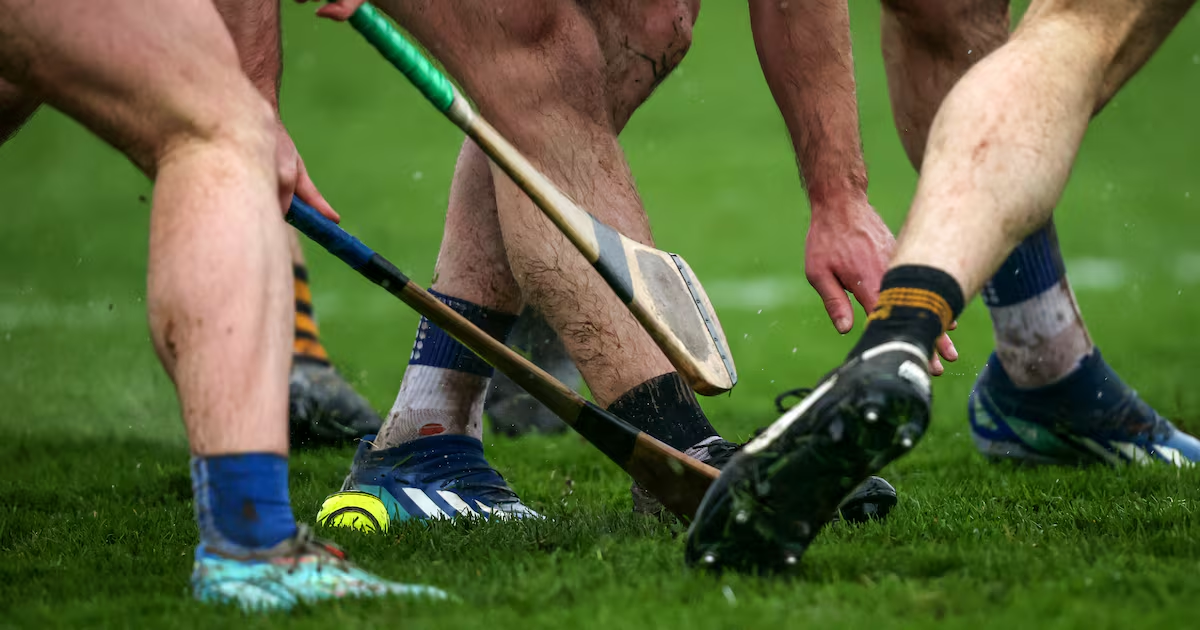
“Is assault not assault because it’s on the field?” asks Kevin from Longford in response to our recent call-out on violence during GAA games.Paul Doyle’s opinion piece on Thursday, in which he discussed the “dangerously stupid culture” of violence in the GAA, was prompted by the scenes between Kerry and Donegal last weekend. We subsequently asked readers for their opinions on whether violence is an issue in our national games.“In relation to the assault that occurred on the field of play when Kerry met Donegal,” Kevin adds, “I watched the footage as two gardaí stood watching the fight. Got me thinking why they didn’t intervene.”Patrick from Dún Laoghaire took a different view, describing Doyle’s article as “sensationalist rubbish”.[ McGuinness and Clifford getting off scot-free is a bad look for the GAA’s disciplinary processOpens in new window ]“I have been playing and coaching at senior and intermediate level in Dublin for over 20 years and although I have seen and been involved in plenty of minor scuffles – and aggression is part of the game, as it should be – any incidents involving serious violence have been very rare."He says the media has long painted a stereotype of GAA violence, “but the reality is that it is rare, and the vast majority of games are played in a healthy competitive spirit.”Patrick adds: “Attention-grabbing pieces like this are harmful to the GAA community that is an overwhelmingly positive influence in modern Irish culture, and I think your paper should reflect this rather than printing this kind of drivel."Recalling his own playing days, Michael from Dublin says he loved the speed, skill and physicality of the games, but “absolutely detested the thuggery that was rife, accepted and expected”.“You couldn’t just play a hard, skilful, fast game on its merits. You had to engage in the off-the-ball violence and the petty hate . . . The lads who did this in the GAA in Dublin were pure thugs and cowards, and they ruined the game for so many people.”While Doyle’s piece mainly looks at incidents in football matches, Seamus from Ballyboden takes particular issue with what he says are intentionally dangerous acts in hurling.“Recently, my son had a hurley jabbed with force through the protective shield of his helmet, done on purpose. It split his face open and required an A&E visit,” he writes.“My opinion is this aggression and violence stems from parents and coaches at a young age. If you talk to some passionate coaches they will tell you hurling is a war. It’s this precise attitude that breeds this violence. Hurling is about skill, speed and fitness, not pulling on a skilful player because you can’t beat them fair and square.”He adds: “There is heavy punishment in rugby for foul play and this should be the same in GAA. Good ethics start with parents and coaches. Bad behaviour should be punished and never condoned.”A trip to A&E prompted another parent to share the story of her son, who fractured his back in an off-the-ball incident during a football match last year. “He hasn’t played since and has been in agony for nearly a year and a half until his recent back surgery, and his club insurance didn’t even cover it.”She adds: “His brother, when playing under-16, was told by a player he’d put him in hospital and broke his sternum in an off-the-ball incident. We hadn’t realised it and when he was in training about four days later, one of his coaches rang to tell me he was unwell.“I took him straight to A&E where they told me his sternum was cracked and rushed him to the cardiac unit. They said if he’d continued playing he’d probably have had a heart attack.”Drawing comparison to other field sports, Senan in Dublin says “the violence which we see in the GAA is unique”. He believes “failure to eliminate small nigglings”, including sledging and the welcome-shoulder often dished out to freshly-introduced subs, “is spoiling the games as spectacles and will ultimately cause a loss of public support for our wonderful games".But there’s no wavering in support from Tom in Clare, who is of the view that poring over such incidents blow the matter out of proportion. “Violence in the GAA is not better or worse than violence in soccer, rugby, etc . . . except it is reported more and a big deal is made out of a punch or two.”JJ in Clonmel, meanwhile, is more of a rugby man and a fervent supporter of his local team, Clonmel RFC. “I attend all our games, home and away, and I do not see any level of violence. This is probably due to a higher level of discipline and respect for the referee.”He also makes a point that “the problem with the GAA comes from its very strength”.He writes: “The bond between the parish and the team can lead to a form of faction-fighting . . . Even the ads on radio and TV for the GAA sound belligerent. There needs to be more respect for referees, less people on the sidelines and less of this ‘dying for the parish’.”But John from Donegal came with his homework done. “This all started with an article by Darragh Ó Sé in your newspaper on April 22nd.” In that piece, Ó Sé wrote of a hit by Donegal’s Michael Murphy on Kerry’s Dylan Casey during the Division 1 league final. “A box in the jaw is a box in the jaw,” Ó Sé wrote of the incident, “and you can’t be a team who lets that slide. Murphy needed to be reminded of that and if it meant a Kerry player taking a card, so be it.”John feels this eye-for-an-eye mentality is part of the issue. “I’m in no way condoning what Murphy did, but when you have ‘respected’ commentators like Ó Sé advocating for retribution in an opinion piece, what hope is there of getting rid of this violence in the game.”He adds: “Indeed, what’s the point in a newspaper like The Irish Times publishing ‘let’s talks about the GAA and a dangerously stupid culture of violence’ when only four weeks previously they published Ó Sé’s piece advocating the same violence that it’s now suddenly shocked by?”Despite the level of debate generated from recent high-profile incidents, Barry from Westmeath is adamant that such occurrences are not the norm. Drawing on 30 years “of both spectating at and refereeing club games”, he writes: “Brawls or melees are increasingly infrequent in Gaelic games. Less than 5 per cent of matches feature such a coming together, it’s probably closer to 1-2 per cent. Players of all ages are far more disciplined than 20-30 years ago.“(Doyle) referenced the Kerry-Donegal game, which had one act of significant aggression that was rightly punished. Other than that, a bit of jostling or pushing.”He also notes: “There were two players red carded throughout last year’s All-Ireland football championship and the standard of refereeing throughout was extremely high, as exemplified by Brendan Cawley’s performance in the final where no cards were issued.”
Readers respond to GAA violence debate: ‘Die-for-your-parish’ rhetoric a real problem
Some readers say Gaelic games no more violent than rugby or soccer, but many others point to a dangerous culture that breeds conflict
1,175 words~5 min read