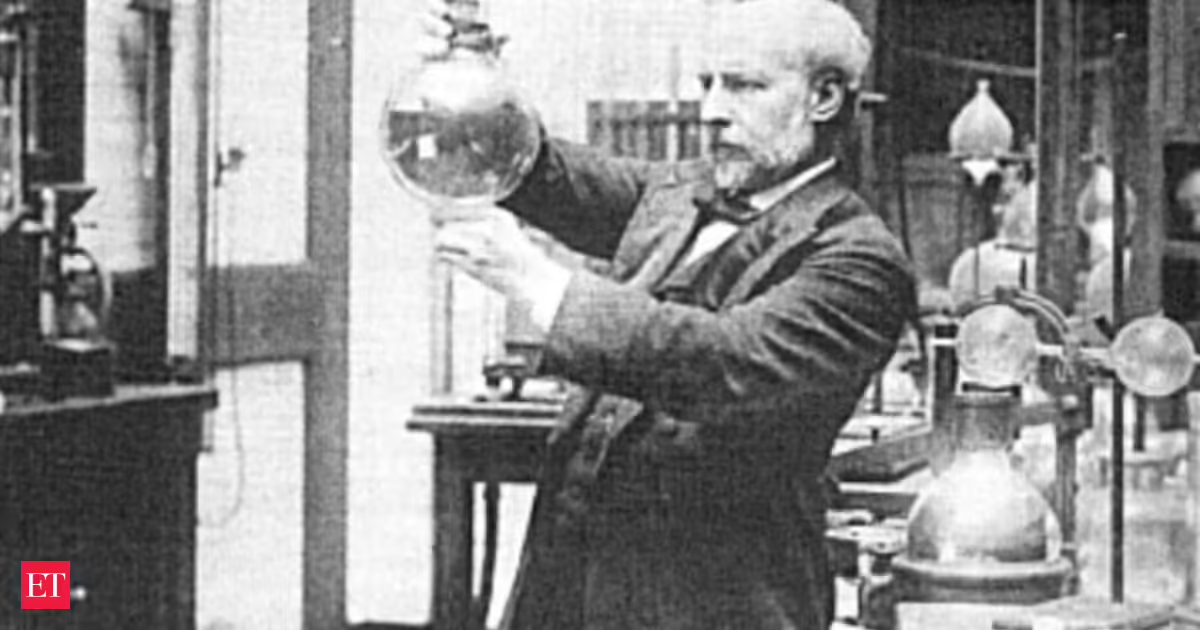
Some inventions begin with a consumer need, while others begin with a scientific problem so specific that nobody imagines the wider public will ever care about it. The vacuum flask belongs firmly in the second category. In the late nineteenth century, chemists and physicists were racing to understand matter at extremely low temperatures, and that meant finding ways to store liquefied gases long enough to study them before they rapidly warmed and evaporated.Scottish chemist James Dewar’s solution was a double-walled glass vessel with a vacuum between the layers, a design that dramatically slowed heat transfer and made low-temperature experiments far more practical. Research published in the Philosophical Transactions of the Royal Society and, later, in cryogenic history reviews in Cryogenics and the Journal of the Royal Society of Medicine describe the Dewar flask as one of the key enabling technologies behind the development of modern low-temperature science. What makes the story remarkable is that a vessel designed for laboratory work eventually became one of the most familiar objects in everyday life.James Dewar | Wikimedia CommonsA laboratory problem demanded a new kind of containerBy the 1890s, researchers across Europe were making rapid progress in cooling gases to extraordinarily low temperatures, but they faced a practical obstacle that repeatedly limited their work. Liquefied gases could be produced, yet storing them long enough for careful observation remained difficult because ordinary containers allowed heat to enter too quickly. A historical review published in the Journal of the Royal Society of Medicine explains that Dewar developed his vacuum flask specifically to support experiments involving liquefied gases, while a broader cryogenic history published in Cryogenics places the invention within a wave of advances that helped transform low-temperature research from a scientific curiosity into a repeatable field of study. The flask was not merely a storage vessel sitting on the sidelines of scientific discovery; it was part of the infrastructure that made many of those discoveries possible.The principle behind the design was elegantly simple: by placing one glass container inside another and removing the air between them, Dewar created a vacuum barrier that greatly reduced heat transfer. The result was a container capable of keeping cold materials cold for much longer than ordinary glassware could manage.Why the vacuum changed everythingScientists had long understood that heat moves through conduction, convection, and radiation, and a vacuum dramatically reduces the first two of those processes. Dewar created an environment in which outside heat struggled to reach the contents by eliminating most of the air between the walls. Cryogenic reviews published through PubMed note that the vacuum flask became an essential tool because it allowed researchers to handle and study liquefied gases under more controlled conditions. Many low-temperature experiments would have been difficult to repeat, compare, or extend without reliable insulation.Scientists were no longer working against the clock quite so aggressively, and they could store materials, move them between locations, and conduct experiments with greater confidence that temperature changes would not immediately ruin their results. In science, that kind of stability can be just as important as a major theoretical breakthrough.The public discovered a different use for the same physicsWhat happened next is one of the most common patterns in technological history: a tool created for specialists turned out to solve a broader problem that ordinary people faced as well. The scientific literature makes it clear that Dewar’s original purpose concerned liquefied gases and cryogenic research, yet the underlying principle proved useful far beyond the laboratory. A container that prevents heat from entering can also prevent heat from escaping, and once manufacturers recognized that possibility, the same insulation concept could be used to keep coffee hot, soup warm, or drinking water cool during travel.The transition from laboratory equipment to consumer product did not require a new scientific discovery; it required a new application. The physics remained exactly the same, but the audience changed. That adaptability explains why the Thermos became so successful. People did not need to understand cryogenics to appreciate a bottle that maintained temperature for hours. The design had already proven itself under demanding scientific conditions, making it more than capable of handling everyday life.Dewar's vacuum flask in the museum of the Royal Institution | Wikimedia CommonsA scientific tool that never really left scienceAlthough most people now associate vacuum flasks with travel mugs and lunch bags, the scientific importance of Dewar’s invention never disappeared. Modern cryogenic research still relies on descendants of the original design, and low-temperature laboratories around the world continue to use vessels based on the same insulating principles developed in the nineteenth century.Historical reviews of cryogenic science consistently place the Dewar flask alongside other foundational technologies that helped researchers work with liquefied gases, superconductivity, and extremely low temperatures. Its importance comes not from complexity but from effectiveness. It solved a difficult problem in a way that remained useful for generations.
In 1893, a chemist was silvering double-walled glass for cold gases and made a stubborn flask, which created the thermos
In the pursuit of knowledge, scientist James Dewar engineered an innovative container specifically designed for the exploration of ultra-chilled gases. This vacuum flask not only preserved the frigid temperatures of its contents but also caught the attention of everyday users who discovered it could keep beverages steaming hot as well.
804 words~4 min read