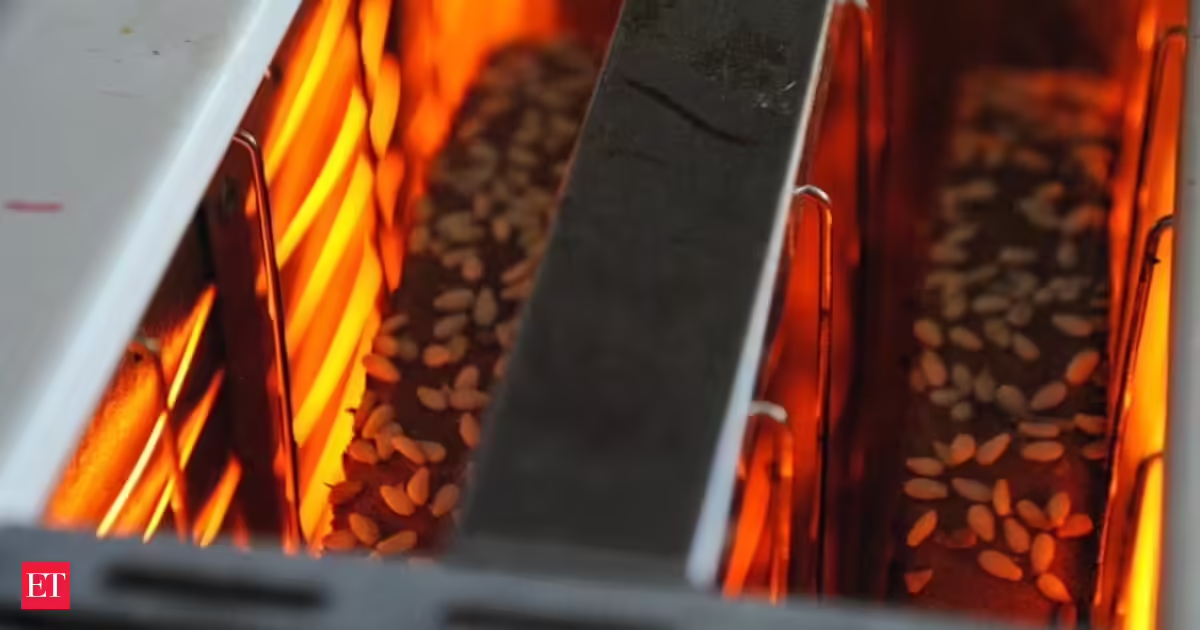
Many household inventions are remembered for their visible design, but the technologies that truly make them possible are often hidden from view, and the electric toaster is a good example. By the early twentieth century, engineers already understood how to generate heat using electricity, yet turning that principle into a reliable household appliance proved more difficult than it appeared because the heating elements available at the time frequently burned out, degraded, or failed after repeated use.The breakthrough came in 1905, when engineer Albert Marsh developed nichrome, an alloy of nickel and chromium that could withstand high temperatures while remaining a dependable resistance wire. Materials science research published in journals indexed by PubMed, along with engineering studies examining modern heating elements, shows that nichrome remains widely used more than a century later because it combines electrical resistance, durability, and heat tolerance in ways that are remarkably difficult to replace.Uses of nichrome: An electrical device using coils of wire for resistive heating | Wikimedia CommonsThe challenge was never electricity itselfIt is easy to assume that the biggest obstacle in early electric appliances was generating enough electrical power, but in reality, the problem was often much smaller and far more specific. Engineers could make wires hot, but making them hot repeatedly without rapid failure was another matter entirely. Heating elements face an unusually demanding job because they must endure constant cycles of heating and cooling while maintaining predictable performance. Early materials often became brittle, oxidized too quickly, or simply stopped functioning after repeated exposure to high temperatures.Research published in Contributions to Tobacco & Nicotine Research and other materials science studies examining modern heater coils highlights a principle that engineers still rely on today: a heating element must be able to withstand repeated thermal stress while continuing to deliver stable performance. That requirement sounds straightforward, but achieving it requires carefully chosen materials.Why Nichrome proved differentNichrome combined nickel and chromium in proportions that produced a wire capable of generating substantial heat while resisting many of the problems that affected earlier materials. Modern engineering research continues to identify these same properties as reasons for the alloy’s longevity. A study indexed through PubMed examining heater-wire degradation notes that nichrome remains a standard material for heating applications despite operating under demanding thermal conditions.The significance of that durability cannot be overstated. A toaster may appear simple, but it asks a great deal from its heating elements. The wire must become extremely hot, cool down, and repeat the process thousands of times throughout its lifespan. Consumers rarely think about this because the problem was solved so effectively that the technology became invisible.The toaster was only the beginningA peer-reviewed study describing a NOAA-associated frost-point hygrometer notes the use of Nichrome heating elements in scientific instrumentation, which demonstrates that the alloy became valuable wherever controlled heat was required. Although the application differs dramatically from a household toaster, the engineering principle remains the same. Scientists and engineers need materials that can produce reliable heat without rapid deterioration, and nichrome provided exactly that.The material also appears in numerous modern heating systems, laboratory devices, industrial equipment, and consumer products. More than a century after its development, engineers continue to choose nichrome because its balance of properties remains highly practical. This widespread adoption gives us an important lesson in technological history. Some inventions succeed not because they are revolutionary on the surface but because they solve a persistent problem so effectively that countless other technologies can build upon them.Electric toaster | Wikimedia CommonsA small alloy that changed daily lifeThe toaster often receives credit as a symbol of modern convenience, yet the appliance’s success depended heavily on a materials breakthrough that most users never saw. Electric toasting would have remained unreliable, expensive, or impractical for everyday households without a durable heating element.Research examining modern Nichrome performance continues to study how the alloy behaves under repeated thermal stress, while still recognizing it as a standard heating material across many industries. That continued relevance helps explain why Marsh’s contribution remains important. He did not create an indestructible wire, nor did he eliminate every engineering challenge associated with electric heating. What he created was something arguably more valuable: a material reliable enough to make electric appliances practical.
In 1905, an engineer was testing heatproof alloys and made a wire that would not burn out, and the electric toaster came into existence
A special metal alloy called nichrome, invented in 1905, made electric toasters possible. This alloy, a mix of nickel and chromium, could withstand high heat without breaking. Engineers still use nichrome today because it is reliable and hard to replace. This invention solved a major problem, making many electrical devices practical for homes and industries.
697 words~3 min read