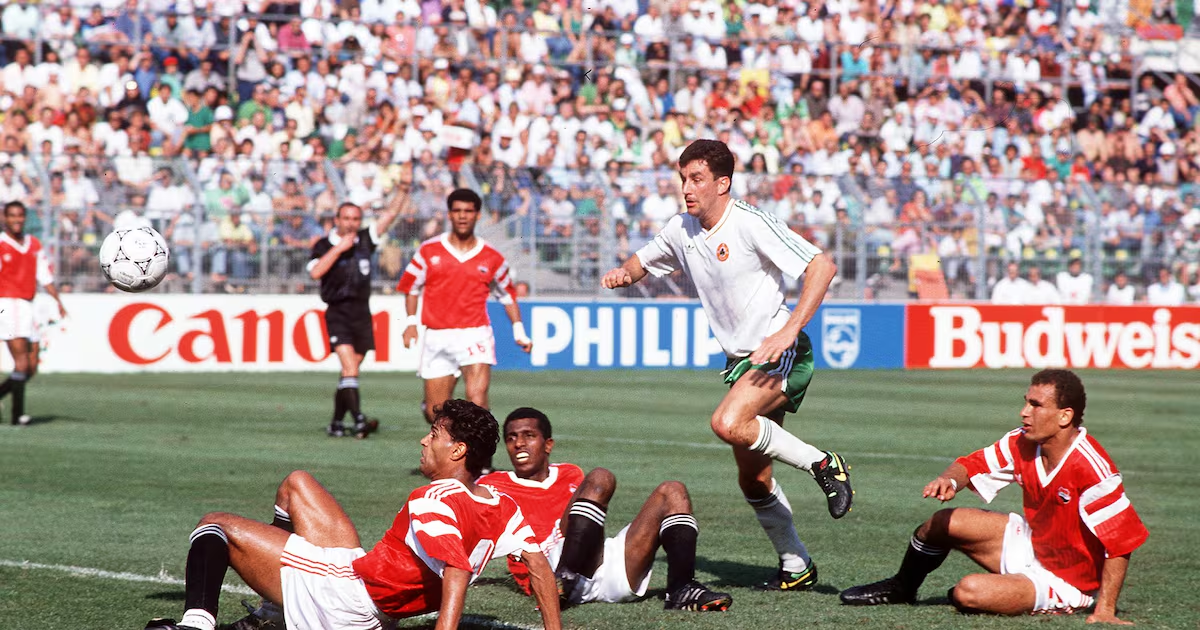
The GAA cottoned on to the World Cup pretty quickly. It was going to be trouble. Five years after the 1966 tournament in England, widely seen as the stalking horse for interest in soccer, certainly among the GAA community, the association published the wide-ranging report of the McNamee commission. It concluded in its section on broadcasting: “With the relatively high percentage of programmes being devoted to sport (about nine per cent in 1970) it was inevitable also that the medium would affect sports organisations.“It is said that TV has been largely responsible for the upsurge of the interest in golf while interest generated by the World Cup soccer competitions in 1966 and 1970 undoubtedly strengthened the development of that game in Ireland.”With impressive reflexes, the GAA pushed the idea of its own live broadcasts. The day after England’s World Cup triumph, it had been arranged that the Ulster final between Down and Donegal would be broadcast live by Teilifís Éireann and the BBC.This didn’t appear to be a great success. Writing on these pages 60 years ago, Paddy Downey fulminated.“From start to finish of a match which had promised a first-class exhibition, the referee Mr Jackie Martin (Tyrone) played a non-stop tune on his whistle awarding a total of 57 frees, of which Donegal’s share was 37.“It was a dismal and unedifying spectacle for the 20,000 spectators present, not to mention the vast audience who saw it on two television channels.”Séamus Kelly, then about halfway through his tenure as Quidnunc, the principal contributor to The Irish Times’ An Irishman’s Diary, contrasted the Ulster final most unfavourably with the World Cup and recommended action.“The obvious answer to Gaelic games such as Sunday’s final lies with the GAA lawmakers. As they are at present framed, the rules for Gaelic football are ambiguous and far from clear. Perhaps now, the men on top will rewrite the rules, particularly those applying to tackling and tighten them up so that players and public need no longer be exposed to exhibitions like Sunday’s.”At the following year’s annual congress, a move was made against the GAA’s already-limited broadcasting schedule, when Roscommon proposed taking All-Ireland semi-finals off air because of their impact on club fixtures.Gavin Diamond of Derry (left) takes on Donegal's Shane Carr during the 2002 Ulster SFC semi-final at Clones, which attracted a very small crowd. Photograph: Patrick Bolger/Inpho The most influential contributor against this was Michael Duffy from Monaghan. He argued that the GAA couldn’t argue that the games were getting inadequate coverage – as had been the constant refrain at annual congresses since the national television service started in 1962 – and then suddenly decide that they wanted to reduce what few broadcasts there were.Thirty-six years later, Duffy’s son and future GAA director general Páraic, then chair of the Games Administration Committee, did his bit to inject reality into the relationship between the association and other sports. He moved an entire national league programme from Sunday to Saturday so that there wouldn’t be a clash with Ireland’s 2003 Grand Slam rugby decider against England.There have been just two clashes between an Ireland World Cup match and a Gaelic games programme. In 1990, the infamously turgid group match against Egypt was broadcast at the same time as two notable Leinster hurling semi-finals.In the first, Dublin beat Wexford to reach the provincial final for the first time since 1964. In the second, Offaly handed Kilkenny a trimming, although the match is best remembered for providing two rising stars with their senior debuts – Brian Whelahan and DJ Carey. Despite these auspicious events, just 17,000 attended.Twelve years later, Ireland v Spain went to penalties the same day as Donegal beat Derry in the Ulster championship – the only fixture that afternoon scheduled for earlier than 4pm so as not to clash with the soccer.It attracted a paltry crowd, estimated at 2,000, which match reports said doubled in size as soon as Ireland had lost the penalty shoot-out. It was so embarrassing that in the GAA’s annual report, it was the only match for which an attendance wasn’t recorded.When it comes to clashes with World Cup finals, all but two of which have been on a Sunday (the first in Uruguay in 1930 and then England in 1966), the GAA just has to plough ahead. Given that the occasion has yet to feature Ireland and as the soccer tends to be in the evening, there hasn’t been much damage at the turnstiles.The same can’t be said for the life of a Gaelic games reporter. From 1998 until 2018, it generally wasn’t possible to finish in time to see anything but fragments of the World Cup final.In 2002, it was obligingly staged as a morning broadcast from Japan but I hadn’t finished doing a match report from the previous night and had to get it finished before that afternoon’s Munster hurling final between Waterford and Tipperary.Eight years later, there was the advantage of an early throw-in for the Meath-Louth Leinster final, leaving me convinced that I’d be home for a full viewing experience. Of course, referee Martin Sludden’s curious insistence that Joe Sheridan could score a goal like a gridiron touchdown caused such an eruption of controversy that I barely made it back for extra-time in the Spain-Netherlands final.Last time out, Fifa emulated the GAA in 2022 by having a winter championship, which was perfect but unlikely to be repeated. Next month, this year’s World Cup concludes on the same day as the All-Ireland hurling final. But in four years – God willing – there’ll be no stopping me.*John Meyler’s Hurling Advisory Committee would like to encourage as much public engagement as possible on the subject of what improvements people would like to see made to the game. The survey takes only about 15 minutes and can be completed here.– sean.moran@irishtimes.com
How the GAA finally learned to stop worrying about the World Cup
For decades, the association has had to adapt to the challenge of live broadcasting and even Ireland’s involvement
972 words~4 min read