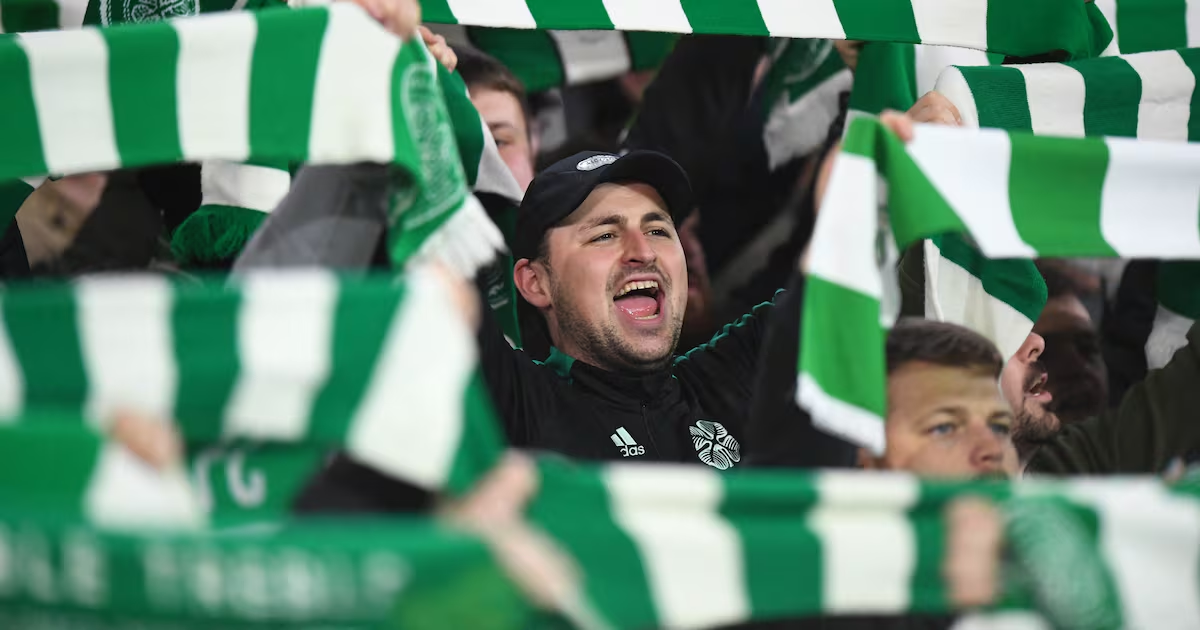
With the 2026 version of the World Cup starting this week, unfortunately Ireland are on the outside looking in once again. Given the pricing scheme adopted by Fifa for this year’s competition, maybe that’s not such a bad thing. Credit Union managers the length and breadth of the country must have heaved a collective sigh of relief when our qualification aspirations were dashed in the penalty shoot-out at the (mis)Fortuna Arena in Prague in March. This time, we didn’t even have the villainous hand of Thierry Henry to blame for our exit. How we must wish for the situation presented to the Football Association of Ireland (FAI) in 1950, when the Ireland team declined a late invitation to attend the World Cup in Brazil due to the unavailability of some players and the considerable expense involved in the transatlantic crossing. At least there is some consolation in the knowledge that several footballing missionaries from these shores contributed to the development of soccer clubs in some of the most famous footballing nations who are bound for North America this summer. The most famous of those was Brother Walfrid Kerins who was born in Sligo in 1840. Having survived the worst of the Famine years, he was among the quarter of a million Irish people who emigrated to Glasgow during the Famine and the years afterwards. Shortly after arriving in the city, he joined the Marist order of priests and having completed his training in Beauchamp in France he returned to Glasgow where he became a trainee teacher at St Mungo’s and later, assistant headmaster at St Mary’s primary school in the Calton district. His work with the poorest of Glasgow’s Irish community in the city led him to setting up various clubs and activities for young boys. Noticing the upsurge in popularity of football, he founded Celtic Football Club on November 6th, 1887, with the stated aim of alleviating the poverty in Glasgow’s East End parishes. Celtic became synonymous with the Irish Catholic community in Glasgow, going on be one of Scotland’s most successful teams and the first British team to win the European Cup in 1967.In the same year as Kerins founded Celtic FC, Patrick O’Connell was born in Drumcondra. Starting his football career with Belfast Celtic in 1908, O’Connell went on to play with several clubs in England including Sheffield Wednesday, Hull City and Manchester United before the first World War brought football to a standstill. O’Connell later turned up in Spain where he embarked on a new career as a coach, firstly with Racing Santander and then Atlético Madrid. However, it was with Real Betis that “Don Patricio” achieved his greatest success when he coached them to win their only Spanish league title in 1935. His success saw him appointed coach of Barcelona that same year, only for his tenure to be interrupted by another war, this time the Spanish civil war. During the conflict he took Barcelona on a lucrative fundraising trip to North America, which raised much needed funds to help the club get back on its feet after the war had ended. Ireland’s contribution was not limited to European clubs. Paddy McCarthy, a native of Cashel, left Ireland for Argentina in 1900, where he took up work as a PE teacher in the La Boca area of Buenos Aires. Among his pupils were five Italian immigrants who were inspired by him to form the club Boca Juniors. McCarthy was the club’s first coach and was later given the title of “president” which he held for 17 years. Despite some suggestions though, the club’s blue and gold shirt which bears a striking resemblance to the Tipperary GAA shirt, had nothing to do with McCarthy. [ Here are 20 things I have learned in 20 years of writing An Irish DiaryOpens in new window ]Other notable Irishmen who contributed to the development of top soccer clubs were John McKenna and John Kirwan. “Honest” John McKenna was a native of Monaghan and went on to have a huge influence in the early development of Everton football club – then the only club in Liverpool. However, a dispute over rent to be paid on a pitch near the Anfield Road saw McKenna become the joint secretary of the newly formed Liverpool Football Club in 1892. McKenna was acknowledged as an accomplished administrator and the man who changed the colour of the club’s shirts from blue to the famous red shirts now synonymous with the team. “Jock” Kirwan from Wicklow played for Everton and Chelsea, won 17 caps for Ireland and an All-Ireland football medal with Dublin in 1904. In 1910 he became the first paid manager AFC Ajax Amsterdam, taking the club to new heights.The influence of coaches such as Jack Charlton, Mick McCarthy and Giovanni Trapattoni was required to get us back to the World Cup and Euro finals but it was two returning missionaries, Martin O’Neill and Roy Keane who brought us to our last major championships in 2016.
Remembering the Irish soccer missionaries who helped develop top clubs
Brother Walfrid Kerins from Sligo and Patrick O’Connell from Dublin were devoted to the game
832 words~4 min read