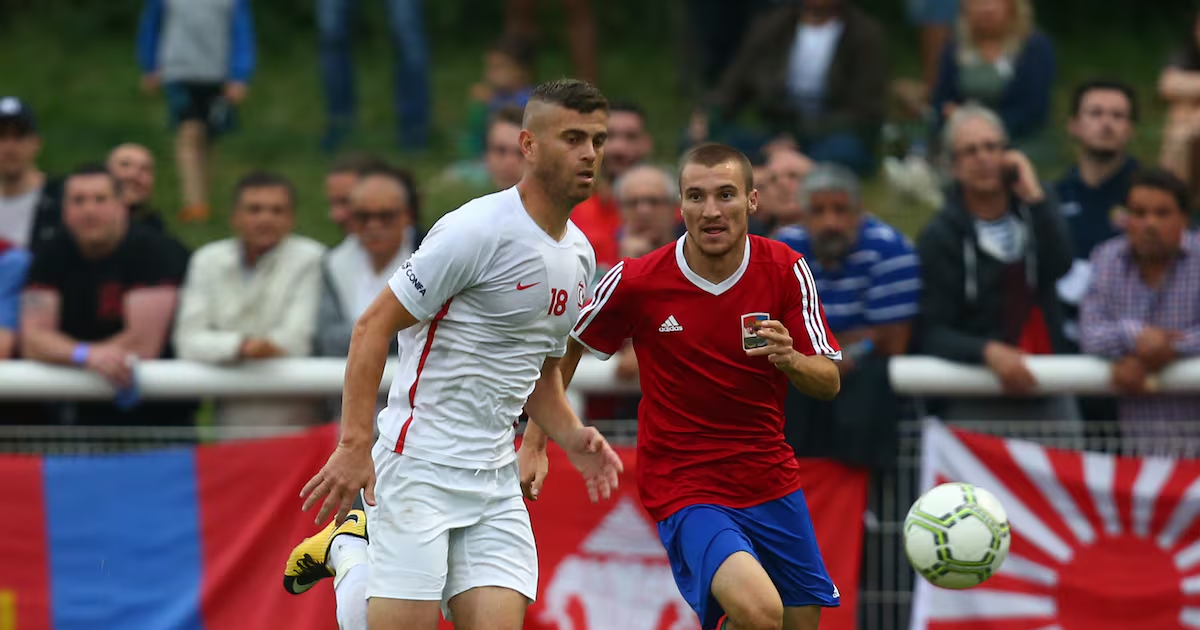
When Irish hearts were broken in that cruel penalty shoot-out in Prague last March, it brought the number of consecutive World Cups we have missed out on to six. Frustrated Ireland fans have found themselves wondering when Irish football’s glory days will return.But just weeks later, Oisín Mac Eó stood in a conference room in Northern Cyprus making a presentation that could see Ireland back on the international soccer stage.The Derry native was presenting a case to Conifa, the Confederation of Independent Football Associations, at its annual general meeting. Conifa represent teams who do not reach the requirements for Fifa membership. It describes itself as “the football federation for all associations outside Fifa”. It’s a global non-profit organisation that supports representatives of international football teams from nations, de-facto nations, regions, minority peoples and sports isolated territories.Mac Eó, a former school principal, stood before the assembly in April to make his presentation. He was not representing a county, province or state. He was representing a language.His proposal was for Cumann Sacair Gaeilge (CSG), an all-island football team for Irish speakers. The association has been unanimously accepted into Conifa’s ranks, becoming one of the newest members of a football organisation that has spent the last decade building an alternative international game.“To be honest, I first came across Conifa on an Instagram reel,” Mac Eó says. “I’m the kind of person who can’t resist a challenge, particularly one that involves building something new from the bottom up, especially if it could enhance our daily lives as a living Gaelic language community.”Mainstream international football exists within Fifa’s rigid architecture of 211 recognised national associations, all of which are internationally recognised nations. So what if you identify with a nation that doesn’t have international recognition? Conifa is populated by teams representing communities as diverse as the Sami people of Scandinavia, the Hungarian minority in Ukraine, the Isle of Man, Kurdistan, Tibet and now Irish language speakers. Tibet fans wave Tibetan flags during a Conifa World Football Cup match against Abkhazia in Enfield, north London, in May 2018. Photograph: Ben Stansall/Getty Conifa was founded in 2013. The organisation says its members collectively represent more than 950 million people worldwide. Membership can be based on linguistic, ethnic, regional, national or diasporic identity regardless of diplomatic recognition.In 2018, Conifa’s World Football Cup was held across London and the southeast of England. Sixteen teams participated, representing an estimated 334 million people across five continents. The finalists were Northern Cyprus and Kárpátalja, a team representing the Hungarian minority in Ukraine’s Zakarpattia region. Kárpátalja won on penalties. Tibet, Barawa, Cascadia, Padania and the United Koreans in Japan all also competed.The tournament drew in thousands of supporters, but was not without its controversy. The Greek community in London protested against the inclusion of Northern Cyprus (a Turkish-backed breakaway region). Some sponsors pulled out over the inclusion of Tibet due to fears of upsetting China. The controversial nature of the tournament is highlighted in the fact that they have not been able to host a World Football Cup since 2018. The tournament has been planned for Kurdish Iraq the past number of years, but has been postponed due to rising geopolitical tensions in the area.Conifa can provide some legitimacy for communities or nations for whom independence or recognition might not be obtainable. The founding principles of Conifa speak of building bridges between peoples, minorities and isolated regions through sport. For reasons that are obvious, this can be politically sensitive territory. Over the years Conifa has included members from regions involved in territorial disputes and independence movements. The organisation insists it remains politically neutral, focusing instead on the right of communities to participate in international football.Riccardo Ravasi of Padania during the Conifa World Football Cup bronze medal match against Szekely Land at Queen Elizabeth II Stadium, London, in June 2018. Photograph: Kieran Galvin/Getty One of the most controversial Conifa entrants was the Donetsk People’s Republic (DPR), a Russian-backed separatist region in eastern Ukraine. People saw the DPR team as representing the Russian invasion of eastern Ukraine and of being an attempt to spread imperialist Russian propaganda. Conifa insisted they represent all communities – if the Hungarian community in Ukraine or the Korean community in Japan were allowed teams in Conifa, then why would the Russian community in Ukraine not be? Conifa’s general secretary at the time publicly said he disagreed with the DPR politically, but allowed them to play under the group’s inclusive charter. The DPR played in Conifa until 2022.This balancing act between staying genuinely politically neutral but also trying to represent all of these groups of people is a tough one. Several planned Conifa tournaments have encountered diplomatic obstacles. Visa issues, geopolitical tensions and questions of recognition have repeatedly complicated fixtures. Kabylia, a region in Algeria seeking independence, had many players who pulled out of their squad at the last minute in the 2018 World Football Cup due to fears that there would be repercussions from the Algerian government when they returned home for representing a separatist team.The Barawa Football Association, representing people from a coastal region of Somalia, were chosen as the host team for the 2018 tournament. The association is based largely in the United Kingdom due to migration, so the tournament took place across non-league football grounds in England.Elsewhere, the Sápmi national team has become a source of pride for the indigenous Sámi people across Norway, Sweden, Finland and Russia. Cascadia fields players from Oregon, Washington and British Columbia. The Tibetan national side offers a rare international platform for Tibetans in exile.The common thread between these teams is not sovereignty but identity. That is exactly what gave Mac Eó the idea to form an Irish language team.Mac Eó was influenced by a grandmother who was a native Irish speaker from Mín an Labáin, Co Donegal. He later helped found Gaelscoil na Daróige in Derry and spent years working in Irish-language education and community development.Szilard Magyari of Szekely Land and Nicolas Dossi of Padania during the 2018 Conifa World Football third-place play-off final. Photograph: Kieran Galvin/Getty Football has always been part of his life. A devoted Derry City FC supporter, he has followed the club around Ireland and Europe since its return to League of Ireland football in the 1980s. “It’s about civic pride and supporting your community as much as anything else,” he says.Mac Eó explains his reasoning behind the formation of the team as not being about a big statement or a protest, but simply about creating more spaces for Irish to be used. “The more opportunities we have to use the language naturally in our everyday lives, the better for us as a living language community.”For many activists, the challenge is creating spaces where Irish functions as an everyday language rather than a symbolic one. Sport offers one such space. The GAA has long provided a natural home for Irish-language expression, but outside Gaelic games opportunities are more limited.Now that Cumann Sacair Gaeilge has been accepted into Conifa, the hard work begins. CSG must now organise fixtures, recruit players and establish itself within the Conifa calendar. Friendly matches are the immediate priority. Longer term, Mac Eó dreams of building CSG into a competitive force within Conifa. “Ultimately, [our aim] to go all the way to the World [Football] Cup,” Mac Eó says. He is only half-joking.For all its eccentricities, Conifa has demonstrated a capacity to turn unlikely ideas into reality. A decade ago, the notion of international tournaments featuring teams representing minority languages, diasporas and stateless peoples seemed fanciful. Today it is an established, if imperfect, part of football’s landscape. Whether Irish speakers ever find themselves lining up against Cascadia, Tibet or the Sámi in a Conifa World Football Cup remains to be seen.When the Georgian breakaway region of Abkhazia won the World Football Cup in 2016, the region broke out into street parties and celebrations. For them this was akin to international recognition and the Fifa World Cup – something which their nation, as they see it, may never have the chance to compete in. As for Cumann Sacair Gaeilge, who knows? An Irish team might soon be in a World Cup after all.
‘Éire abú’: How Ireland could yet again taste football glory on the world stage
Alternative to Fifa runs own global tournament and has accepted Cumann Sacair Gaeilge, an all-island team for Irish speakers
1,358 words~6 min read