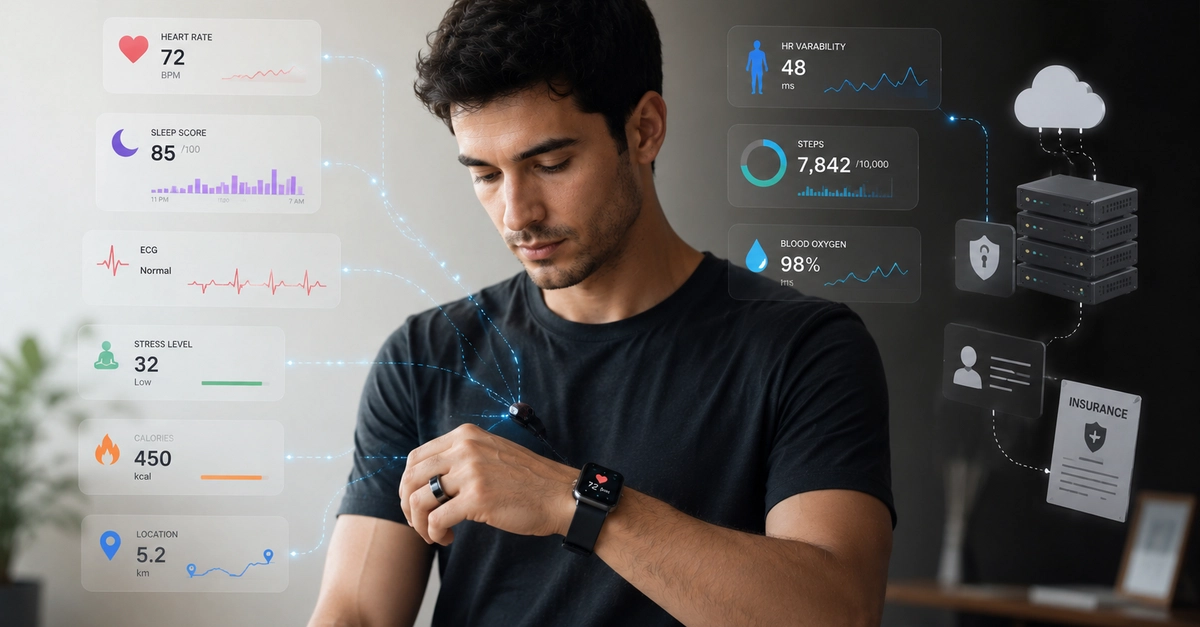
Elyse Betters Picaro / ZDNETFollow ZDNET: Add us as a preferred source on Google.ZDNET's key takeawaysWearables generate a lot of data, but doctors can't always use it.A system built for episodic care struggles with streaming data. Some doctors are hopeful advances like AI could help.Cardiologist Dr. David Kao is used to patients walking into appointments armed with data from their wearables. One Wednesday morning in late May was no different: a patient showed him stats from her smart band that she was worried about."Probably 70% of it, I just don't know what to do with clinically, because it's all been made up by the company," said Kao, who is an associate professor of cardiology at the University of Colorado School of Medicine. "And then there were like two things that were incredibly useful that we would not have had if she wasn't wearing her [device]."Scenes like this one have been playing out across the country for more than a decade as patients and doctors struggle to handle the glut of metrics produced by wearable technology. "You just get this fire hose of all this different kind of information," Kao said. "Usually you have to look up some of it to even have a remote idea of how to comment on it, and there's not a way to digitally summarize or support a clinician in understanding what to do with any of that."More than 30% of adults in the US own a fitness or wellness wearable, according to a report from data platform Statista. As these devices have proliferated, so has the sheer amount of metrics about the people wearing them. Heart rate, blood pressure, sleep patterns, stress, pulse oxygen, and more. In short, the individual human has never been more quantified. While wearables are often marketed with big promises of how data can lead to a healthier, more optimized life, the reality is far more complicated for the patients and doctors who want to figure out what these insights mean and how to use them.Streaming careUnless you have a chronic condition or an annual checkup, odds are you only visit the doctor when something happens. In an era of wearable health devices, an episodic care system isn't structured to accommodate an ongoing stream of health data. "As much as the physicians do believe in its utility, their systems, their infrastructure, and the resources that they have, including time and staffing, aren't set up to receive and make use of that data," said Ream Shoreibah, teaching associate professor of marketing at the University of Alabama at Birmingham.Shoreibah is on a team of researchers who published a recent report in The Journal of Consumer Affairs exploring the challenges that exist among patients, their data, and doctors. One key issue they highlighted is integrating wearable data into patients' electronic health records, or EHRs.Also: Asking AI for medical advice? There's a right and wrong way, one doctor explainsAbsorbing wearable data into an EHR is hard for a variety of reasons. For one, the process requires two separate clouds owned by two big companies to talk with each other. There also has to be a way to guarantee that patient data from a wearable makes it into the correct person's EHR, said Dr. Ida Sim, professor of medicine at the University of San Francisco, as well as computational precision health at UCSF and the University of California, Berkeley. Sim is also the co-director of the UCSF and UC Berkeley joint program in Computational Precision Health."All of that is just a Wild, Wild West," she said.But even when wearable data could be quickly and easily ported into an EHR, Sim said, even now, providers are managing myriad accounts and logins for different proprietary platforms required to view the data, which might not even be presented in the same format.Meanwhile, governance remains murky, and providers will have to decide which data to store, or not to store, and for how long. Does your doctor need a record of your heart rate recorded every five minutes for the last three months -- or in perpetuity? And as Sim noted, various wearables use metrics like recovery and strain, whose meanings often don't translate neatly into a clinical setting. Some doctors question whether they can trust the metrics at all.Shoreibah and her fellow researchers discussed this issue in their study. "These validity concerns create a professional dilemma: dismissing wearable-generated data risks alienating engaged patients, while acting on potentially inaccurate readings risks clinical harm," the study said.Validation like FDA approval or third-party testing, as well as greater transparency from wearables makers, could build trust in the data among both doctors and patients."We don't know the input, we don't know the processing, and all we get is a label, and a number, and some explanation, which may sound very scientific, but may not be at all," Sim said. Digging out of the digital avalancheDr. Kenneth Civello, an electrophysiologist at Our Lady of the Lake Regional Medical Center in Baton Rouge, Louisiana, can remember back to 2009 when the Fitbit hit the market, and patients started coming in with data. In particular, he remembers the first time he encountered new levels of insight. An elderly woman visited him, with everything loaded on her iPad. She was at an age where she was at risk for atrial fibrillation, and she was concerned."It looked like a rhythm that was a signature of atrial fibrillation," he said. "It was at that point that I kind of became a believer in wearables." Civello said there wasn't a total and immediate embrace of these new data sources. He described himself as both a fan and critic of wearable data, but the insights helped shape his view of what the future could look like. For example, when trying to remotely monitor patients' blood pressure, a wearable that's already on someone's wrist means that person doesn't have to stop and check it (or forget to) during the day. And to be sure, wearables have saved lives. Over the years, consumers have credited devices such as the Apple Watch for alerting them to situations like life-threatening irregular heart rhythms and more. Many clinical wearables, such as continuous glucose monitors, already exist and flow into EHRs. In fields like cardiology, the remote monitoring of patients isn't a new trend, either. Even patients without wearables bring in data. Sim said she's had folks come in with tables of blood pressure data on illustrated pages. Or scrawled on napkins.As chaotic as this approach sounds, doctors like Civello have reason to be optimistic. Wearable makers are making moves to smooth the friction. In 2025, Samsung bought care orchestration platform Xealth. Xealth integrates with Epic, the largest electronic health records vendor in the country. Civello hopes this move will make it easier to get data from Samsung health devices into patients' records. And if someone can fix the EHR problem, Civello thinks AI tools can be instrumental in helping doctors synthesize the "digital avalanche" of health data and create more personalized care. "The personalized part of it is going to come from large language models that know you know your healthcare data, and then put that together to have a synopsis that works with your doctor as the human in the loop," he said, also acknowledging that policy and regulation around medical information in LLMs has a way to go. After all, HIPAA doesn't apply to chatbots and consumer smart devices.The good news is that Kao said the University of Colorado is working on solutions to these challenges.The goal is "how do you partner or pair the operational electronic health record with some kind of intelligence support or feature or devices or something that consumes all that external wearable data and processes or interprets it in a way that everybody agrees is useful, and then puts the useful parts back into the health record for providers to act on?" he said.Sim is helping work on an open-source platform called JupyterHealth that aims to solve this data-ingestion problem without putting all digital infrastructure in the hands of a big company."Health is a public good, and we should not be looking at this as a purely commercial play. It's not. It's a public good, and so we need public infrastructure," Sim said.Also: 5 reasons you should be more tight-lipped with your chatbot (and how to fix past mistakes)Some general advice and best practices are forming, as well. The American Academy of Neurology released guidance in March for neurologists on the use of wearables."Physicians have a lot they need to keep up on within the field of medicine, and so having guidance created can be helpful for clinicians to learn some basics about the technology, have the limitations discussed and to raise awareness before the appointment with the patient," said Dr. Sarah M. Benish, neurologist and lead author of an American Academy of Neurology article on wearable devices, via email.As more of us sport wearables, Sim also hopes people keep in mind that even with copious amounts of cleanly synthesized data, charts and tables aren't necessarily a magic key that unlocks health. Diagnosing and treating a human isn't as straightforward as replacing a car's carburetor, she said.For Kao, he guides patients through disappointment, sometimes, when he just can't use their trove of data. "Patients, admirably, want to know more about themselves and how their body is doing and reacting to things."
Wearables produce huge amounts of health data - and doctors are struggling to keep up
Patients have never had more data about their health, but much of it is unusable. Here's why.
1,562 words~7 min read