A scientific team had colored PV modules using quasi-ordered photonic pigments rather than conventional absorbing dyes. The technique was inspired by blue feather birds. The colored PV modules exhibited efficiencies that represent more than a 50% improvement over conventional pigments.
A research group in China has developed a method for coloring PV modules using quasi-ordered photonic pigments instead of conventional absorbing dyes. Unlike traditional dyes, which create color by absorbing part of the incoming sunlight, the new pigments generate color through selective light scattering, allowing more solar radiation to reach the underlying solar cells and reducing efficiency losses.
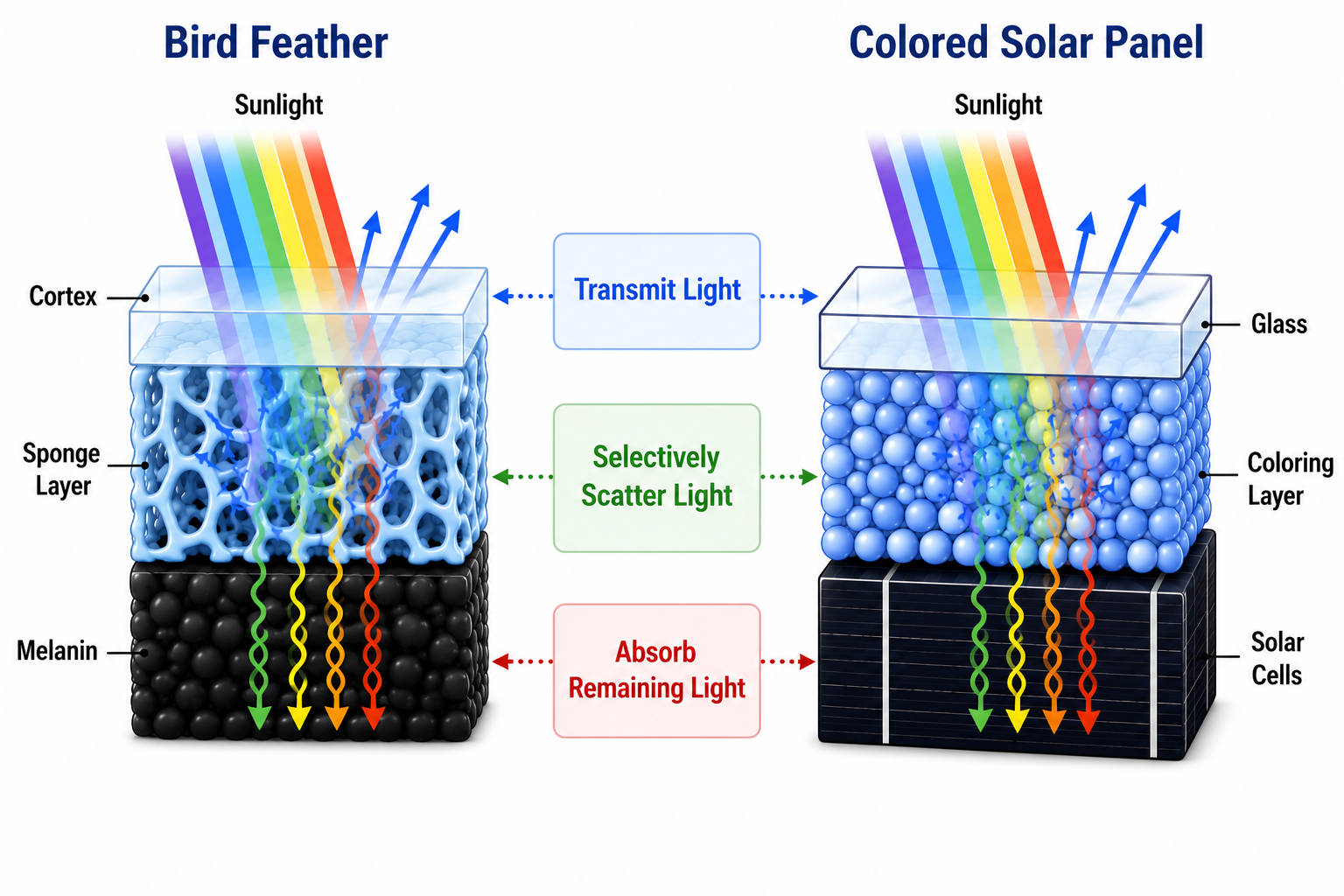
“Inspired by the blue feather combining a keratin-air network with black melanin to create structural color, we herein demonstrate the coloring of PV modules by placing quasi-ordered photonic pigments atop solar cells,” the researchers said. “These pigments, composed exclusively of silica microspheres and polyacrylates, enable selective and diffuse reflection of visible light while negligible absorption of solar radiation.”
The team explained that blue-feathered birds such as the Eurasian jay produce their coloration without blue pigments. Instead, sunlight passes through a transparent outer cortex and reaches a sponge-like nanostructure of keratin and air that selectively scatters blue wavelengths while transmitting the remaining wavelengths. The transmitted light is then absorbed by an underlying layer of dark melanin granules, leaving only the scattered blue light visible.