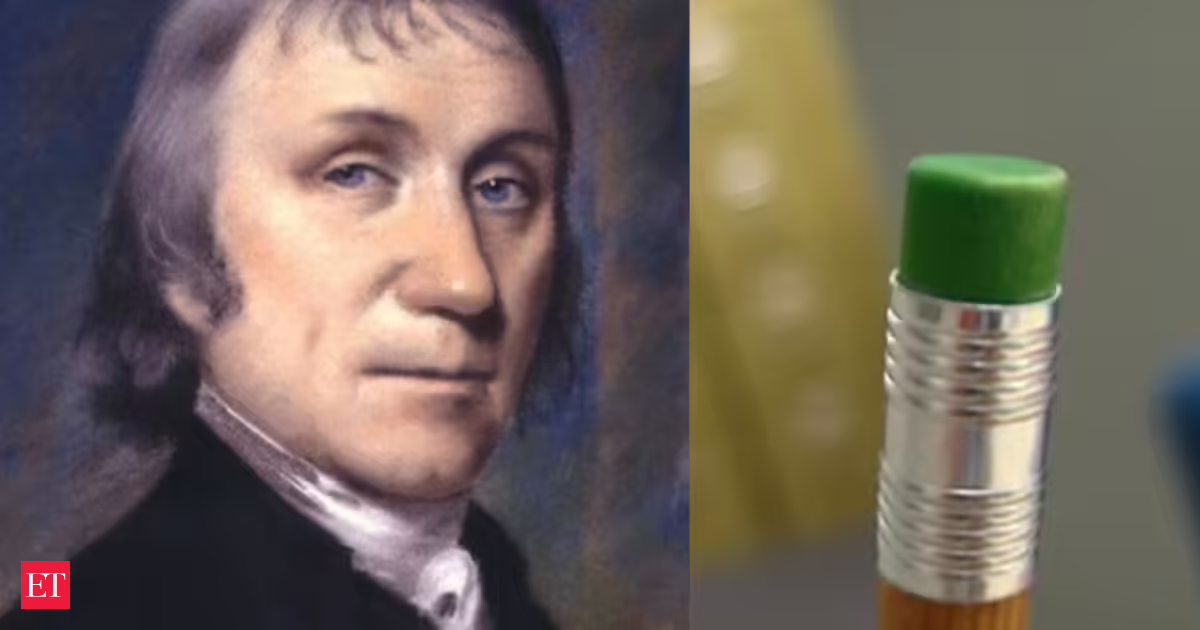
Inventions sometimes come about from a large scientific project, but other times, it is something simple that bothers someone and keeps bugging him until he finds a solution. This was the case with Hungarian journalist László Bíró in 1931. He encountered a problem that all writers of the time experienced: smudgy fountain pens.At the same time, however, he noticed that newspapers were not troubled by the same problem, since their ink dried quickly. Bíró started asking himself why this could not be done with a pen as well. His observation led to one invention that transformed the process of writing forever, one we now take for granted in our everyday lives.A common frustration became an engineering problemThis was not just an aesthetic issue but also functional. Writing had to be done with ink pens, which used relatively thin liquid ink that took too long to dry, so if someone wrote very fast, he or she was sure to find the ink smudging on the paper after a while. Instead of accepting this nuisance as the way things were, Bíró decided to take it upon himself to address this design flaw.The importance of the above observation is clarified by subsequent scientific studies. A paper published in Forensic Science International reported that a considerable amount of ink solvent evaporated within just a few seconds of deposition. Fast evaporation is not just an added advantage but is what made the use of ballpoint pen feasible in the first place.László Bíró | Wikimedia CommonsMoreover, the above observation raised an engineering issue. The ink should flow easily to enable proper writing, but not flood the surface.Why the ballpoint succeeded where other pens struggledThe idea of using a ballpoint pen is quite straightforward. Rather than letting the ink flow freely from the container, the ballpoint uses a small moving sphere to deliver the ink to the paper. Not only did it solve the problem of dripping, but it also enabled greater control when using a different kind of ink. Researchers who analyze the chemical components of contemporary ballpoint pens say that a successful formula requires balancing the amounts of solvent, lubricant, binder, and resin. If the ink is too liquid, then it can smear the writing. If the ink flow is insufficient, skipping occurs. In this regard, the ballpoint pen addressed both concerns.It did not take long to discover its practical benefits. According to historical records kept at the Illinois Institute of Technology, the pen provided an economical and durable replacement for the fountain pens. It was smaller and more convenient to carry, and reliable in any environment. When it comes to practicality, the user does not care about elegance and beauty.Ball-point pen | Wikimedia CommonsA small improvement that reshaped everyday lifeIt was not in its role in changing the writing itself that the ballpoint had an effect, but in eliminating the friction of the writing process. After a device becomes affordable, reliable, and comfortable, its adoption across schools, offices, households, and businesses is rapid. The ballpoint found a natural place among other instruments of modern times. As shown in ink chemistry research articles listed by the National Library of Medicine, the improvements were consistent even years after Bíró's initial innovation. However, manufacturers preserved the same key idea behind the design. This is probably why the ballpoint pen remains relevant to this day.This is exactly what makes Bíró's experience so memorable. He did not seek to revolutionize communication, just noticed something wrong and tried to solve the issue. A journalist observed newspaper inks with different drying times and realized there was a solution for the problem. The result was an instrument which would become extremely popular among millions of people. Nowadays, the ballpoint pen is so ubiquitous that most people do not pay much attention to it; however, the story shows that the pen can actually make someone's day easier if chosen wisely.
In 1931, a journalist noticed that newspaper ink dried faster than his pen, which led to the invention of the ballpoint pen
While reporting on the latest stories, Hungarian journalist László Bíró found himself frustrated by the black smudges left by traditional fountain pens and the slow-drying ink of newspapers. Seizing the opportunity to improve the writing experience, he invented the ballpoint pen, a straightforward yet groundbreaking tool that streamlined the act of writing.
647 words~3 min read