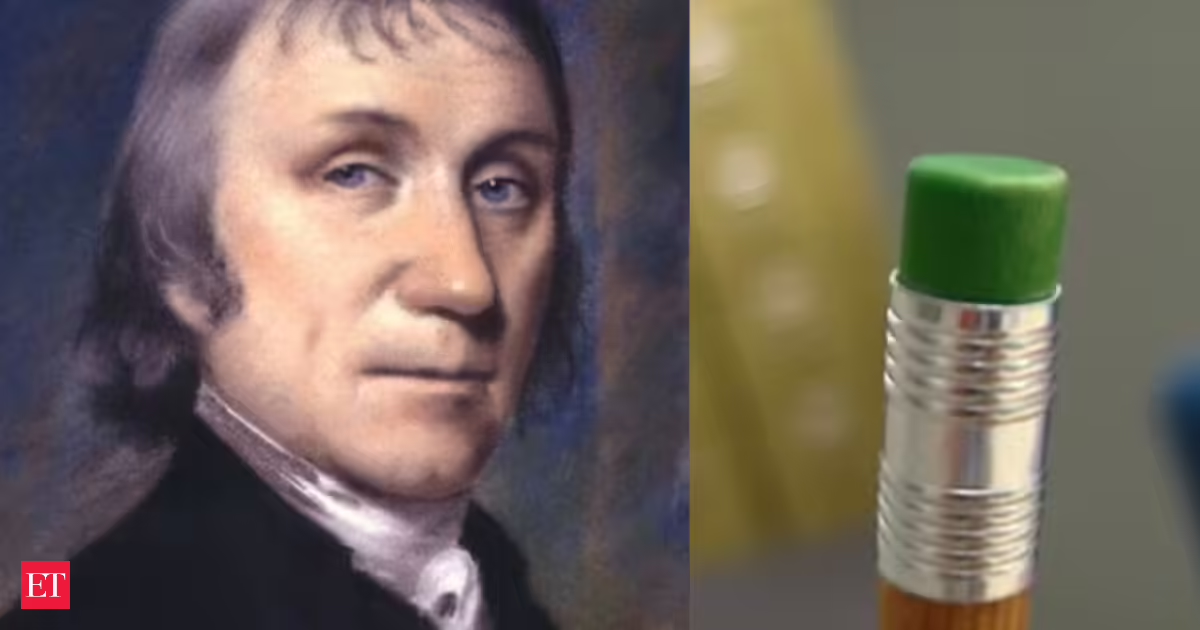
In 1770, a scientist was handling a lump of rubber and found it rubbed pencil away, leading to the creation of the eraser, changing every school deskSynopsisA pivotal moment in 1770 came when Joseph Priestley noted that natural rubber could easily wipe away graphite marks from paper. A material well-known to indigenous communities, Priestley's revelation opened the door to the invention of the eraser. This simple tool turned writing mistakes into manageable corrections, fundamentally changing the approach for everyone from schoolchildren to professional authors.Joseph Priestley | Wikimedia CommonsSome creations appear after a period of intense publicity, with immense significance. There are some inventions that begin with a simple observation that seems too trivial to be a creation but has far-reaching impacts in the future. The present-day eraser is one such creation.As early as 1770, an English scientist, Joseph Priestley, observed that using a small piece of natural rubber, one could easily rub graphite marks off paper. While historians of materials have pointed out that natural rubber had long been in use in Central and South America prior to its discovery by Europeans, what Joseph Priestley created here was not the material itself but its most interesting use.Joseph Priestley | Wikimedia CommonsRubber was already old long before Europe discovered a new use for itOne of the most significant elements of the story is usually overlooked. The eraser was not invented through the invention of the rubber compound. According to a study published in Progress in Polymer Science and a review of the history of natural rubber, indigenous peoples of Mesoamerican and South American cultures had been harvesting and using latex from rubber trees for centuries before European scientists studied the substance. They used rubber for ceremonies, tools, waterproofing, and even playing games long before the invention in eighteenth-century Europe.When European scientists finally obtained samples of natural rubber, they knew the substance was special in many ways: it could stretch, be compressed, bounce, and exhibit properties unlike those of any other common material. Despite these properties, the best-known practical application of the substance had yet to emerge. This is the beauty of the eraser story. Invention did not mean inventing something new but rather discovering the practical use of an old material.A simple observation changed writing foreverHistorical records reviewed in the scientific literature in the materials field show that Priestley discovered that rubber can effectively erase pencil marks on paper. This discovery was practical rather than theoretical, and no experiment or complicated apparatus was involved; no new machine was invented. It was just a substance that solved a problem. The timing was critical, as writing had become a key component of education, business, science, and government processes during that period. Although writing with pencils made it easier to correct errors than writing with ink, it still represented an inconvenience. The availability of a substance capable of successfully erasing graphite was the solution.Scientists describing the history of rubber point out that rubber rapidly came to be known as a material used to erase graphite, leading to its name "rubber." This is remarkable in that few objects are so closely associated with an action that their names are defined by it, making this discovery unforgettable for many years to come. However, more importantly, the discovery of the eraser fundamentally changed the nature of writing itself.A pencil eraser | Wikimedia CommonsFrom scientific curiosity to classroom essentialLike other useful inventions, the eraser was not immediately accessible to everyone from the start. Rather, people learned about its qualities, manufacturing improved, and interest grew organically as people understood its purpose. In reviews appearing in Philosophical Transactions of the Royal Society and in more general histories of natural rubber itself, the practical application of materials is considered a decisive factor in determining the course of its development into a commonplace tool. And practical application of rubber as an eraser was precisely one such application.No words were needed to describe the object and explain its purpose; everything was clear at once. The mark showed up, the mark went away. Not many objects can speak of their purpose so openly. Thinking about it, the discovery seems incredibly minute: a scientist picked up a piece of rubber and saw what happened when it came into contact with the pencil marks. However, many great discoveries start this way. Someone notices something helpful that others have not and gives a common item a whole new place in our lives. While the eraser may seem to eliminate only graphite from a surface, its contribution goes much deeper. By making revision work easier, providing protection against the risk of permanent mistakes, and offering a second chance in the learning process, it opened up a world of possibilities for students, authors, engineers, and artists.Read More News on(Catch all the US News, UK News, Canada News, International Breaking News Events, and Latest News Updates on The Economic Times.) Download The Economic Times News App to get Daily International News Updates....moreless
In 1770, a scientist was handling a lump of rubber and found it rubbed pencil away, leading to the creation of the eraser, changing every school desk
A pivotal moment in 1770 came when Joseph Priestley noted that natural rubber could easily wipe away graphite marks from paper. A material well-known to indigenous communities, Priestley's revelation opened the door to the invention of the eraser. This simple tool turned writing mistakes into manageable corrections, fundamentally changing the approach for everyone from schoolchildren to professional authors.
822 words~4 min read