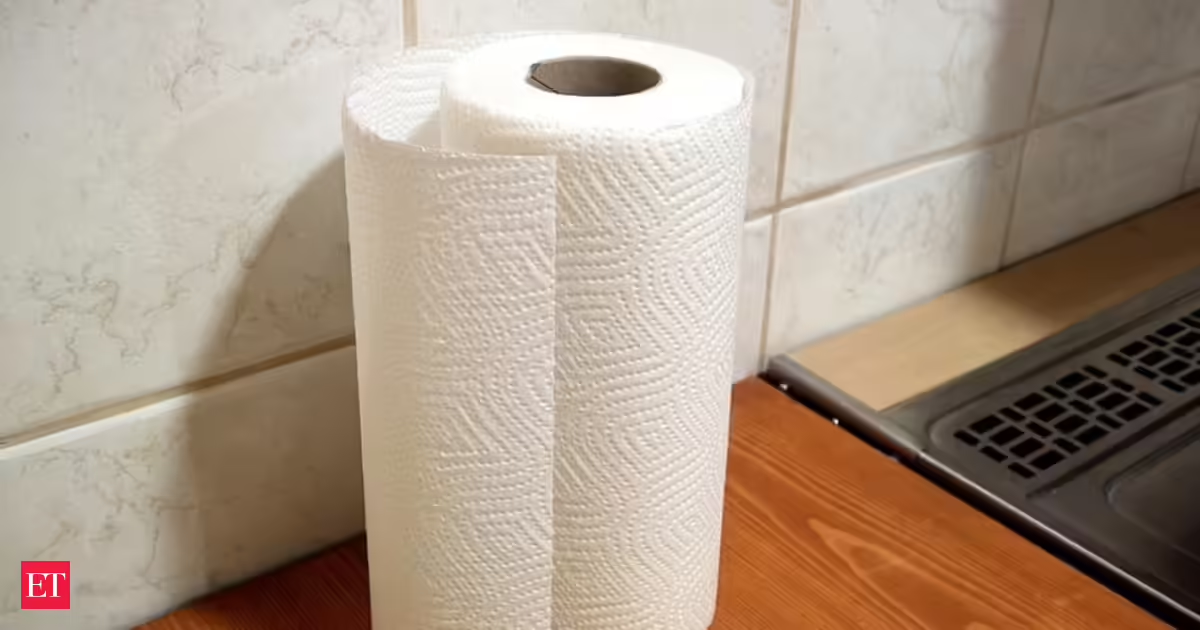
While some items can be attributed to lengthy, well-thought-out planning, others originate out of necessity. As stated in Scott Paper Company’s historical background, paper towels originated from a manufacturing defect in 1907. Namely, a defective shipment of tissue paper was too strong for its intended use.However, rather than waste what could be saved, the company decided to find another use for the product, using it as sturdier, more absorbent sheets. From an industrial accident, paper towels became an everyday product. The origin of this item demonstrates yet another characteristic of industry: some products become innovations when they are found to have unexpected uses in solving another problem.Paper towel | Wikimedia CommonsA manufacturing problem created an unexpected opportunityThe backstory of paper towels is interesting, since the process starts not with seeking to develop an entirely new product class but with facing an issue on the production line. According to the historical accounts, some tissue sheets, originally intended for a different purpose, turned out to be surprisingly strong.Rather than considering these products as waste, the firm decided to investigate whether they could be put to other practical uses. It is quite a common practice in industrial production; companies are always experimenting with different materials. While such experiments sometimes lead to complications, there are occasionally unexpected benefits.It is important to understand that the paper manufacturing industry at the time was undergoing dramatic transformations. The history of papermaking, provided by Penn State, shows how technological innovations enabled the production of standardized paper sheets with specific physical properties. As a result, it became possible to consider paper as a material created specifically for certain needs.The real breakthrough was absorbency combined with strengthThe usefulness of absorbent paper was clear, but being highly absorbent alone was insufficient to make an effective paper towel. There were other factors, such as wet strength and absorptivity, that made the use of paper towels different from that of regular paper. Wetness and durability can be analyzed from a materials science perspective, and highly absorbent materials tend to lose their durability when moistened with water; it became necessary to develop a sheet that could absorb liquids while maintaining its mechanical properties to properly wipe surfaces.As seen in the introduction to paper production at Penn State, further advancements in the field enabled paper producers to make sheets that could serve various purposes depending on exactly what was required. It can be said that paper became an advanced platform due to this progress rather than remaining just an everyday material. It is interesting that paper towels found themselves at the sweet spot between disposability and durability.Hygiene gave the product a powerful advantageHowever, in addition to convenience, the increase in demand for paper towels could be associated with changes in the concepts of hygiene and sanitation. The effectiveness of hand drying in reducing microbial transfer is supported by numerous studies published in Mayo Clinic Proceedings and other peer-reviewed hand hygiene literature. Leftover moisture from the hands may become a carrier for microorganisms, making hand drying part of the process rather than its conclusion.Indeed, a study published in Mayo Clinic Proceedings indicated that paper towels are effective at drying hands and limiting the risk of contamination. In addition, another study analyzing different hand-drying methods has shown that paper towels provide better hygiene protection than alternative drying options. Therefore, the increased popularity of disposable paper products in the twentieth century can be explained not only by convenience but also by changes in hygiene standards.1915 newspaper ad for the company's toilet paper | Wikimedia CommonsA salvage operation became a household habitInnovations can arise in a variety of ways, sometimes through improvements to existing products rather than creating something entirely new, as seen in the development of paper towels. While a batch of tissue paper that did not turn out as expected was not necessarily intended for the purpose it served, once its qualities were recognized, it sparked the creation of a product used by millions each day. Several aspects of paper towel manufacturing had to converge at the right moment for this to happen: developments in papermaking, its absorptive quality, growing focus on hygiene, and consumer demand for easy cleanup.When this came together, adopting this product became very simple, as it solved a frequently encountered problem without any further explanation needed. Simplicity is what has kept the product relevant over the years. Over a hundred years since its invention, it basically still does the same things it did then: absorb moisture and messes, and be discarded afterward. The paper towel became one of the most popular household goods despite having arisen from what initially seemed like a manufacturing error, and few other manufacturing mistakes have enjoyed such a prosperous fate.
In 1907, a paper company trying to salvage a shipment of tissue sent out stronger sheets, which led to the creation of paper towels
In 1907, what began as a manufacturing mishap morphed into the revolutionary invention of paper towels. The unexpected resilience of tissue paper found itself embraced by consumers, with innovations in papermaking and a rising demand for cleanliness igniting its fame. This practical, throwaway solution soon became essential in kitchens and bathrooms alike, tackling spills and grime like a pro.
782 words~4 min read