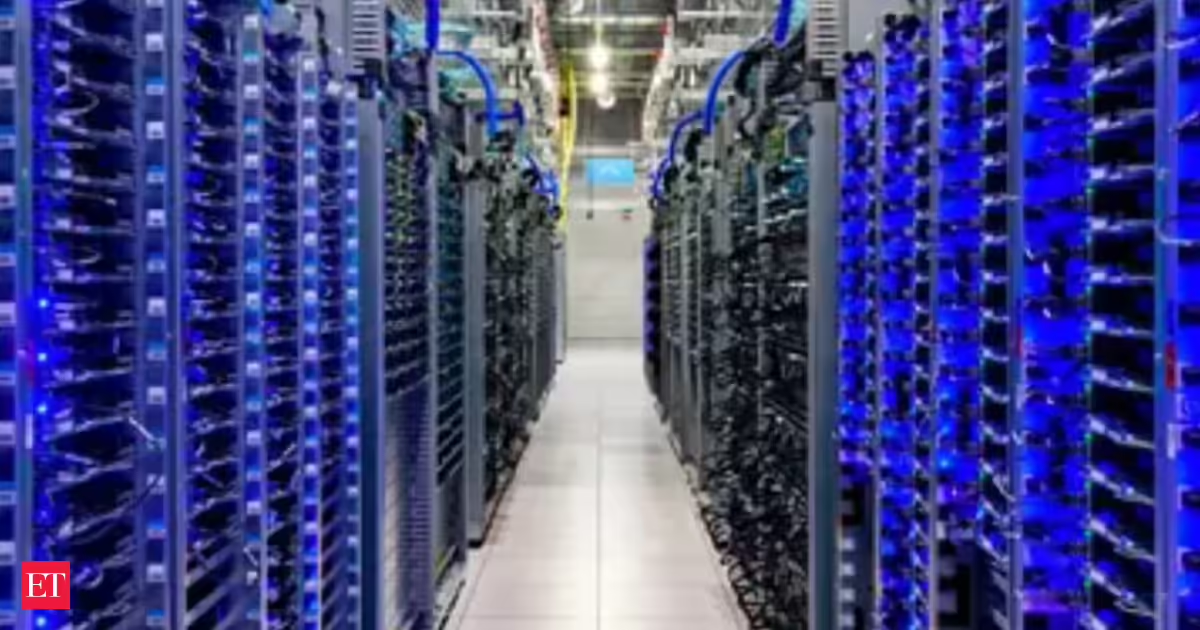
Major global technology companies are racing to set up large data centres in Southern India. Cities such as Chennai, Bengaluru and Hyderabad are emerging as preferred hubs for hyperscale digital infrastructure, supported by coastal connectivity, skilled workforces and state incentives. Industry estimates suggest that data centre capacity in the region is set to grow by roughly 65% by 2030. This expansion is not incremental. Each new campus brings electricity demand comparable to that of a mid-sized city, and these facilities must run continuously. Southern India is increasingly positioning itself as a digital infrastructure corridor serving both domestic and international markets.Digital HubThe scale of this shift forces a difficult question. Southern India must add vast amounts of power in a relatively short period of time, yet it cannot afford to meet that growth with higher carbon emissions. Solar and wind capacity are expanding rapidly, but data centres cannot depend on intermittent supply. They require electricity that is both clean and constant. This is where existing large-scale infrastructure, including generation from the Kudankulam Nuclear Power Project, begins to shape the conversation about how the region can grow without deepening its environmental footprint.South India’s electricity demand is already under pressure from industrial expansion, rapid urbanisation and rising temperatures. Manufacturing corridors, ports and logistics hubs depend on uninterrupted supply to remain competitive. Digital infrastructure adds a new layer of baseline demand that operates around the clock. Electricity is no longer only about meeting seasonal peaks. It underpins an economy that expects constant connectivity and continuous production.In this context, Southern India hosts three major operational nuclear power stations, with the Kudankulam Nuclear Power Project standing as the region’s largest contributor to electricity generation, and its contribution to the southern grid becomes easier to quantify. The first two reactors at the site generate about 2,000 megawatts of electricity. Cumulative generation has crossed 100,000 million units. Electricity from the plant is distributed across the region, with allocations such as 925 megawatts to Tamil Nadu, 442 megawatts to Karnataka, 266 megawatts to Kerala and 67 megawatts to Puducherry. This steady output supports major industrial clusters and urban centres that rely on dependable baseload supply.Reliable generation at this scale has environmental consequences as well. Electricity from Kudankulam replaces power that would otherwise come from coal-fired plants. The operating reactors have helped avoid an estimated 86 million tonnes of carbon dioxide emissions cumulatively. The department of atomic energy notes that each unit of nuclear electricity displacing coal can prevent roughly one kg of CO₂ emissions. On that basis, the annual avoided emissions from Kudankulam run into the low tens of millions of tonnes, basis the yearly output. For a region that continues to grow economically, these figures illustrate how large-scale clean generation can moderate the carbon intensity of expansion.Southern India has invested heavily in renewable energy and that momentum is essential to long-term climate strategy. Solar and wind capacity will continue to grow across the region. Their variability, however, creates operational constraints for systems that must deliver electricity without interruption. Data centres, industrial facilities and dense urban networks cannot pause when sunlight fades or wind speeds fall. Grid scale storage technologies are advancing, but they remain limited at the scale required to support uninterrupted supply. Stable sources of clean baseload generation therefore remain a necessary partner to renewable expansion.The Kudankulam complex is now moving into a new stage of development. Construction of Units 3 and 4 has progressed beyond eighty percent, and commissioning of the next reactor is expected around 2026. Completion of the planned six-unit complex will move the site toward an installed capacity of roughly 6,000 megawatts. Recent regulatory reforms, including the framework introduced under the SHANTI Act, are designed to streamline approvals and financing structures for nuclear projects. For expansion programmes such as Kudankulam, such measures can reduce execution bottlenecks and improve long term investment visibility. These nuclear regulatory reforms strengthen India’s ability to attract energy intensive digital investments, particularly in the southern data centre cluster, where access to reliable clean power is increasingly a competitive advantage.The trajectory of Kudankulam also illustrates how large infrastructure projects become embedded in regional systems over time. Debate around the project was intense and often polarised. As the plant entered stable operation and its contribution to the grid became measurable, its role shifted from abstraction to utility. Electricity that runs industries, powers cities and reduces emissions tends to reshape public understanding in concrete terms.Southern India now faces an energy landscape defined by convergence. Industrial growth, digital infrastructure and climate commitments are pulling in the same direction. Meeting these demands requires an architecture that combines renewable ambition with dependable sources of clean baseload power. The experience of Kudankulam does not resolve every challenge, but it demonstrates how diversified infrastructure can support economic expansion while limiting environmental cost. As the region evolves into a major centre of digital and industrial activity, access to large volumes of reliable clean energy will remain a foundational requirement for its future.India’s digital and industrial expansion is tightening the link between energy infrastructure and economic competitiveness. Large scale investments in data centres and manufacturing depend on electricity that is reliable and compatible with climate commitments. Projects such as Kudankulam illustrate the level of capacity and planning required to support that transition. The question is no longer simply how much electricity is produced, but whether it is dependable and clean enough to sustain growth. In the coming decade, that distinction will play a decisive role in shaping India’s economic trajectory.(The views expressed are personal)This article is authored by Rudra Prasad Pradhan, professor, department of humanities and social sciences, BITS Pilani KK Birla Goa Campus, Goa and Political Economy Distinguished Fellow, Centre for Public Policy Research.
South India’s digital hubs need clean power supply
This article is authored by Rudra Prasad Pradhan.
946 words~4 min read