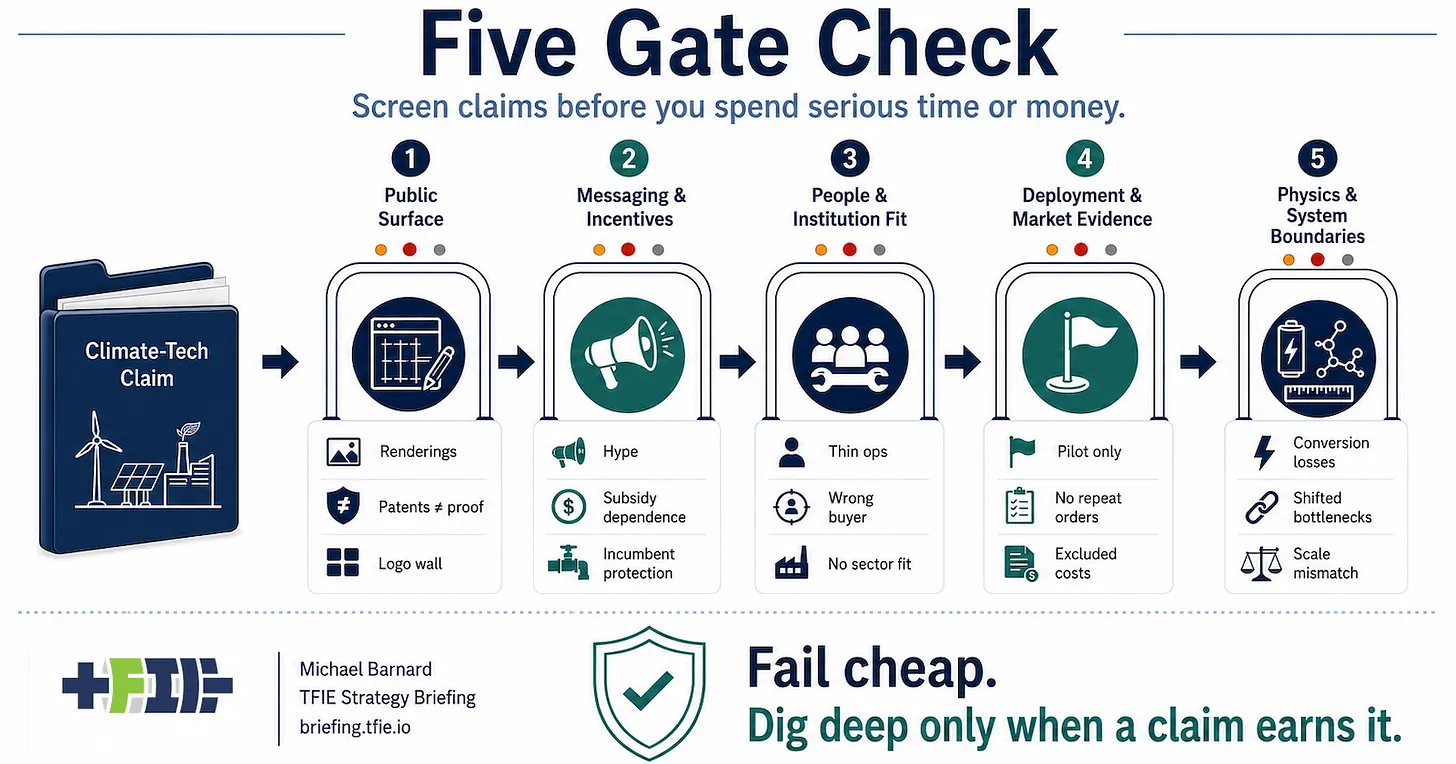
Climate-tech claims need to be tested against comparators, customers, costs, and repeat procurement, not just announcements and pilots.
Support CleanTechnica's work through a Substack subscription or on Stripe.
Energy transition analysis is littered with evidence that is real and stories that are not. A pilot exists, therefore the market is forming. A government grant lands, therefore the technology has been validated. An offtake agreement appears, therefore customers must be willing to pay. A large company issues a press release, therefore deployment is imminent. That chain of reasoning shows up constantly in hydrogen, carbon capture, synthetic fuels, small modular reactors, long-duration storage, aviation fuels, maritime fuels, and every other corner of climate-tech where a hopeful story can get ahead of the operating evidence.
The useful habit is counterinduction: when a fact is presented as evidence for a climate-tech story, ask whether it proves the opposite. Does the pilot show readiness for scale, or how much special treatment is needed? Does the grant validate the technology, or reveal that private capital would not carry the risk? Does the offtake agreement prove market demand, or just corporate signaling at an undisclosed price? The full TFIE Strategy Briefing analysis works through the method in more detail, but the core move is simple: keep the fact, challenge the story attached to it.