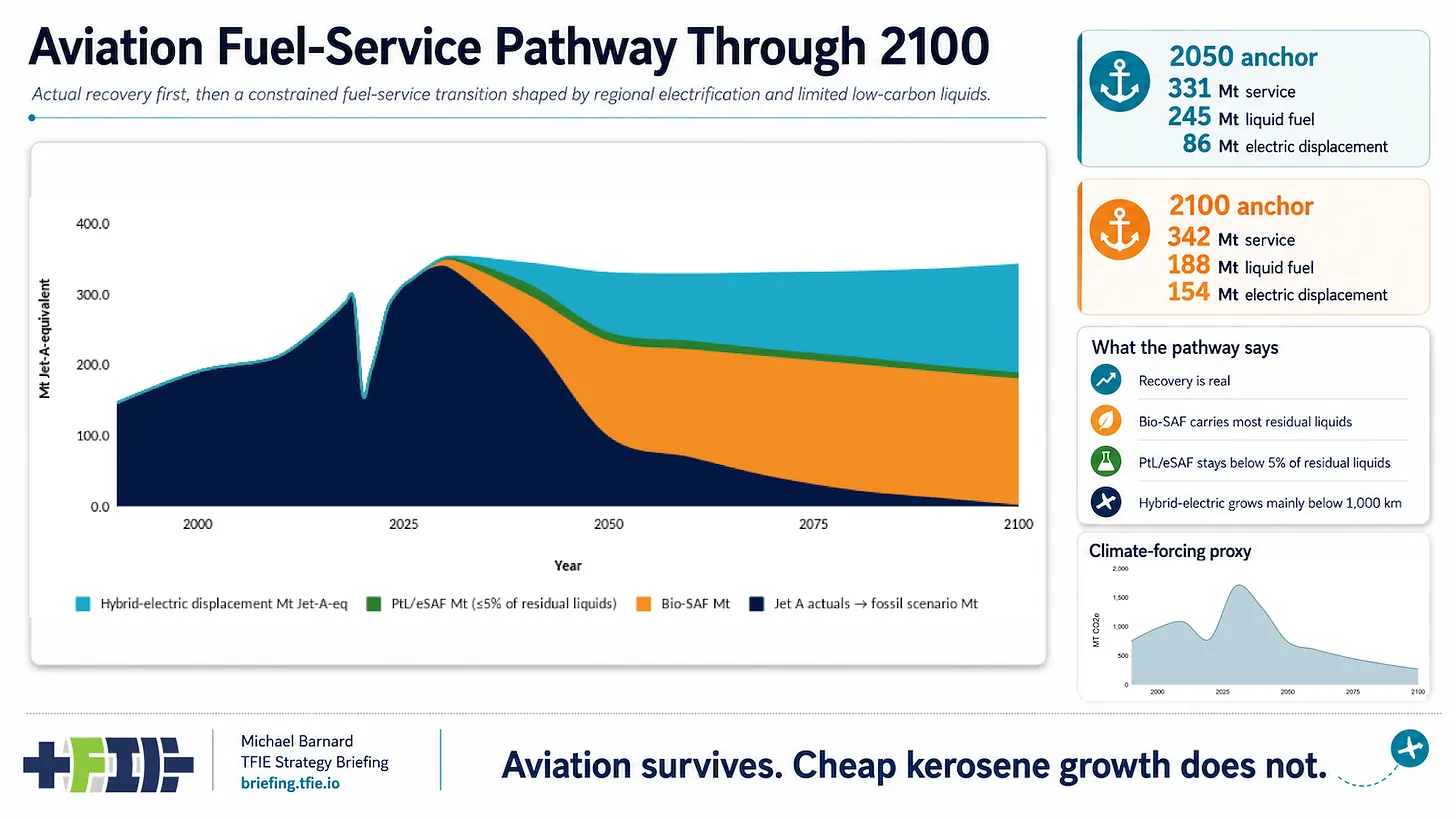
The updated aviation fuel-service projection starts from post-COVID recovery, then bends liquid-fuel growth through regional-electric displacement, constrained SAF and demand pressure.
Support CleanTechnica's work through a Substack subscription or on Stripe.
Aviation is one of the harder transition sectors to model well because it invites two bad shortcuts. One is to assume that flying keeps growing as it did in the cheap-kerosene era, with a cleaner molecule somehow dropped into the same demand curve. The other is to assume that decarbonization or post-COVID behavioral change makes aviation demand collapse. Neither is a good starting point.
COVID did not permanently break aviation. Fuel demand recovered enough that any serious long-term projection has to start from that reality, not from a pandemic trough. People still fly for family, migration, business, holidays, emergencies, remote communities, islands, medical needs, and simple curiosity. Aviation provides real mobility services, and those services do not disappear because aviation is hard to decarbonize.
But recovery is not the same thing as a return to cheap kerosene growth. The old aviation model was built around abundant, energy-dense, relatively cheap liquid fossil fuel. That fuel shaped aircraft design, airline economics, hub networks, ticket prices, route structures, and expectations about growth. Once the sector has to absorb sustainable aviation fuel mandates, lifecycle emissions rules, carbon prices, feedstock constraints, synthetic-fuel costs, and more scrutiny on avoidable flying, the fuel-service curve changes.