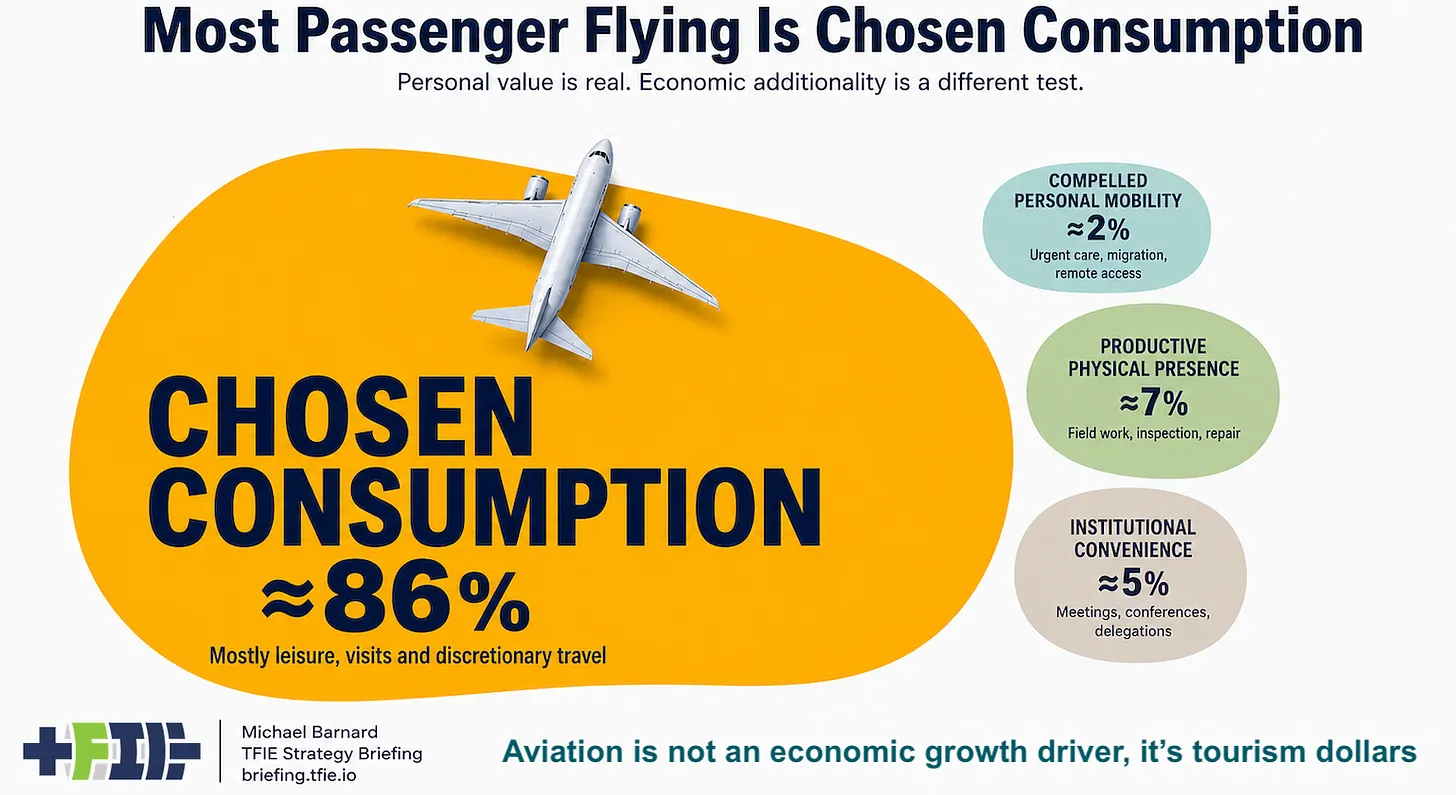
Most passenger flying is chosen consumption. Aviation’s economic footprint is real, but additionality depends on what each journey causes that would not otherwise happen.
Support CleanTechnica's work through a Substack subscription, on Patreon, or on Stripe. Help us produce all of the high-quality, original content we publish week after week despite the challenges of content-scraping AI, antisocial media, inflation, and other hurdles.
Aviation performs useful economic work. It connects remote communities, moves urgent and high-value cargo, brings visitors to places that rely on tourism and enables some work that still requires people to be physically present with equipment, sites, customers or negotiating partners. Those are strong arguments for aviation as a service. They do not prove that every additional passenger journey creates additional economic growth.
The industry usually presents its economic case as a footprint. IATA, drawing on the latest Aviation Benefits Beyond Borders work, says aviation supports 86.5 million jobs, generates $4.1 trillion in economic activity and accounts for 3.9% of global GDP. Those figures describe activity around airlines, airports, suppliers, employees and tourism. They do not tell us what would happen if a marginal flight, route or trip did not occur.