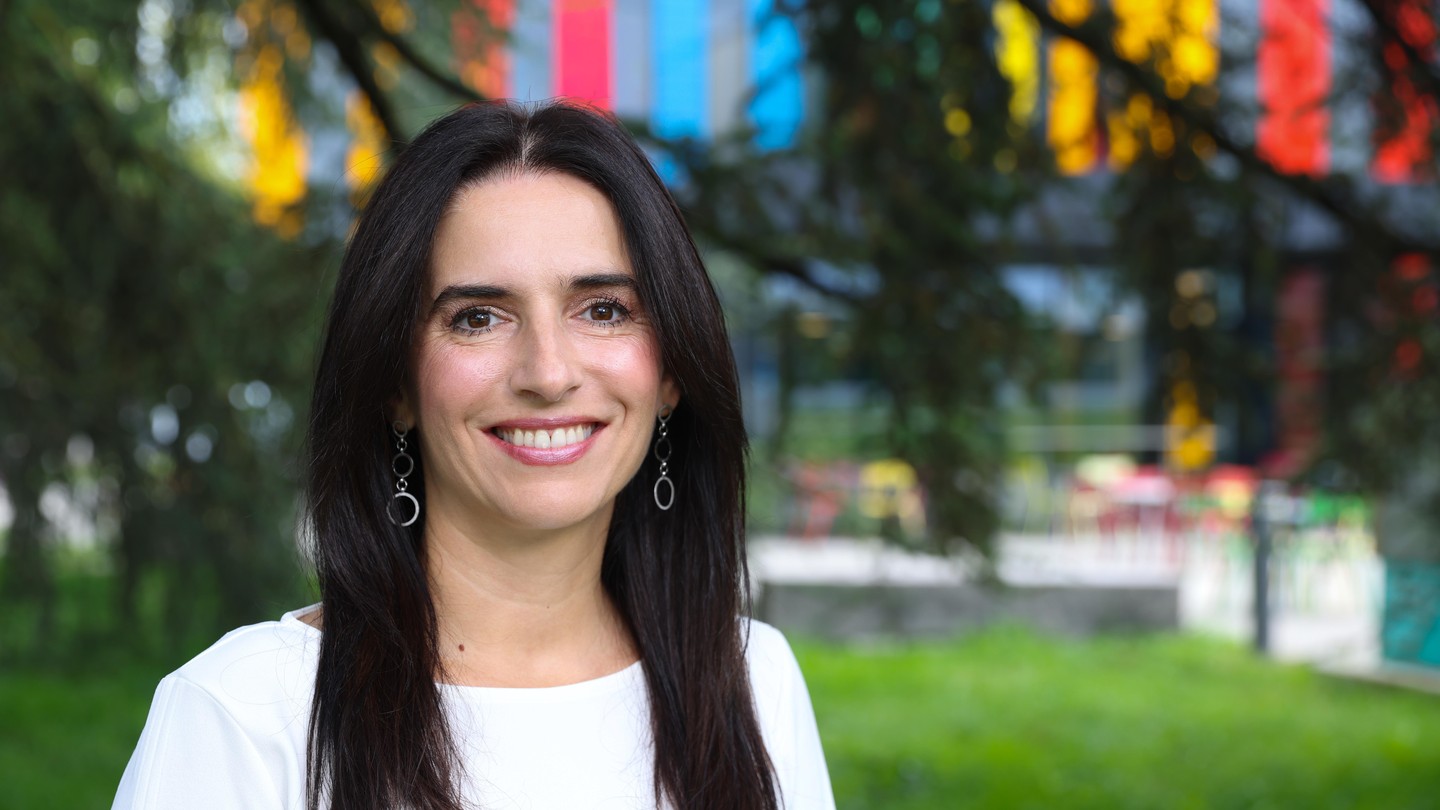
Mirjana Stojilović had to teach in French soon after arriving at EPFL from Serbia. Language proved to be no obstacle for the engineer, who has been named the best teacher in the computer science section for 2025.Her father thought she’d take over his veterinary clinic one day. “Even though I love animals, I was drawn more to logic-oriented fields like math and physics,” says Mirjana Stojilović. “But I was never the kind of person who takes apart computers in the basement!” When it came time for college, she decided to enroll at the University of Belgrade’s School of Electrical Engineering. “Partly because a cousin who I really admired went there,” she says.Stojilović has always enjoyed a challenge, whether related to math, physics, languages or anything else. “I began competing in science and language competitions when I was ten years old,” she says. “That gave me an opportunity to travel and meet children from other parts of the country. I wouldn’t describe myself as a competitive person today, but when I was younger, that drive undoubtedly helped me navigate the highly demanding, competitive environment of engineering.” Another thing that helped her was her desire to advance quickly. “When I was in college, I couldn’t wait to get out into the ‘real world’ and start my career,” she says. “So I did everything I could to finish my degree program in four years instead of five.”After graduating, Stojilović took a research position at the Mihajlo Pupin Institute in Belgrade. Yet she was drawn back to academia less than two years later and started a PhD on the design of domain-specific reconfigurable arrays – while keeping her job at the Institute. “Those were really intense years. And exciting ones too!”The importance of female role models Stojilović spent several months at EPFL when she was a PhD student through a doctoral exchange program. “That’s what made me want to eventually move to Switzerland,” she says. She was able to do that in 2013, just after completing her PhD. “I worked as a scientific collaborator at HEIG-VD for the first three years. During my last two years, I gave my first class at EPFL.” In 2016, a position opened up at EPFL’s School of Computer and Communication Sciences. “I seized the opportunity immediately.” Today Stojilović is a scientist at EPFL’s Parallel Systems Architecture Laboratory.Creating a game – a demanding process – is effective from a learning perspective. It’s project-oriented and stimulates students’ creativityWhen she first came to Switzerland, she was struck by the gender disparity in her field. “In Serbia, you see more women in fields like electrical engineering, civil engineering, math and physics,” she says. In fact, when she told people what she had decided to major in at college, “nobody blinked an eye.” But elsewhere in Europe, including in Switzerland, “there are fewer women in certain scientific and engineering disciplines, although universities such as EPFL are working to change that.” Stojilović stresses that female role models are particularly important. “To that end, I hope I’m making my own small contribution by serving as an example.”A safe space for learning Stojilović has mixed memories of her first teaching experience at EPFL. “I loved the students’ energy, but giving the lectures in French was a real challenge for me,” she says. “I found it even more challenging to have coffee with my French-speaking colleagues!” Ten years later, she still feels a little nervous before getting up in front of the classroom. “But in a positive way – like an actor who gets butterflies before going on stage. After the first few minutes, “I relax and get into the flow.”Stojilović explains that there are three core aspects of her teaching style. “First, I try to demystify the material,” she says. That means speaking slowly and clearly without taking any shortcuts, even if she has to spell out certain concepts more than strictly necessary. She also uses games to keep students interested and engaged. “I’m personally not a gamer, but creating a game – a demanding process – is effective from a learning perspective. It’s project-oriented and stimulates students’ creativity.”The second aspect involves using a lot of visuals. “My slides are a combination of text, numbers and colors,” she says. They tell a kind of story that serves as a unifying theme for her lectures. And the third aspect is to stay as close as possible to her students, showing that she can relate to them. For instance, she readily uses news articles, recent scientific breakthroughs or developments related to her course as a starting point for the class discussion. And she takes the time to speak with students informally. “I want my classroom to be a space where students feel safe and at ease.”
“I try to stay as close as possible to my students”
Mirjana Stojilović had to teach in French soon after arriving at EPFL from Serbia. Language proved to be no obstacle for the engineer, who has been named the best teacher in the computer science section for 2025.
788 words~4 min read