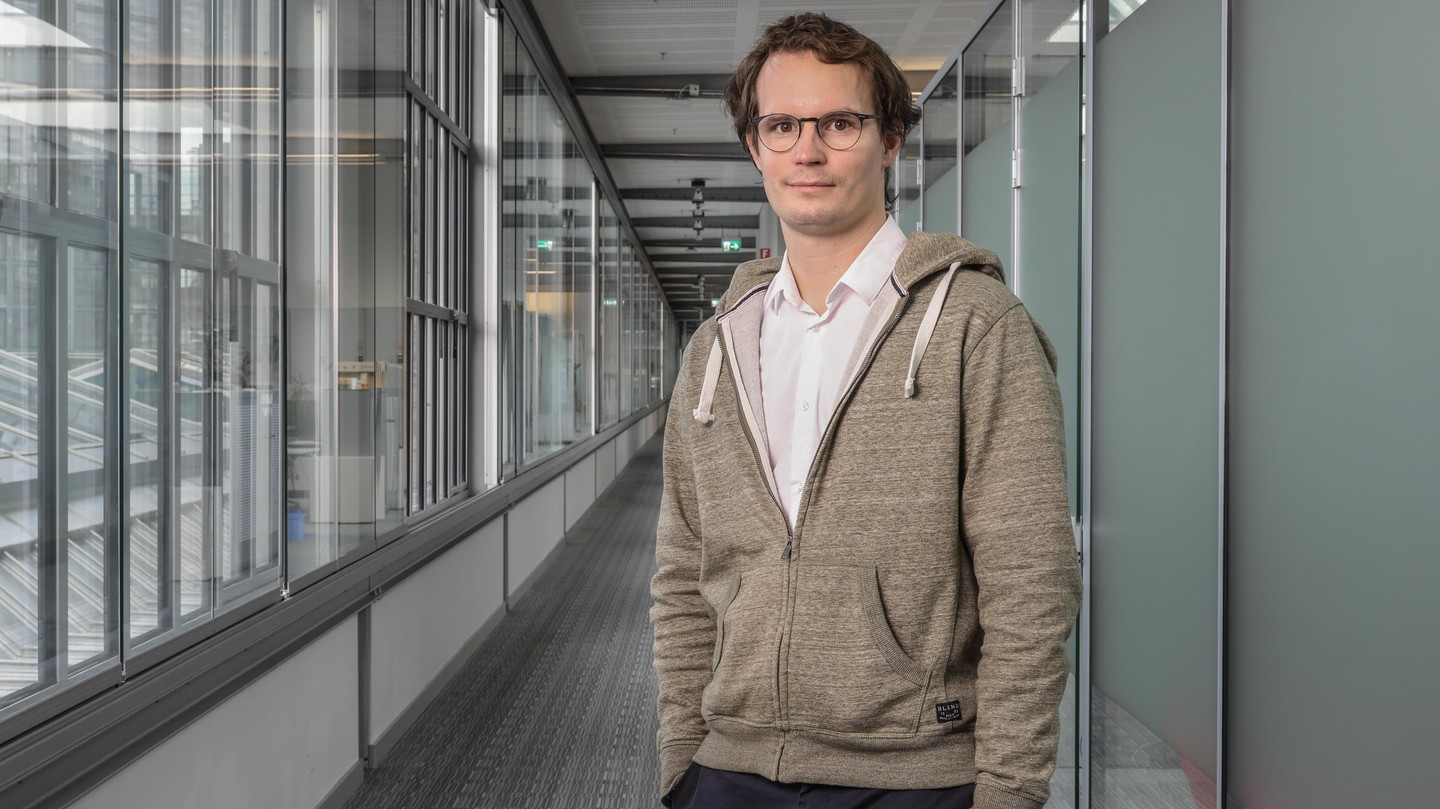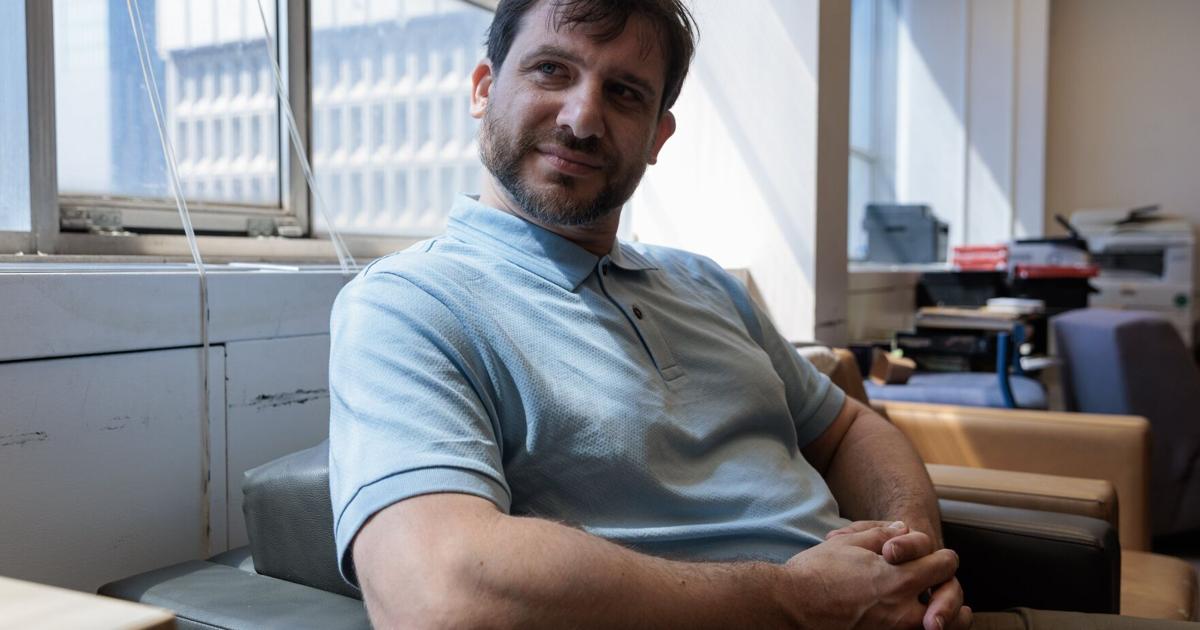
Alexander Mathis lives and breathes mathematics. Yet it was neuroscience that paved the way to a high-flying academic career for the EPFL professor, who was named best teacher in the life sciences engineering section for 2025.Students in Alexander Mathis’ classes sometimes leave with chocolate bars or even EPFL hoodies – prizes that reward stand-out work or particularly meaningful contributions in class. “This system creates a friendly sense of competition that encourages students to push themselves and speak up in lectures, while keeping the atmosphere relaxed,” he says.But beyond the giveaways, Mathis – an assistant professor and head of the Mathis Group of Computational Neuroscience & AI – takes his teaching seriously, building his courses around a combination of strong theoretical foundations and advanced real-world applications. “What makes me most proud is when students say in their feedback that what I teach will make a real difference in their careers,” he says.Mathis, who hails from Bregenz, Austria, believes that real learning happens only when students are genuinely motivated. “My goal is to help students understand why they’re learning something in the first place,” he explains. “Too many of them still focus on the wrong things: they’re more concerned about how they should study in order to get good grades.”Learning to take the helmAlthough Mathis says he has always enjoyed teaching, he admits that his first classes at EPFL in 2021 were a steep learning curve. He was no newcomer to the role, having previously worked as a teaching assistant in Germany and a lecturer in the US. But teaching at EPFL during the second COVID-19 lockdown was a different experience altogether: “In that first semester, I often found myself alone in front of over 100 students. What’s more, I’d planned twice as much material as could fit into a single semester.”Another challenge Mathis has faced is coordinating his teaching assistants. Five years ago, around 140 students were enrolled in his bachelor’s class. Today, that number is close to 200. At the same time, his team of teaching assistants has expanded to around 20 people. Mathis admits that “managing all of that can be quite daunting.”Mathematics, computers and animalsAs a teenager, Mathis would probably have been surprised to learn that he would one day teach to lecture halls packed with students. However, he always knew he would attend university. Fascinated by mathematics and its logical structure from an early age, he chose to study the subject at Ludwig Maximilian University (LMU) Munich. “It felt like a world away from the math I’d been doing in high school,” he says. “It was something of a shock – but a positive one!”Pure mathematics may have come naturally to Mathis, but he soon realized that it wasn’t where he wanted to build his career. “What interested me was applying math to issues I genuinely cared about,” he explains. “During my time at university, I also enjoyed programming and tinkering with computers on the side.” Nature and animals were another longstanding interest: “I’d spend time observing them and trying to understand their behavior. Now, my work combines my three passions: mathematics, computer science and life science.”An unexpected move into neuroscienceMathis’ career took a decisive turn when he discovered neuroscience. “To be honest, I didn’t know much about it at first,” he admits. While completing his master’s degree in mathematics at LMU Munich, he came across an opening for a PhD position in computational neuroscience, and decided to seize the opportunity. “I had to work hard to catch up during my PhD,” he says. “But my background in mathematics helped. For instance, it allowed me to explain some previously unknown aspects of grid cells,” or neurons that fire in regular patterns and help the brain navigate its surroundings.Mathis soon developed a deep fascination for neuroscience. After earning his PhD, he headed to Harvard University for a postdoc in the Department of Molecular and Cellular Biology. In 2020, he joined EPFL and went on to found his own his own research group working at the intersection of computational neuroscience and machine learning.The pitfalls of generative AIDespite his enthusiasm for technology, Mathis – like teachers everywhere – is also grappling with the impact of generative AI in the classroom: “Some students mistakenly believe they can rely on these tools instead of building strong programming skills.” ChatGPT emerged during the five years when he taught software engineering. It was a development that forced him to adapt his approach. “My goal for the near term is to rethink my classes from the ground up so they better reflect the reality of the world we live in today,” he says.
“Real learning happens only when students are genuinely motivated”
Alexander Mathis lives and breathes mathematics. Yet it was neuroscience that paved the way to a high-flying academic career for the EPFL professor, who was named best teacher in the life sciences engineering section for 2025.
768 words~3 min read