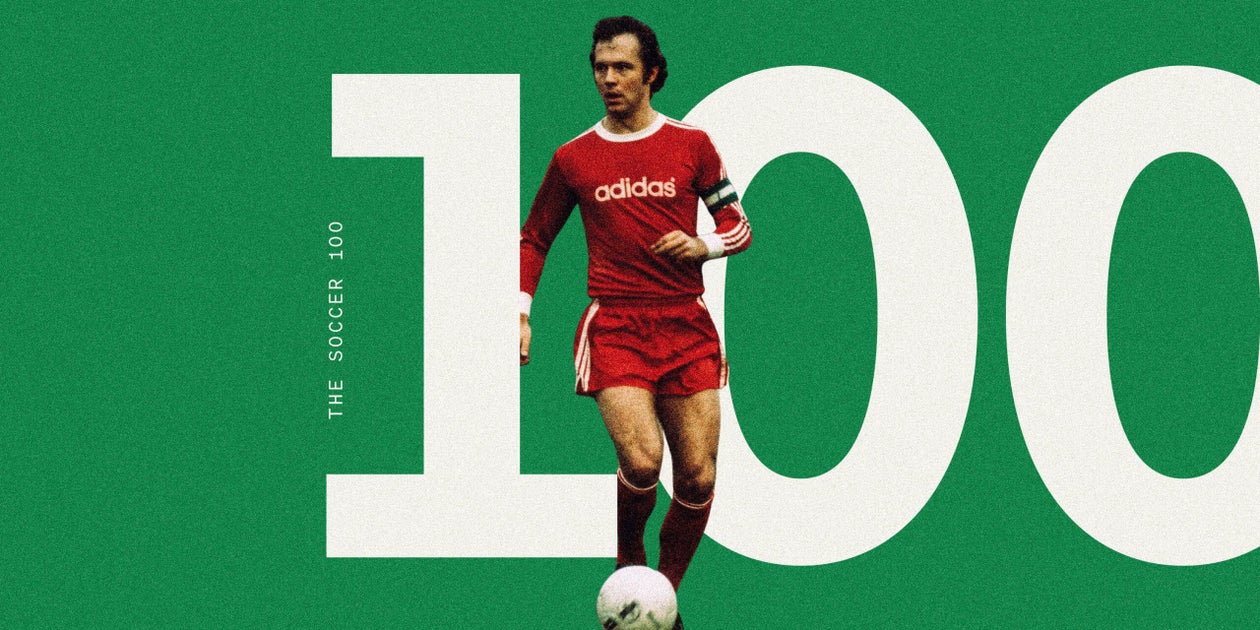
As part of our buildup to the 2026 FIFA men’s World Cup in the United States, Canada and Mexico, we are publishing excerpted chapters from The Soccer 100, The Athletic’s definitive book on the 100 greatest players of all time, courtesy of HarperCollins Publishers.The 10 players we will feature are the highest ranked World Cup winners of our 100. Today we feature one of the greatest to ever wear the Bayern Munich and West Germany shirts.If you subscribe to the multiverse theory — the idea that every decision we make splits the world into different universes: one where we turn left, one where we turn right — then somewhere in the infiniteness there is another reality where the biggest club in Munich is not actually Bayern, but 1860.The split may have occurred during a Bavarian junior football tournament in 1958.A young striker was playing for his team, SC Munich 1906, but the word was that the club was struggling to find the money and coaches to continue with all their teams the following season. A group of the players thus planned to move to 1860, who were the biggest club in the region at that time and who they just happened to be playing in the final of the tournament.The game was ill-tempered and the striker in question became embroiled in an altercation with an opponent. The 1860 player ended up giving the forward a slap around the face.And that, the story goes, is how Franz Beckenbauer decided to snub his local side — the one he grew up supporting and whose forwards, Ludwig Zausinger and Kurt Mondschein, he so idolized — in favor of Bayern.There is almost certainly a good degree of mythmaking to the tale. It was one Beckenbauer was fond of telling and a few different people have claimed to be the deliverer of the slap over the years. But whether the truth is that neat, or whether there was more nuance, his decision changed the course of German, European, and maybe even world football history.Is that an exaggeration? Perhaps, but Beckenbauer’s impact on the game shouldn’t be underestimated.Fans take photographs of a bronze statue of Der Kaiser outside the Allianz Arena (Maja Hitij/Getty Images)He wasn’t just a brilliant player. There are loads of brilliant players. Another 99 of them in this book, for starters. Very few are brilliant players and invent things that change the game. But Beckenbauer was and did.Maybe it is also a slight stretch to say that he invented Bayern as we know them today. But when he made his first-team debut for them in 1964, they were the second-most-popular team in Munich and were in the German second tier. They were promoted the following season, won the DFB-Pokal the season after that, claimed the European Cup Winners’ Cup in 1967 and their first Bundesliga title (along with the DFB-Pokal again) in 1969, and were three-time European champions by the mid-1970s.Beckenbauer was captain for a lot of this, and although coaches like Udo Lattek and Branko Zebec were clearly influential and players like Gerd Müller, Sepp Maier, and Paul Breitner had comparable impacts on the pitch, only one of those men earned the nickname “Der Kaiser”.Franz Beckenbauer swaps pennants with Atletico Madrid’s captain Adelardo ahead of the 1974 European Cup final in Brussels (BELGA/AFP via Getty Images)Correlation does not always equal causation, but before Beckenbauer arrived, Bayern had one German title in 1932 — in the pre-Bundesliga days, the champions were decided through regional leagues that then fed into a playoff-type system — and one German cup to their name. By the time he left in 1977, they were the dominant force in German football and would remain so for the following generations.Unless something implausible happens between the writing of this book and whenever you are reading it, they will almost certainly remain the biggest club in Germany for some time to come.And he was always keen to take the credit for it. “Lattek should have been grateful to me,” he wrote in one of his autobiographies, published in 1975, about the success that had been built at Bayern by the early 1970s. If you want an idea of how much he was deferred to at Bayern, regard what Müller, the greatest goalscorer in Bayern and German history, told Bild in 1971. “I will always be in Beckenbauer’s shadow,” he said. “At some other club, I would have the chance to be the number one.”Franz Beckenbauer and Gerd Müller, Bayern Munich greats (Rustullstein bild via Getty Images)Beckenbauer also invented a position.The Italian interpretation of the sweeper, or libero, was purely as a prophylactic; the player who sat behind the defense and swept up any lingering attacking threats, the last, last line of defense after the last line of defense.His version of the position was rather truer to the literal translation of the word libero, which is Italian for “free” or “independent”. Beckenbauer was initially a slightly flighty forward who was moved back into midfield by a youth coach concerned about how often he was kicked up in the air by ruffian defenders. When he arrived at Bayern, he was moved even farther back in part because of his slightly bratty nature. The theory was to teach him some responsibility and teamwork. And it paid off.
The Soccer 100: Franz Beckenbauer — Der Kaiser and the slap that helped make Bayern Munich a force
In the seventh of our extracts from The Soccer 100, we revisit the glittering if complicated career of Franz Beckenbauer
2,247 words~10 min read