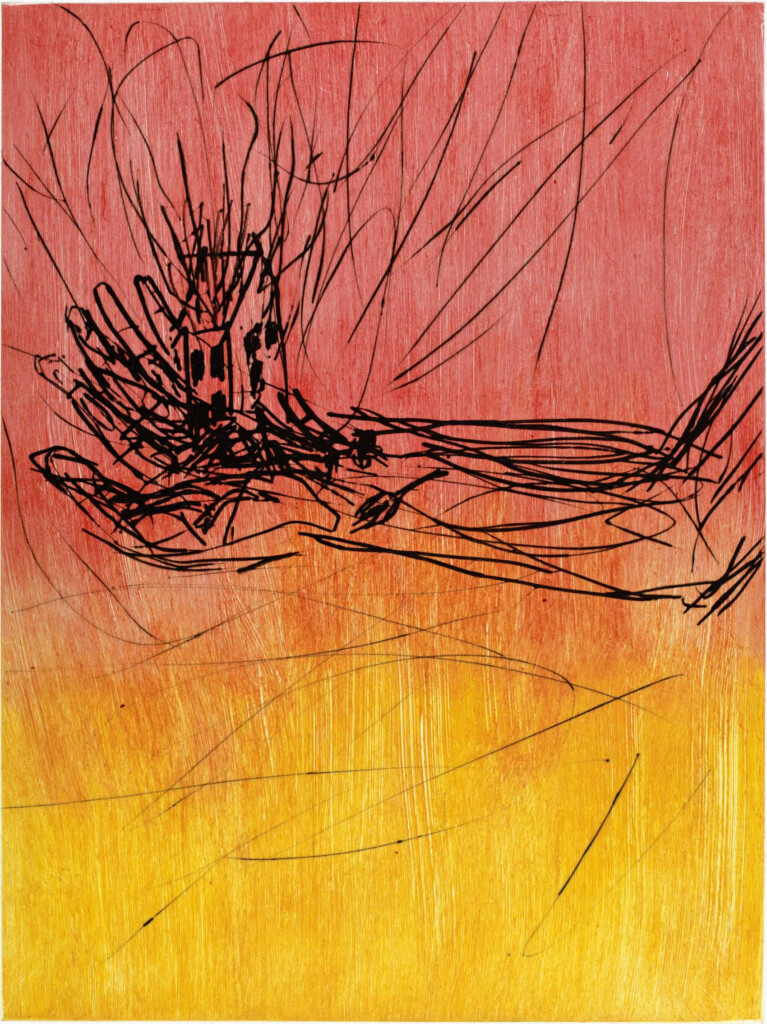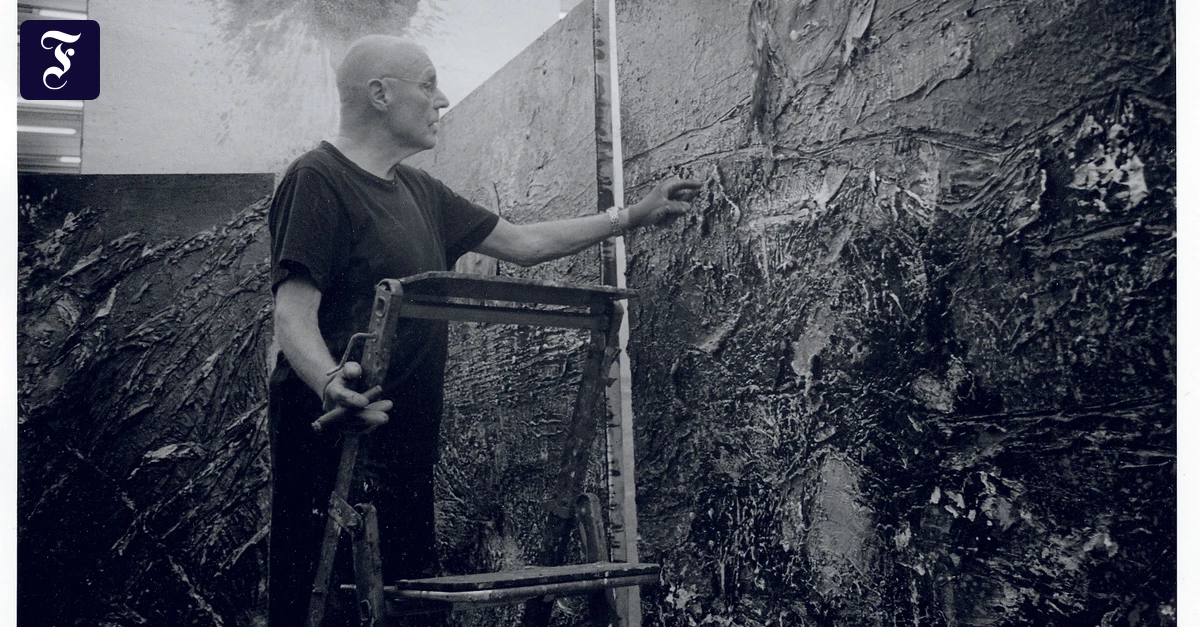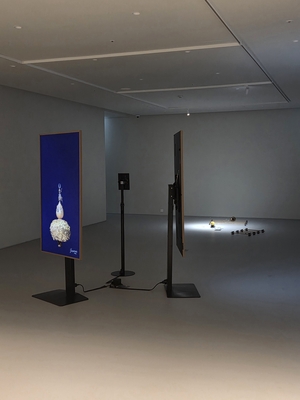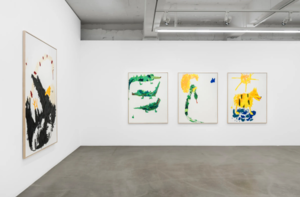
Installation view of "Feil Good" at Gallery Baton in Seoul (Gallery Baton) For German painter Andi Fischer, some of the most important moments in painting happen when things do not go according to plan."Failure is not the opposite of success, but part of the same process," Fischer said in a recent written interview with The Korea Herald.The artist’s latest exhibition in Seoul, "Feil Good" at Gallery Baton in the spring, reflected a philosophy that embraces uncertainty, mistakes and unexpected outcomes.Rather than treating failure as something negative, Fischer sees it as an essential part of the creative process — one that can open new possibilities and lead a work in directions the artist had never anticipated."In painting especially, failure can be very productive: a wrong decision, an awkward form, or a broken composition can suddenly open up a new direction."Many of the failures that stayed with him throughout his career, the artist said, occurred when he attempted to control a painting too closely — trying to force a work toward a specific result often proved less productive than allowing it to develop on its own."These experiences have taught me that letting go is often more important than control," he said."Failure, for me, is therefore not a final condition but a necessary state of experimentation." Installation view of "Feil Good" at Gallery Baton in Seoul (Gallery Baton) The idea of loosening control appears throughout Fischer’s work, particularly in his recurring use of animals.Snakes, crows, crocodiles, wolves and tigers frequently appear in his paintings, but they are rarely presented as straightforward symbols. Instead, Fischer is interested in their ability to carry multiple, sometimes contradictory meanings."A snake can suggest danger, transformation, seduction or renewal," he explained. "A crow can feel ominous, intelligent, comic or even familiar — depending on how it appears."Rather than providing clear narratives, his paintings encourage viewers to form their own associations.For Fischer, animals occupy a space between mythology, memory and observation and allow him to create images that feel both ancient and contemporary, while remaining open to interpretation."I am interested in how animals can become emotional or psychological actors within a painting, rather than simply motifs taken from nature," he said.What inspires the artist is also how images are transmitted culturally — historical European depictions of tigers show how people imagined unfamiliar creatures, revealing the role of memory, storytelling and interpretation in the making of images. Andi Fischer's "Aha Happy There Grass" (left) and "Aha Wisdom Returns" are on view at "Feil Good" at Gallery Baton in Seoul. (Park Yuna/The Korea Herald) "These historical depictions of tigers are fascinating because they reveal as much about the imagination of those who created them as they do about the animal itself," Fischer said."I am not trying to represent the world accurately. I am more interested in the moment when an image becomes unstable — when it is shaped by memory, misunderstanding, storytelling and desire."That perspective helps explain why many of his paintings resist easy interpretation. In "Aha Happy There Grass," an animal figure appears lying — somewhere between a tiger and dog — inviting viewers to linger in moments of doubts, curiosity and imagination.Fischer said the ambiguity is deliberate.“If the viewer hesitates — if they are unsure whether they are looking at a tiger, a dog, or something else — then the image begins to function in the way I intend,” he said.“I do not see art as a way of arriving at clear answers, but as a way of remaining present within complexity.”The exhibition "Feil Good" at Gallery Baton in Seoul ran from March 4 to April 11.
Why ambiguity matters to German painter Andi Fischer
For German painter Andi Fischer, some of the most important moments in painting happen when things do not go according to plan. "Failure is not the opposite of
598 words~3 min read