Park Yuna
Art & Architecture
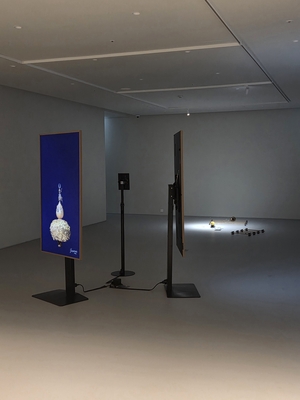
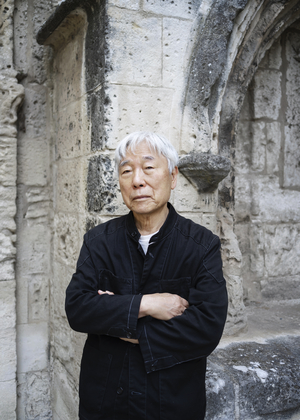
The pioneer of Japan's mono-ha and Korea's dansaekhwa movement reflects on art in the age of AI, human connection and contemporary anxiety Lee Ufan (Courtesy of Studio Lee Ufan) VENICE, Italy -- Large brushstrokes spread across white canvases evoke both tension and harmony through rhythm and negative space. In another room, stones and steel plates face one another in silent confrontation.Korean-born artist Lee Ufan’s works may initially appear minimal and deceptively simple, but the artist says they emerged only after countless repetitions, effort and moments of contemplation."Controlling strength is important (when painting). It only emerges after an enormous amount of practice."Even moving a stone, if you truly understand the material, you come to know how it should be handled in your own way,” Lee told The Korea Herald on May 8 during the artist’s morning walk along Riva degli Schiavoni, the waterfront promenade in Venice. "Correspondance" by Lee Ufan (Courtesy of the artist) “Some days I am dissatisfied with a painting, so I keep reworking it over and over again, sometimes becoming frustrated,” Lee said.The collateral exhibition of the 2026 Venice Biennale, “Lee Ufan,” traces six decades of the artist’s evolution through eight galleries of selected paintings and installations.Lee rose to prominence as a leading figure in the Japanese mono-ha movement — literally meaning “school of things” — while also becoming a key contributor to Korea’s dansaekhwa, or monochromatic painting, movement.The mono-ha movement, which emerged in the late 1960s amid rapid industrialization and capitalism, rejected the idea of excessive production and fabrication.Instead, it emphasized presenting materials as they are and allowing objects to naturally enter into relationships and resonance with their surrounding space and nature. "From Line," Lee Ufan (Courtesy of the artist) "If modern art is solely about asserting the self, my work appeals to the external world to open another dimension. Thus, the viewer does not see me but rather encounters the world I have evoked," the artist wrote in the exhibition text.On view in the exhibition is “Relatum — Infinity,” featuring locally sourced rounded stones and a mirrored pathway resting atop a layer of pebbles that fills the space, proposing balanced tension between natural and industrial materials.Viewers are invited to walk along the pathway of two polished steel plates between the two large stones at the center, while contemplating the interaction between the natural materials and the steel plates born of industrial production. Installation view of "Lee Ufan" at SMAC Venice, Italy (Park Yuna/The Korea Herald) Installation view of "Lee Ufan" at SMAC Venice, Italy (Park Yuna/The Korea Herald) As one of the leading figures who shaped contemporary art in both Korea and Japan, Lee said the world is entering an entirely new era, adding that “no one expected the age of artificial intelligence would arrive this quickly.”“Things are convenient now because answers come very quickly," he said. "But the process has disappeared."“The time spent thinking and expressing seems to be gradually disappearing. It might be convenient now, but it will also create many problems."The artist encouraged one to go out into the world and encounter diverse people and experiences, saying such encounters can ultimately lead to deeper reflection and realization."What matters is the process. Above all, encounters are important." "With Winds," Lee Ufan (Courtesy of the artist) Asked whether global recognition and decades of artistic achievement had brought him happiness, Lee reflected on the meaning of the word itself.“The concept of the word ‘happiness’ originally came from outside Korea. In Western countries, people use the word quite often in everyday life, but in Korea, we do not express happiness so frequently,” he said.“Under the same sky, we are all just points. What is the use of saying one person succeeded and another did not? In the end, we are all similar beings.” Installation view of "Lee Ufan" at SMAC Venice, Italy (Park Yuna/The Korea Herald) The exhibition also features Lee’s “Dialogue” series of large-scale single-brushstroke paintings. Though the marks may appear spontaneous, Lee repeatedly layers paint over the same gesture, at times retracing a single brushstroke over the course of a month.Lee’s most recent and ongoing “Response” series is also part of the presentation, which explores vibrant color through expressive strokes in bold reds and blues.The wavering edges, varying from near black to almost white, merge with the canvas.Lee was born during the Japanese occupation in South Gyeongsang Province in 1936. In 1956, following training in traditional ink brush techniques at Seoul National University High School, he moved to Tokyo, where he studied philosophy at Nihon University.He is now based in Europe and Japan."Although I was born in Korea, now I have lived in Europe for decades. You should not stay only within Korea. Whenever possible, meet and exchange with people from different countries,” he said. Installation view of "Lee Ufan" at SMAC Venice, Italy (Park Yuna/The Korea Herald) Lee said art inspiration comes from many different places, ranging from historical masterpieces to ordinary moments in everyday life.“Even when looking at a cigarette butt, there may come a day when it suddenly appears different to you,” he said.The Venice exhibition, presented by Dia Art Foundation and curated by Jessica Morgan, opens concurrently with a major display of Lee’s painting and sculpture at Dia Beacon in New York. Together, these two exhibitions celebrate the artist’s 90th birthday.When asked why he makes art, Lee said there is ultimately no clear answer.“Why do I make art? It is like asking why I live — many things in life simply have no answer," Lee said. "Relatum (formerly Iron Field)," Lee Ufan (Courtesy of Dia Art Foundation, New York)