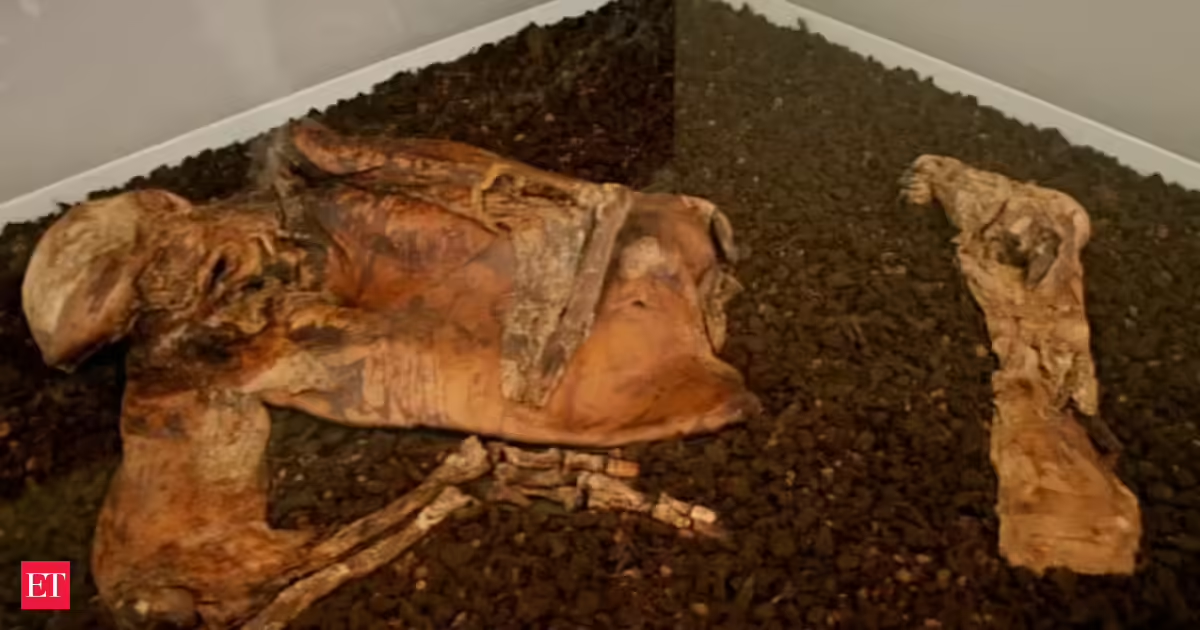
It was during the summer of 1984 when laborers working at a peat-cutting operation in northwestern England stumbled upon something unusual. Lindow Moss was an expansive area in Cheshire where peat had been commercially mined for decades. The days in the area were always routine. However, something unusual started coming up from the black peat.Initially, it seemed like an isolated incident. But as more experts got on board, it turned out to be something related to a far bigger story buried underground. What was supposed to have been an ordinary day came to be remembered as one of the biggest archaeological finds in recent history in Britain.An unexpected discovery at Lindow MossLaborers digging up peat found some human remains, which alerted authorities, who then consulted archaeologists. It turned out that the discovery was not the first at Lindow Moss, according to the University of Manchester.This individual, unearthed in 1984, later became known as Lindow Man, the finest preserved bog body to be found in Britain. In the early stages of the excavation, however, no one realized the significance of the discovery.How peat bogs preserve human remainsThe conditions created by peat bogs differ greatly from those in regular soil. Peat bogs are characterized by excessive moisture content, acidic environment, and lack of oxygen. All these factors impede organic matter decomposition processes. Consequently, materials that usually disintegrate in nature can last up to centuries and even millenia.Scientists have discovered not only prehistoric clothes and wooden items but also well-preserved human remains in peat bogs throughout northern Europe. Skin and hair are often found on such remains, whereas in the case of non-boggy areas, bones can survive only. The authors of a scientific article published in The Journal of the Royal Society of Medicine observe that a bog environment preserves soft tissues in a perfect state.This is the spot (foreground), where the Iron Age man "Lindow Pete" was found. Image Credit - WikimediaWhy was Lindow Man unique?There are many archaeological finds involving skeletons only. However, this discovery was much more unusual because of the presence of the skin and hair preserved. It allowed scientists to look at things which could not be studied otherwise because of decomposition. Such preservation turned a mere find into a serious scientific research.Archaeologists were not just looking at bones but at the remains of an actual man who lived long ago. Moreover, scientists were able to raise some questions related to the life and death of this man due to such preservation.Establishing the date of the mysteryAnother important task for the team of archaeologists was to determine the age of Lindow Man. Through radiocarbon dating and other procedures, scientists established that Lindow Man lived during the Iron Age, around the 1st century BCE -CE. This made dating the remains possible and situated the finding in terms of the Iron Age period of history. This was no longer just a curiosity; this was part of telling the story of Iron Age Britain.Scientists were able to make comparisons based on the remains to existing knowledge about the culture, health, and social practices of that time. Many questions were generated, which are still under discussion by scholars in the present day.Why are scientists interested?Lindow Man has become one of the greatest archaeological finds from Britain because he is not only a discovery but also evidence. Due to the state of the body, specialists have been able to perform various scientific research on it and draw theories about the nature of the circumstances which led to his death.Although there is still much that is unknown, it is clear that it is an extremely interesting finding scientifically. Specialists consider this case to be an excellent illustration of how valuable a good preservation can be.A discovery that is still intriguing to this dayEven several decades after the discovery, there is considerable interest in Lindow Man among both academics and the general public. First of all, the way in which Lindow Man was discovered adds some intrigue to the story. Archaeologists did not discover this ancient specimen through deliberate digging; rather, he was found accidentally.This unusual discovery occurred when a person working in the bog noticed something sticking out of the dark mass of peat. Further investigation revealed that it was not just any piece of wood or bone, but the remains of a well-preserved Iron Age man. In many ways, Lindow Man became not only the object of research but a symbol of the fascinating discoveries that are possible even in modern times in a seemingly mundane setting.
In 1984, an innocent peat cutting at Lindow Moss led to Lindow Man’s discovery which uncovered one of Britain's most famous ancient mysteries
A significant archaeological find occurred in 1984 at Lindow Moss in Cheshire, England. Laborers unearthed a well-preserved Iron Age human body, now known as Lindow Man. The peat bog's unique conditions preserved the remains, offering invaluable insights into the past. This discovery remains a key piece of evidence for understanding Iron Age Britain.
754 words~3 min read