Hwang Joo-young
Staff reporter at The Korea Herald’s National Desk, based in Seoul. Covers South Korea’s national security and foreign policy, with a focus on the Defense, Foreign and Unification Ministries, as well as the National Assembly.Before entering journalism, served as an Air Force officer. Experience includes providing translation and interpretation, as well as strategic input for planning efforts, at the ROK-US Combined Forces Command. During three years of military service, took part in six major South Korea-US combined exercises.
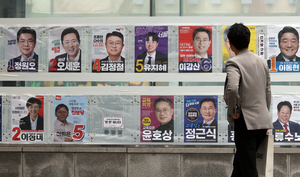
A citizen looks at campaign posters for South Korea's ninth nationwide local elections near Myeong-dong Station in central Seoul on May 21. (Yonhap) Local elections in South Korea have traditionally seen voters cast their ballots largely along party lines. This year, however, several contested regions are showing signs that voters may split their ballots — supporting one party in a major race while backing independent candidates or those from another party simultaneously.Different choices at ballot boxOne of the clearest examples is North Jeolla Province, traditionally considered a Democratic Party of Korea stronghold.A Korea Society Opinion Institute poll conducted May 23-24, before the polling blackout period began, found independent candidate Kim Kwan-young leading the gubernatorial race with 44.1 percent support, ahead of Democratic Party nominee Lee Won-taek at 40 percent.Kim, the incumbent governor, was formerly affiliated with the Democratic Party but was expelled after a controversy involving allegations he handed out cash to young party members and local councilors. Lee, a lawmaker representing a constituency in North Jeolla Province, secured the party's nomination after Kim's expulsion.The poll contrasts sharply with the same survey's party preference findings, which showed support for the Democratic Party at 68.3 percent.Similar signs have emerged in Busan's Buk-A constituency, where a parliamentary by-election is being held alongside local elections.A Gallup Korea poll conducted on May 21-22 found independent candidate Han Dong-hoon narrowly leading the race with 36 percent support, ahead of Democratic Party candidate Ha Jung-woo, a former presidential aide, at 35 percent.Han, formerly leader of the conservative People Power Party, is running as an independent after having been expelled from the party amid allegations he and his family members posted online messages critical of former President Yoon Suk Yeol, his wife Kim Keon Hee and party leadership.In the same survey, Democratic Party candidate Chun Jae-soo led incumbent conservative Mayor Park Heong-joon 55 percent to 34 percent.Chun previously served three terms as a lawmaker representing the city's Buk-gu before stepping down to run for mayor, while Park is seeking a third consecutive term.In Gyeonggi Province's Pyeongtaek-B district, a three-way race has also highlighted the possibility that voters may make different choices depending on the race.While Democratic Party gubernatorial candidate Choo Mi-ae, a six-term lawmaker, has maintained a lead in provincial polls, parliamentary by-election surveys showed Democratic Party candidate Kim Yong-nam, main opposition People Power Party candidate Yoo Eui-dong and Cho Kuk of the minor left-leaning Rebuilding Korea Party running in a tight three-way race.Cho, a former justice minister in the Moon Jae-in administration and former leader of the Rebuilding Korea Party, is among the highest-profile figures contesting a by-election. Independent candidate Han Dong-hoon (left), Democratic Party candidate Ha Jung-woo (center) and People Power Party candidate Park Min-shik attend a meal service event during the campaign for the parliamentary by-election in Busan's Buk-A constituency on May 21. (Yonhap) Why voters are splitObservers say the latest polling suggests voters are increasingly evaluating candidates separately from party labels.Political commentator Park Sang-byeong said voters are becoming more willing to distinguish between party preference and candidate choice."Voters may support a political camp overall while expressing dissatisfaction with a particular party nomination or candidate," Park said. "Such voting patterns tend to emerge when voters seek to send a message to political parties without abandoning their broader ideological preferences."Yoon Tae-gon, a political commentator and head of political consulting firm The Moa, said the growing visibility of local government heads has also contributed to the trend."As district chiefs have become more visible and their roles have grown, more voters are choosing candidates from parties different from those of mayoral candidates," Yoon said. "There is also a tendency for voters to directly assess the performance of incumbent district chiefs seeking reelection."Narrowing raceThe trend, meanwhile, comes as the Democratic Party's once-commanding advantage in the local elections appears to be narrowing.Until recently, opinion polls had suggested the Democratic Party could win as many as 15 of the nation's 16 mayoral and gubernatorial races, buoyed by strong approval of President Lee Jae Myung and the People Power Party's continuing internal struggles.More recent polling, however, points to a less decisive outcome.An analysis of 382 public opinion polls conducted by a research team led by Seoul National University professor Han Kyu-sup estimated that the Democratic Party could win between nine and 14 of the nation's 16 mayoral and gubernatorial races.The People Power Party was projected to win between two and seven races, while an independent candidate was favored in one contest.Some Democratic Party lawmakers, however, caution against reading too much into the polling data.Rep. Park Sang-hyuk said voters ultimately tend to consolidate behind their preferred party once they enter the voting booth."In actual voting, people who support the Democratic Party are likely to end up supporting Democratic Party candidates across the ballot," Park said. "The level of support independent candidates are receiving in surveys may not fully materialize on election day."Rep. Kim Hyun echoed the view, contending that local elections have historically been driven more by party competition than individual candidate appeal."Nationwide elections are fundamentally contests between parties," Kim said. "In the final stage of the campaign, party affiliation tends to matter more than personal popularity."Early voting, held Friday and Saturday, drew a record 23.51 percent turnout, the highest ever recorded for local elections."It remains to be seen whether the higher early turnout will translate into higher overall participation and whether it will amplify or weaken the apparent split-ballot voting trend," Yoon said.