A pattern tends to emerge during major news cycles. A big event — like the 2024 election, or the Super Bowl, or March Madness — dominates headlines, and by extension prediction market volumes, so people come away with the impression that “that’s the only thing prediction markets are good for.”
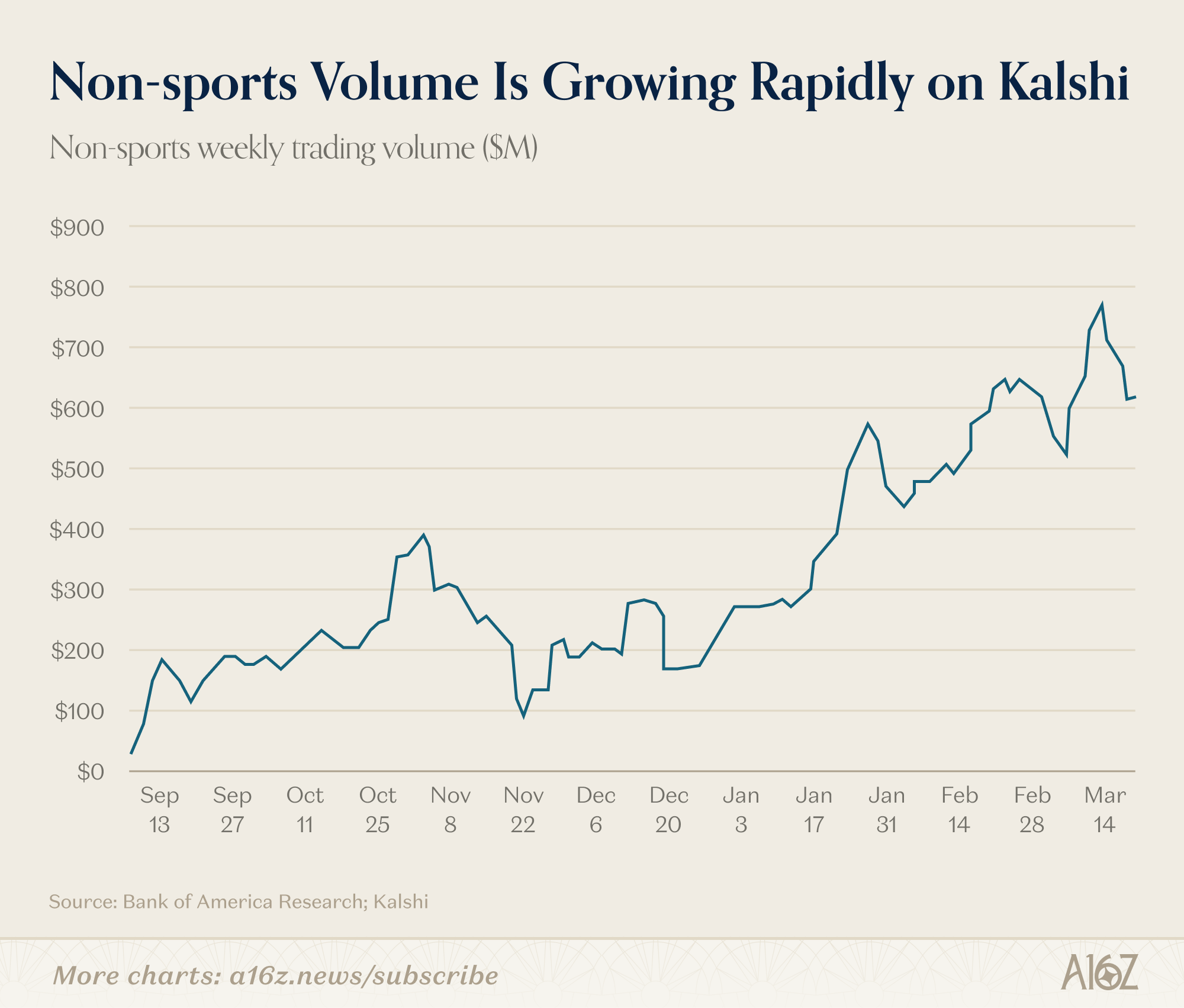
And while earlier narratives may have suggested prediction markets were only viable during election cycles, prediction markets have seen significant growth in other sectors. At the time of the Kalshi Research Conference in March earlier this year, sports trading had just hit nearly $3 billion in weekly volume — roughly 80% of Kalshi’s total, largely driven by March Madness. But the more revealing stat? Sports as a share of total volume was actually at an all-time low even as its absolute volume hit an all-time high.
Every other category was growing faster. The Kalshi co-founders pointed to entertainment, crypto, politics, and culture as categories showing stronger user-growth — and better volume-retention cohorts than sports. Sports may function as a mass-market catalyst — a familiar, scheduled, emotionally engaging wedge product — but the company was seeing significant growth in its longer-tail markets that make up the remaining 20%+ of Kalshi’s volume.